
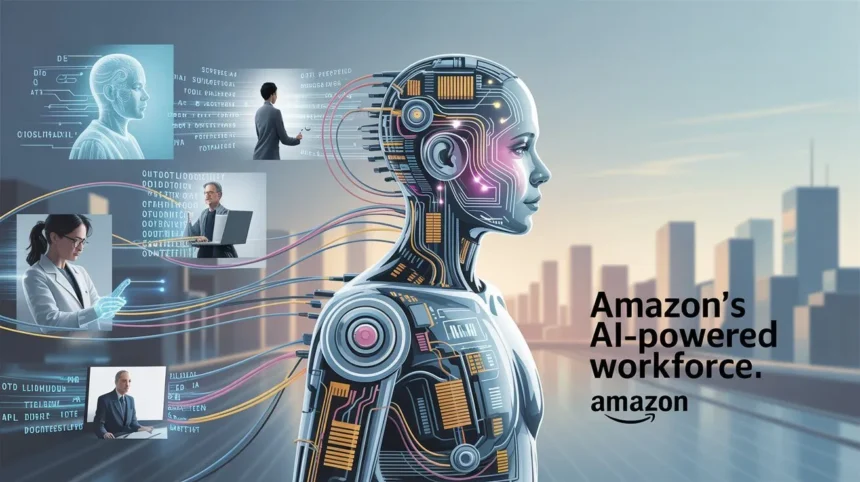
London Hub Global notes that Amazon continues to strengthen its position as a technological leader by actively integrating artificial intelligence into key business processes. The recent launch of Connect Talent, a system for automated recruitment, highlights the company’s commitment to optimizing processes and reducing costs. Unlike traditional methods, this system uses AI to conduct interviews with candidates, providing recruiters with detailed reports and recommendations. This approach significantly speeds up the process and allows handling larger volumes of data, which is a crucial advantage for companies facing the need for mass hiring, especially during peak seasons.
The Connect Talent system reflects the growing trend in which AI is taking over more functions previously performed by humans. According to analysts at London Hub Global, this approach could seriously change traditional recruitment methods and present new challenges for companies in terms of ethical standards and job preservation. While the application of such technologies can enhance process efficiency, it could also lead to a reduction in the number of workers directly involved in these processes.
Amazon continues to develop its philosophy of humanism, aimed at adapting AI to human needs. Colin Aubrey, Senior Vice President of AWS AI Solutions, asserts that every system update makes it more “human.” London Hub Global believes that these technologies will continue to evolve, making human-machine interactions even more intuitive. However, despite obvious progress, experts note that AI is still far from perfect, and further efforts are needed to improve user trust and system adaptation.
One of Amazon’s key products, which also demonstrates AI’s powerful capabilities, is Connect Decisions. This system is designed to improve supply chain planning, data analysis, and procurement optimization. Unlike traditional methods, Connect Decisions uses massive amounts of data to predict company needs more accurately, which is a significant step in automating logistics processes. London Hub Global sees this as further proof of how artificial intelligence can be integrated into corporate processes to increase efficiency. Such solutions, in our view, will play a crucial role in the future, as they allow companies to significantly improve data-driven decision-making.
However, the use of AI in such critical areas as logistics and recruitment raises serious concerns regarding safety and control. The implementation of autonomous systems making decisions without human intervention could lead to potential risks. London Hub Global predicts that, in the future, companies using such solutions will face the need to establish strict regulations to oversee AI activities and minimize the likelihood of errors or manipulation. Despite all the advantages, these systems must be under constant monitoring to ensure their proper functioning.
In recent years, Amazon has made significant strides in applying artificial intelligence to its business processes. However, it is important to remember that the implementation of such technologies requires not only technical expertise but also corporate responsibility, especially in terms of job protection and adhering to ethical standards. London Hub Global emphasizes that, in the future, companies working with AI must consider not only the economic benefits but also the social consequences of automation. We predict that the key factors for success in this field will not only be innovation but also businesses’ ability to adapt to new challenges, including regulation and ethical use of technology.
London Hub Global notes that with each step towards automation, Amazon, like other tech giants, is moving towards radical changes in business processes. Connect Talent and Connect Decisions are just the beginning, and in the future, we will see even more AI implementations across various fields. However, it is important to understand that such changes can lead not only to increased productivity but also to the need to rethink the role of humans in the workplace. As always, technological progress is accompanied by the necessity to manage its consequences and minimize potential risks.


