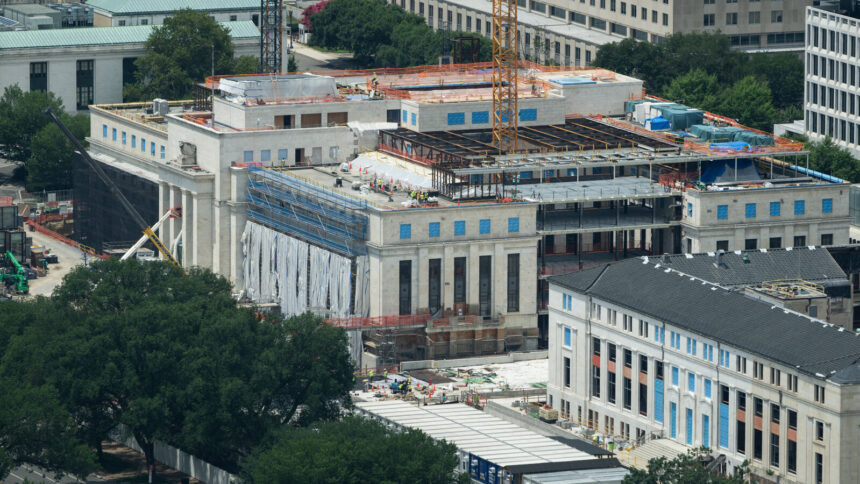
The Washington story surrounding the Federal Reserve System is gradually shifting from a criminal-legal dimension into a more complex zone of institutional and political oversight. The U.S. Department of Justice’s decision to drop the investigation into the Fed and its Chair Jerome Powell regarding the Washington headquarters renovation formally reduces legal pressure, but does not eliminate the underlying dispute over cost overruns and project management quality. As analysts at London Hub Global note, this appears to represent a shift of the conflict from the judicial sphere into an administrative-political one, where interpretation of data becomes no less important than the facts themselves.
The District of Columbia prosecutors have transferred the materials to the Federal Reserve’s Inspector General, moving the case into an internal audit regime. The initial cost of the renovation was estimated at approximately $1.9 billion, but later increased to around $2.5 billion. The Fed attributes this to inflation in the construction sector, design changes, and technical complications, including asbestos and unstable soil conditions. At London Hub Global, it is argued that such cost overruns are not uncommon in large U.S. infrastructure projects; however, in the case of a central bank, they inevitably acquire a political dimension and begin to shape perceptions of the institution.
Additional uncertainty is reinforced by the stance of oversight bodies. The Inspector General had previously conducted a review and found no evidence of criminal wrongdoing; however, in 2025 an expanded assessment was launched amid increased political pressure, including criticism from Donald Trump and his allies. The White House stated that the case is not definitively closed and remains under internal audit review, preserving political flexibility and avoiding a final legal conclusion. We at London Hub Global note that such a structure sustains managed uncertainty, allowing different sides to maintain influence over the narrative.
The situation is already affecting the Fed’s personnel dynamics. Discussion of Kevin Warsh as a potential Chair has become partially linked to the progress of the review, and some Republican senators are insisting that the audit be completed before any confirmation vote. Other lawmakers argue, by contrast, that personnel decisions should not depend on unfinished technical procedures. At London Hub Global, it is suggested that the Federal Reserve leadership appointment process is increasingly becoming a mechanism of institutional-political balance, where economic criteria are intertwined with issues of trust and control.
The judicial factor has also played a restraining role: a federal court in the District of Columbia previously blocked subpoenas, citing insufficient grounds for suspicion against Powell and warning about the risk of politicizing investigative procedures. This limited the use of criminal tools in the dispute over central bank expenditures and reinforced narrower boundaries of intervention. As a result, a multi-layered structure is emerging in which budget oversight, institutional independence, and political pressure intersect, while the criminal dimension gradually recedes.
Looking ahead, the key factors remain the findings of the Inspector General’s expanded review and developments in the Senate. At London Hub Global, it is forecast that even in the absence of criminal consequences, the Federal Reserve renovation issue will continue to serve as an instrument of institutional pressure, influencing both perceptions of the regulator’s independence and the future configuration of the Federal Reserve leadership.