
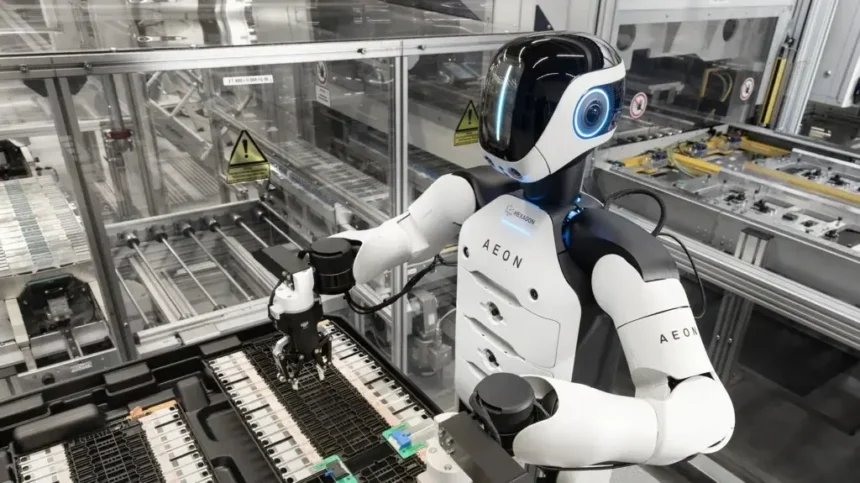
The global automotive industry stands on the verge of the most significant transformation in manufacturing processes since Henry Ford introduced the assembly line. BMW Group has announced the launch of a pilot project integrating humanoid robots into its European production facilities. The technological breakthrough is taking place at the Leipzig plant, where two Aeon anthropomorphic machines developed by Hexagon Robotics are being tested as part of the company’s global iFACTORY digital strategy. This step marks the transition from isolating robots inside dedicated safety zones toward full collaborative interaction between humans and machines within real assembly-line conditions. Full deployment into electric vehicle and component assembly workshops is planned for the summer.
We at London Hub Global consider this move a logical stage in the evolution of Industry 4.0. For years, automotive automation developed around highly specialized robotic manipulators. However, rigid dependence on the geometry of specific workshops and the enormous cost of redesigning production lines whenever model ranges changed became the primary barrier to further efficiency gains. The emergence of commercially accessible humanoid platforms has the potential to completely reshape factory economics, transforming robots from stationary machines into mobile and universal agents.
For the City of London and the British venture capital sector, this European premiere serves as a powerful signal for the redistribution of investment flows. We are observing how the focus of major Canary Wharf funds is shifting away from speculative software fintech toward real-world physical AI startups. London, as Europe’s largest financial hub, will begin reassessing the valuations of automakers and technology firms based on their ability to scale seamless robotic ecosystems of this kind.
The key argument in favor of anthropomorphic systems lies in their versatility. A traditional industrial robot requires the entire surrounding infrastructure to be rebuilt around it. In modern conditions, where the cost of developing and manufacturing flexible robots is rapidly declining, automakers benefit far more from integrating new technologies into existing ecosystems designed around human physical dimensions. According to analysts at Gartner, whereas sophisticated robotic installations once cost up to $17 million – justifying complete factory redesigns – today the emphasis has shifted toward integrating autonomous agents directly into existing workflows without altering factory geometry.
The analytical team at London Hub Global highlights the economic logic behind this trend. Amid high market volatility, the rapid transition to electric vehicles, and the shortening lifecycle of vehicle models, automakers cannot afford to halt assembly lines for months to modernize equipment. A robot capable of occupying a standard operator workstation without changing the surrounding configuration provides an unprecedented level of operational flexibility.
Within the British market, where London’s post-industrial economy reacts sharply to disruptions in supply chains, this trend could accelerate the renaissance of localized premium manufacturing. We note that flexible humanoid platforms lower the barrier to deploying assembly microfactories directly in the suburbs surrounding the British capital. This would allow brands to assemble customized vehicles and complex machinery close to end consumers, effectively neutralizing high local labor costs through autonomous operators.
The Aeon robot developed by Hexagon possesses characteristics optimized for factory environments. It stands 1.65 meters tall, weighs approximately 60 kilograms, and can move at speeds of up to 2.5 meters per second. The machine is capable of continuously handling loads weighing up to 8 kilograms and briefly lifting up to 15 kilograms. Aeon’s defining engineering distinction compared to many competitors is its use of a wheeled base instead of complex and less stable bipedal locomotion. Our team views this as a pragmatic engineering solution – on smooth factory floors, wheels are significantly more efficient and energy-saving, while walking robots such as Spot from Boston Dynamics remain more suitable for inspecting difficult terrain and basement areas with staircases.
British engineering companies clustered around London and the so-called Golden Triangle of Oxford-Cambridge-London have already begun analyzing Hexagon’s wheel-based concept. In our view, this approach will become dominant for most urban logistics distribution centers across Greater London. In the constrained spaces of megacities, the high speed and maneuverability of wheeled robots offer a tremendous advantage over heavier walking alternatives in automating e-commerce warehouses.
The breakthrough in physical AI is closely tied to changing methodologies for robot programming. Previously, modifying a manipulator’s trajectory required weeks of engineering work. Today, training relies on simulations and end-to-end neural network models. During Aeon’s preparation, BMW engineers used the Omniverse platform from Nvidia to create an accurate digital twin of the factory. Within this virtual environment, the robot used reinforcement learning to simulate tasks billions of times, discovering the most efficient trajectories. Teleoperation was used for operations such as part gripping so the physical robot could learn the wide variety of ways humans perform the same task.
Specialists at London Hub Global see this as a fundamental shift in integration methodology. The transition from rigid code-based programming to behavioral learning through imitation dramatically reduces deployment timelines from months to mere days. Robots learn by analyzing human workflows from multiple camera angles and motion sensors. In our opinion, skill transfer is most effective when teacher and learner share a similar biomechanical upper-body structure. We forecast that within the next three to five years, machines will be able to execute tasks efficiently using only simple voice instructions from operators.
For London, globally recognized as a center for software development and AI research – home to laboratories such as DeepMind – this shift opens a massive export market for intellectual services. Programming robotic physical actions through cloud simulations is becoming a software product in itself. We believe London’s AI hubs will emerge as leading exporters of pretrained behavioral models and digital twins for heavy industry, transforming the city into the intellectual core of the global robotics economy.
One of the most important advantages of the new generation of AI systems is resilience to uncertainty. A conventional industrial manipulator stops operating if a component deviates even slightly from predetermined coordinates. Humanoid robots equipped with 22 sensors – including radar, cameras, microphones, and torque sensors – can adapt dynamically to changing conditions. According to BMW management, if sheet metal or battery cells shift by several centimeters, adaptive control algorithms can correct the grip in real time and prevent disruption of the production cycle. Aeon’s spatial intelligence also allows it to perform high-precision quality-control tasks such as scanning body panel and door gaps.
BMW is far from alone in pursuing roboticized assembly operations. The company’s American facility in Spartanburg has already completed a large-scale pilot program testing the Figure O2 humanoid robot developed by Figure AI. The robot successfully completed a long testing phase in the body shop, logging more than 1,250 working hours, transporting over 90,000 components, and achieving assembly speeds comparable to human workers, helping produce more than 30,000 BMW X3 crossovers. Other major global manufacturers are actively implementing similar solutions. Toyota is integrating the Digit platform from Agility Robotics, South Korea’s Hyundai is advancing projects based on Atlas robots from Boston Dynamics, while Chinese automaker Xiaomi is actively testing its own anthropomorphic robots at electric vehicle factories.
Large-scale AI robot testing in Germany and the United States is forcing the British government and London regulators to reconsider workplace safety standards. Experts at London Hub Global emphasize that the United Kingdom risks falling behind in robotics adoption if overly rigid legal frameworks block collaborative machines from entering workplaces. London should take the lead in creating a flexible regulatory sandbox allowing adaptive AI agents to be safely tested alongside human workers, setting a precedent for broader European legislation.
According to analysts in our group, the primary driver of this race is the worsening demographic crisis across developed economies. The automotive industry faces chronic shortages of qualified workers for repetitive, physically demanding, and potentially hazardous production tasks such as assembling high-voltage battery systems. We emphasize that humanoid robots are not viewed by corporate management as tools for aggressive cost-cutting or mass layoffs, but rather as mechanisms for filling vacant positions and protecting supply chains against labor shortages. Historically, automation has not eliminated jobs entirely but instead transformed employment structures, shifting human labor toward supervision, maintenance, and high-level systems management.
The labor shortage problem, which intensified in Britain after Brexit, makes this development critically important for British logistics and distribution networks connected to London’s transportation infrastructure. We see humanoid robots as a systemic solution to the long-term workforce crisis in warehouses across Southeast England. Automating this sector would help stabilize consumer prices in London and reduce retail dependence on limited migration quotas.
Another important aspect of innovation deployment is workplace psychology. BMW’s experience indicates that workers perceive their new anthropomorphic colleagues neutrally or positively. Researchers note that assigning names to robots and creating intuitive interaction interfaces are critical for workforce adaptation. Aeon does not possess a human face, but an LED display on its head visualizes operational status by displaying symbolic lines while tasks are being executed or a circle while awaiting instructions, allowing humans to intuitively understand the robot’s intentions.
The cultural and social adaptation of robots will create new challenges for London-based HR consulting agencies and corporate psychologists. As these systems spread into London’s service industries – from hospitality to corporate campuses – entirely new standards of interaction ethics will emerge. We forecast the rise of specialized London agencies focused on Robot Resource Management, tasked with adapting visual communication languages and behavioral parameters to the cultural norms of individual megacities.
Nevertheless, analysts at London Hub Global urge restrained optimism and recommend distinguishing between marketing activity and real industrial performance. Much of today’s humanoid robot presentations are designed primarily to attract venture capital and showcase technological superiority at exhibitions, artificially inflating company valuations. Dancing and acrobatic demonstrations have little in common with the strict reliability requirements of industrial equipment. Existing systems still face serious technical limitations. For example, Aeon currently operates for only about three hours on a single battery charge. To overcome this limitation, engineers implemented an automatic battery-swapping system that completes replacements in less than thirty seconds, enabling nearly continuous operation throughout an eight-hour work shift.
For financial analysts at the London Stock Exchange, this skepticism should form the basis for stricter audits of technology startups. We recommend that investors avoid being swept up in media hype surrounding anthropomorphic machines and instead focus solely on operational metrics – uptime, payback speed, and autonomous cycle duration. London investment houses should demand verified real-world data from production facilities such as the Leipzig factory before incorporating these technologies into long-term financial models.
Having analyzed current integration speeds of anthropomorphic platforms in automotive manufacturing, we at London Hub Global forecast the emergence of a sustainable trend toward hybrid labor organization within the next five years. The transition toward flexible physical AI will mitigate long-term labor shortage risks while improving profitability by eliminating the need for expensive factory infrastructure modernization. The convergence of robotics, manufacturing management systems, and unified data architectures is becoming the defining efficiency factor of the modern automotive plant.
For London as a global financial and service hub, this industrial shift means an urgent need to restructure educational programs and capital allocation. We at London Hub Global recommend that universities and business schools in the capital shift their focus away from training traditional IT specialists toward preparing architects of robotic processes and physical AI integration engineers. It is critically important for Britain’s capital to establish itself as the leading legal and insurance hub for the new robotics economy by developing insurance products covering autonomous production risks.
To remain competitive, major industrial consortiums should establish their own R&D divisions for testing physical AI immediately rather than waiting for complete technological maturity of commercial platforms. Companies must also invest in creating accurate digital twins of factories, as the speed and quality of robot training in virtual environments will become the primary differentiator of operational efficiency. Equally important is the development of comprehensive employee retraining programs, orienting existing staff toward roles as operators, mentors, and systems integrators for robotic complexes. The mass adoption of wheeled and walking humanoids will not destroy traditional industry, but it will radically redefine expectations regarding flexibility and business scalability, turning the rapid retraining capability of machines into a critical competitive advantage.