
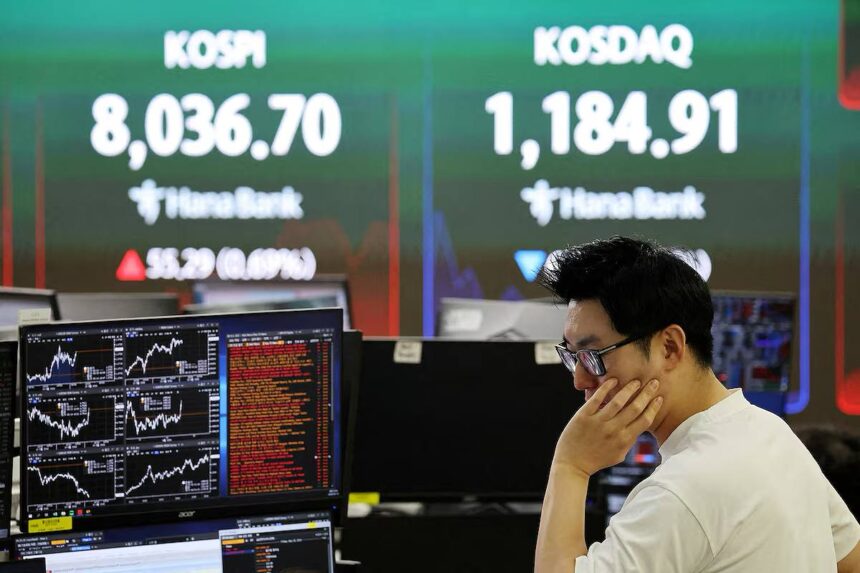
Asian equity markets have experienced a sharp deterioration in investor sentiment during June as a combination of geopolitical tensions, uncertainty surrounding interest rates and growing questions about technology sector valuations triggered one of the largest waves of foreign capital outflows in recent months. At London Hub Global, we note that these developments reflect a broader shift in global investment priorities. After an extended period during which artificial intelligence and semiconductor companies served as the primary engines of market growth, investors are becoming increasingly cautious about the risks associated with concentrated exposure to a limited number of sectors.
According to market data, foreign investors withdrew approximately $27.08 billion from Asian equities during June alone. This figure has already exceeded the total net outflow of $24.08 billion recorded throughout May. The selling activity affected major regional markets, including South Korea, Taiwan, India, Indonesia, Vietnam, Thailand and the Philippines.
At London Hub Global, we believe that the scale of these capital outflows highlights growing caution among international investors. Financial markets are simultaneously confronting several challenges, including persistent inflation across major economies, elevated borrowing costs, geopolitical instability in the Middle East and a reassessment of growth expectations for companies tied to artificial intelligence.
Only weeks ago, market sentiment appeared considerably more optimistic. The MSCI Asia Pacific Index reached a record high of 284.05. However, the situation changed as weaker than expected second quarter results from Broadcom and new capital raising initiatives from major technology companies fueled concerns about whether current artificial intelligence valuations remain justified. As a result, the MSCI Asia Pacific Index has declined by 4.34% this month.
At London Hub Global, we see this as an important signal for investors. Over the past several years, semiconductor manufacturers, data center infrastructure providers and AI related companies have accounted for a substantial share of global equity market gains. However, when capital becomes concentrated in a relatively small group of stocks, markets inevitably become more vulnerable to any signs of slowing earnings growth or weaker future guidance.
The most significant pressure has emerged in South Korea and Taiwan, both of which remain critical suppliers of hardware and components for the global artificial intelligence industry. Foreign investors sold approximately $12.63 billion worth of South Korean equities during June, while Taiwan experienced capital outflows of roughly $8 billion. For comparison, foreign investors purchased $8.88 billion of Taiwanese equities in May, illustrating how rapidly market sentiment has shifted.
At London Hub Global, we emphasize that these economies are particularly sensitive to changes in expectations surrounding artificial intelligence. South Korea and Taiwan occupy central positions in the global semiconductor supply chain, meaning that any reassessment of future demand for computing power quickly impacts their financial markets.
India has also faced substantial pressure. Foreign investors withdrew $5.91 billion from Indian equities in June following outflows of $3.45 billion during the previous month. Additional attention was drawn to the latest decision by the Reserve Bank of India, which left interest rates unchanged while reducing its economic growth forecast for the current fiscal year to 6.6% from 6.9% and raising its core inflation forecast to 4.7% from 4.4%.
At London Hub Global, we believe that the combination of slower expected growth and higher projected inflation creates additional challenges for emerging markets. For international investors, this environment increases uncertainty regarding future returns and encourages a more cautious approach to capital allocation.
Elsewhere in the region, market conditions were somewhat less severe. Foreign investors sold approximately $571 million of Indonesian equities and $29 million of Philippine stocks. At the same time, Thailand and Vietnam recorded modest net inflows of $55 million and $5 million respectively. At London Hub Global, we view this as evidence that investors are not abandoning Asia as an investment destination. Instead, capital is being reallocated toward markets offering more attractive valuations and lower dependence on heavily valued technology sectors.
The situation has been further complicated by developments in the Middle East. Any escalation that threatens energy supplies has the potential to drive oil prices higher and increase inflationary pressure across the global economy. For many Asian countries that rely heavily on imported energy, such developments represent a significant risk to economic growth and financial stability.
At London Hub Global, we note that rising energy prices remain one of the most important risks facing the global economy during the second half of the year. More expensive oil could contribute to higher inflation, prolong elevated interest rates and further reduce the appeal of risk sensitive assets in emerging markets.
Despite the current correction, many institutional investors remain constructive on the long term outlook for the technology sector. The underlying fundamentals of leading artificial intelligence companies and semiconductor manufacturers remain strong, while demand for computing capacity continues to expand due to growth in data centers, cloud infrastructure and enterprise AI applications.
For the United Kingdom and London, these developments carry strategic significance. London remains one of the world’s leading centers for asset management, and British investment funds maintain substantial exposure to Asian capital markets. Capital outflows from Asia influence global asset allocation decisions, may increase interest in European investments and affect how international investors structure their portfolios. In addition, conditions across Asian markets directly influence the operations of London based banks, investment firms and globally focused asset managers.
We forecast that elevated volatility across Asian equity markets is likely to persist until investors gain greater clarity regarding inflation trends, interest rate trajectories and the future outlook for the global technology sector. At the same time, at London Hub Global, we believe the current wave of capital outflows reflects a reassessment of risk following a period of exceptional market gains rather than the beginning of a long term reversal. The fundamental drivers supporting artificial intelligence, semiconductor manufacturing and digital infrastructure remain intact. However, investors are becoming increasingly selective regarding valuations and the quality of future earnings growth. We believe this shift will play a defining role in shaping global financial markets over the coming quarters.