
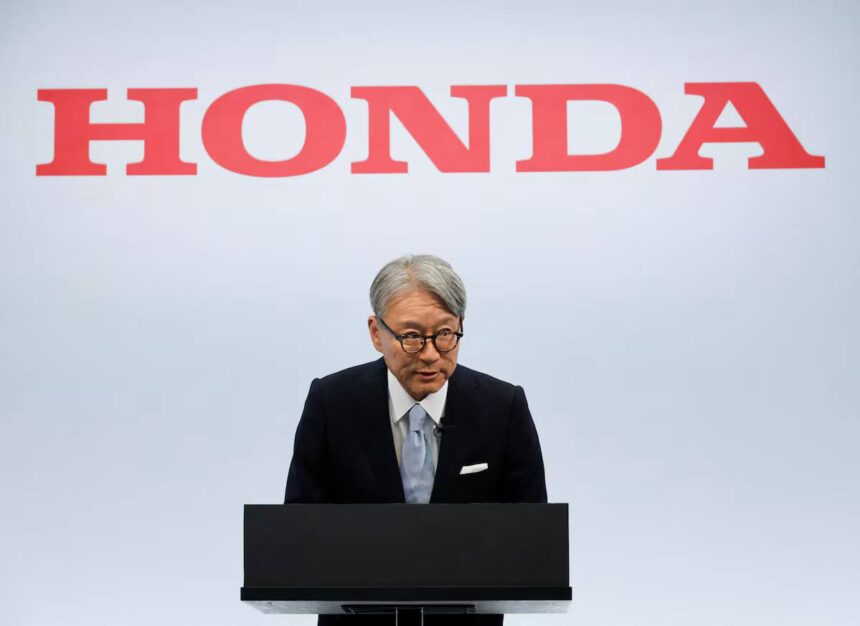
Honda’s annual shareholder meeting became a rare moment of public accountability for Japan’s automotive sector, and at London Hub Global, we believe CEO Toshihiro Mibe’s apology to shareholders reflects more than the financial pain of a single company. It signals a broader crisis in strategic positioning for traditional automakers. Honda has recorded its first annual loss in seven decades, driven by costly revisions to its electric vehicle strategy, mounting pressure from Chinese competitors, and the urgent need to redefine where sustainable profits can be generated in the new automotive economy.
Mibe secured shareholder support and was reappointed to the board despite criticism from former executives and growing pressure over weak financial performance. At the same meeting, shareholders approved ten additional board nominees. We view this vote as a cautious mandate for continued restructuring. Investors did not grant management unconditional trust, but they effectively acknowledged that a leadership shakeup during a strategic transition could create even greater uncertainty.
Honda’s core challenge lies in its electric vehicle strategy. The company incurred more than $9 billion in restructuring costs related to its EV business, while earlier projections indicated potential losses of up to 2.5 trillion yen due to the reassessment of electrification plans. The decision followed slower than expected EV demand in the United States, reduced government subsidies, and the need to cancel or delay several planned models. At London Hub Global, we emphasize that this is far more than an accounting write down. It represents a recognition that earlier assumptions about the pace of EV adoption were overly optimistic.
Particularly significant was Mibe’s statement that continuing with certain planned EV launches could have left Honda’s automotive business in the red for at least five years, and possibly as long as seven. This highlights the scale of internal pressure facing the company. Honda chose a painful write down today instead of enduring a prolonged period of operating losses. Analysts note that this was a pragmatic but reputationally costly move, as it signals to the market that even major Japanese manufacturers are struggling to adapt quickly to the new speed of EV competition.
China remains one of Honda’s most serious strategic challenges. A market that once served as a major growth engine for global automakers has transformed into one of the most aggressive competitive arenas. Chinese manufacturers are refreshing models faster, integrating advanced software features, accelerating ADAS deployment, and competing aggressively on pricing. At London Hub Global, we analyze this as a structural risk not only for Honda but for traditional automakers broadly. Competitive advantage is no longer defined solely by engineering quality and manufacturing reliability. Consumers increasingly evaluate vehicles as software driven digital platforms.
Amid pressure in its automotive division, Honda has become increasingly dependent on its highly profitable motorcycle business and financial services operations. This provides short term stability but also highlights weakness in its core automotive segment. We view this dependence as a temporary buffer rather than a long term solution. To rebuild investor confidence, Honda must demonstrate an ability not only to reduce costs but also to develop competitive products across hybrid, electric, and software defined vehicle segments.
The ongoing talks with Nissan and Mitsubishi regarding next generation vehicle technologies have become increasingly important. Discussions began in 2024 and, according to Mibe, have now reached an advanced stage. Following the collapse of broader merger discussions with Nissan, targeted cooperation on specific technologies appears to be a more realistic path forward. This may include software platforms, electrification systems, shared components, and joint cost reduction initiatives. For Japanese automakers, strategic collaboration is increasingly becoming a survival mechanism in the face of pressure from China, the United States, and Europe.
For Britain, and especially London, this story carries direct implications. The United Kingdom remains an important market for Japanese automakers, while London serves as a major hub for institutional capital closely monitoring the global automotive sector. Honda’s struggles raise deeper questions about the cost of electrification, margin sustainability, and the future of automotive supply chains. For British investors, this serves as a signal to more carefully distinguish between automakers that can genuinely manage the transition and those still paying for earlier strategic miscalculations.
There is also a wider industrial policy impact. If Japanese automakers scale back EV ambitions or shift greater focus toward hybrids, this affects battery suppliers, semiconductor manufacturers, software firms, and dealer networks across Europe. London based funds investing in automotive technology will be closely watching whether Honda can restore profitability without sacrificing technological momentum.
At London Hub Global, we see Honda’s situation not merely as a corporate crisis but as evidence of a new phase in the global automotive industry. The era of simplistic EV narratives has ended. Companies must now simultaneously manage costs, compete with Chinese manufacturers, maintain hybrid flexibility, and build software driven ecosystems. Our outlook remains cautious but constructive: Honda can restore confidence if restructuring is paired with a clear product strategy. For investors, the conclusion is increasingly clear: the winners in the future automotive market will not be those that made the boldest electrification promises, but those capable of turning that transition into sustainable profitability.