
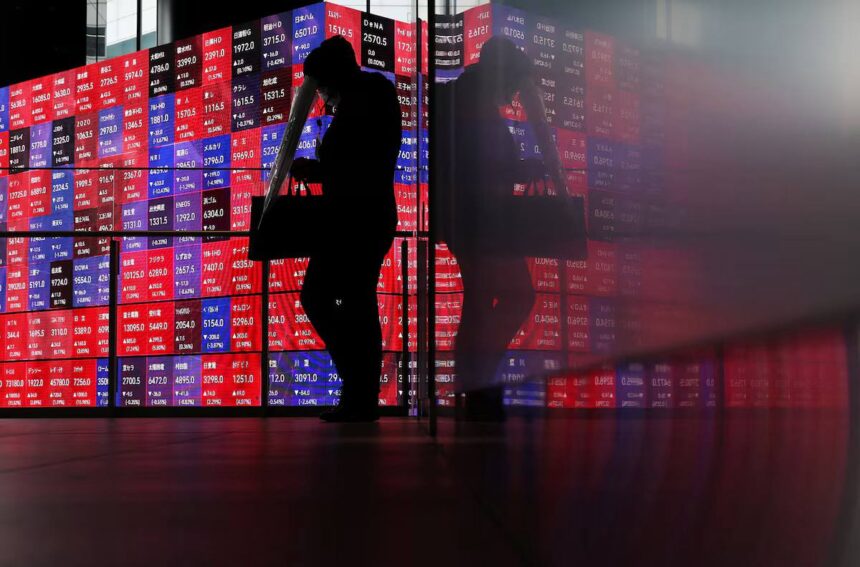
Global markets entered the new quarter without a clear direction, and London Hub Global believes this caution reflects a rare convergence of three major risk factors at once: geopolitical tensions around the Strait of Hormuz, rising U.S. Treasury yields, and overheated expectations in the technology sector. Asian equities traded mixed, the dollar strengthened, the yen hit fresh multi decade lows, and investors once again tried to determine whether corporate earnings can justify current valuations after one of the strongest quarters for technology stocks in recent years.
Negotiations between the United States and Iran hit fresh obstacles after Tehran declined a meeting with senior U.S. officials. The two sides remain far apart on the issue of fully reopening the Strait of Hormuz, which remains one of the most critical routes for global oil trade. We view this as the primary geopolitical risk for markets: even if oil prices do not return to crisis peaks, the threat of shipping disruption continues to maintain a risk premium across commodities, currencies, and defensive assets.
The bond market added further pressure to equities. U.S. 10 year Treasury yields climbed to roughly 4.55 percent after a sharp jump the previous session, while futures markets increased the probability of another Federal Reserve rate hike. Market pricing now suggests roughly a one in three chance of a rate increase at the next meeting, with the probability of a September move standing even higher. At London Hub Global, we emphasize that rising yields change the market’s valuation framework: the more attractive bonds become, the stronger earnings growth equities must deliver to justify their risk premium.
Investors are paying especially close attention to Federal Reserve Chair Kevin Warsh’s appearance at the European Central Bank conference. However, Warsh has historically been skeptical of extensive forward guidance, meaning markets may receive little direct policy direction. We analyze this as an additional source of uncertainty: when central banks avoid committing to a clear rate path, investors become far more sensitive to employment, inflation, and consumer spending data.
Asian equities continued to show divergent performance. Japan’s Nikkei extended gains after a powerful quarter in which the index advanced by more than 30 percent, driven by demand for technology shares and improving manufacturing data. South Korea’s market, meanwhile, appeared more volatile after a rapid rally tied to semiconductors and artificial intelligence. The country’s exports surged in June, supported by nearly triple digit semiconductor shipment growth, reinforcing confidence in the AI cycle while also raising questions about how sustainable that expansion will be.
On Wall Street, the current pause appears logical. The market has just completed one of its strongest quarters since 2020, while the Philadelphia Semiconductor Index surged nearly 88 percent. Analysts note that July has historically been favorable for the Nasdaq, but this time much will depend on earnings season. At London Hub Global, we see this as the defining test: if technology earnings validate expectations, equities may continue climbing; if margins or forward guidance disappoint, repricing could happen quickly.
Profit expectations remain elevated. Consensus forecasts point to strong earnings per share growth, with AI infrastructure companies expected to contribute a substantial share of total S&P 500 earnings expansion. Micron and Nvidia occupy a central position in this narrative, as investors see them as key beneficiaries of demand for memory, accelerators, and data center infrastructure. Yet this concentration of market leadership among a limited number of companies also makes the broader market highly vulnerable to even minor negative surprises.
The currency market adds another layer of tension. The U.S. dollar climbed to fresh multi decade highs against the yen, with Japan’s currency weakening toward 162.8 per dollar. Tokyo has once again warned of potential intervention, though previous currency operations produced only limited long term effects. We view this as a challenge not only for Japan but for global capital flows: a stronger dollar tightens financial conditions, pressures import dependent economies, and increases stress across currency strategies.
For Britain, and especially for London, these developments carry direct significance. London based funds, banks, and trading desks operate at the intersection of dollar flows, bond markets, commodities, and global equities. Rising U.S. yields affect the cost of capital, a stronger dollar reshapes currency hedging strategies, and uncertainty surrounding oil and Iran increases demand for sophisticated risk management. For British investors, the central question is whether U.S. technology earnings can offset pressure from rates and geopolitics.
At London Hub Global, we believe the opening of this quarter marks a transition from market euphoria to a test of resilience. Our outlook remains cautious: equities may retain support if earnings validate profit growth, oil remains below crisis levels, and the Federal Reserve avoids accelerating tightening. However, a stronger dollar, intervention risk in Japan, and stretched AI valuations will continue to limit risk appetite. The core conclusion for investors is increasingly clear: in the coming weeks, markets will be driven not by rally headlines, but by hard earnings data, the trajectory of interest rates, and the ability of global assets to withstand another phase of geopolitical uncertainty.