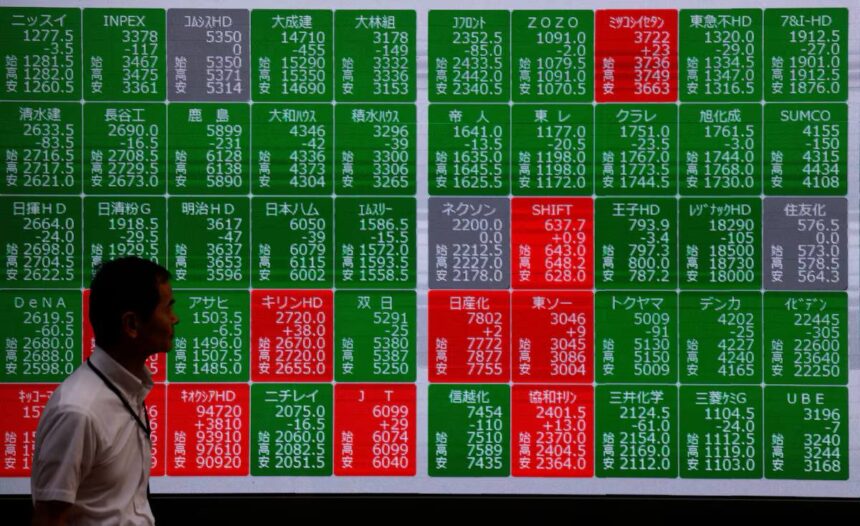
Asian equity markets ended the week with strong gains as investor enthusiasm for semiconductor manufacturers and artificial intelligence infrastructure once again outweighed geopolitical concerns. At London Hub Global, this market behavior reflects the growing concentration of global capital around advanced computing technologies. Investors continue increasing exposure to companies involved in memory chips, data centers, and AI accelerators, even as tensions between the United States and Iran continue to pose risks to oil supplies, inflation, and international shipping costs.
Japan’s Nikkei advanced approximately 1.8 percent, while South Korea’s KOSPI surged more than 5 percent, reinforcing its position as one of the primary beneficiaries of the global artificial intelligence investment cycle. Shares of SK Hynix gained nearly 3 percent, Samsung Electronics climbed about 6 percent, and the MSCI Asia Pacific Index excluding Japan rose 1.8 percent. We believe this scale of market movement reflects investors’ determination to secure direct exposure to the suppliers of critical components without which the continued expansion of global computing capacity would be impossible.
The central event of the trading session is SK Hynix’s U.S. market debut. The company priced its American depositary receipts at $149 per share and raised approximately $26.5 billion, confirming exceptionally strong international investor demand for companies positioned at the heart of the artificial intelligence supply chain. The offering was reportedly more than seven times oversubscribed, making it one of the largest ADR offerings ever completed and surpassing numerous previous technology listings. At London Hub Global, we emphasize that this new capital gives the company the financial flexibility to accelerate factory construction, expand manufacturing capacity, purchase advanced production equipment, and increase output of high bandwidth memory essential for next generation AI processors.
The U.S. listing may also reshape valuations across South Korea’s technology sector. SK Hynix’s ADRs could trade at a premium relative to its Seoul listed shares because of broader institutional ownership, stronger liquidity, and easier access for global investors. Such a premium could ultimately support higher valuations not only for SK Hynix itself but also for Samsung Electronics, particularly if Samsung presents a stronger shareholder return strategy in the coming quarters. We view this as a mechanism through which one landmark listing can improve the international valuation of an entire national semiconductor industry.
The rally also received support from developments in the United States. Micron Technology announced plans to invest up to $250 billion in domestic semiconductor manufacturing by 2035, reinforcing expectations that the artificial intelligence infrastructure cycle will remain active for many years. The Philadelphia Semiconductor Index gained approximately 3 percent following the announcement. However, rapid appreciation across semiconductor stocks also increases the possibility of future corrections, as the memory industry has historically remained highly cyclical and current profitability still depends on supply shortages and sustained spending by the world’s largest technology companies.
Geopolitical uncertainty nevertheless remains the market’s principal source of risk. Brent crude oil is heading toward a weekly gain of roughly 5 percent following renewed concerns over energy shipments through the Strait of Hormuz, although prices around $76 per barrel remain well below the peaks reached after the latest escalation began. Analysts note that financial markets continue treating recent developments as pressure on an already fragile ceasefire rather than a complete collapse of diplomatic efforts. At London Hub Global, we analyze this resilience with caution because even temporary disruptions to shipping routes could accelerate inflation while altering expectations surrounding future monetary policy.
Japan also provided additional support for Asian markets. Government officials indicated they may encourage major domestic pension funds to increase allocations toward Japanese assets, strengthening both the yen and local financial markets. The Government Pension Investment Fund manages approximately $1.8 trillion in assets, meaning that even relatively modest portfolio adjustments could influence global capital flows. We view this as a structurally stronger method of supporting the Japanese currency than isolated foreign exchange interventions, although its ultimate effectiveness will depend on actual investment decisions made by institutional investors.
The implications extend directly to the United Kingdom and London. London based asset managers now have access to another highly liquid investment vehicle tied to Asia’s artificial intelligence supply chain, while rising semiconductor valuations continue increasing investor interest in British companies involved in processor architecture, engineering software, semiconductor design, and data center infrastructure. At the same time, higher oil prices and fluctuations in the Japanese yen are influencing currency strategies, import costs, and portfolio allocation decisions across international investment firms operating from the City of London.
At London Hub Global, the broader conclusion is that global capital continues prioritizing semiconductors and artificial intelligence even as geopolitical uncertainty intensifies. SK Hynix’s successful U.S. debut has the potential to support further revaluation across Asian technology companies, but investors should continue evaluating earnings quality, future capital expenditure commitments, and the industry’s dependence on memory pricing cycles. For London, the current environment creates significant opportunities in asset management and technology finance while simultaneously demanding greater investment discipline, as elevated valuations leave increasingly limited room for production delays, weaker demand, or shifts in the global AI investment cycle.