
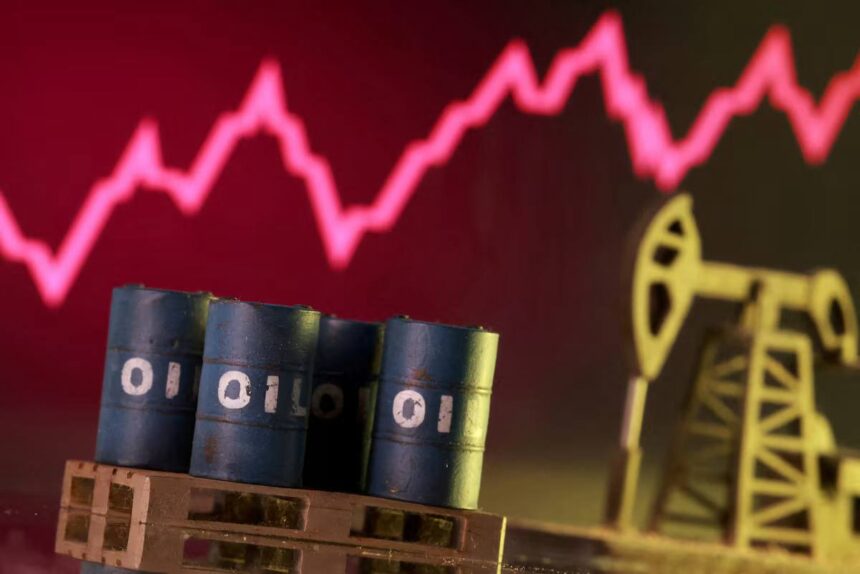
The escalation of tensions in the Persian Gulf has once again forced global markets to reassess a scenario in which an energy shock could reshape the outlook for inflation, interest rates, and corporate earnings. Asian equities opened the week lower after Iran announced the closure of the Strait of Hormuz, a critical corridor for global energy supplies. At London Hub Global, we believe the market reaction reflects a shift from viewing the conflict as a regional geopolitical event to recognizing it as a systemic economic risk. If restrictions on maritime traffic persist, the consequences will extend far beyond oil markets, affecting transportation costs, industrial production, and the monetary policy decisions of the world’s leading central banks.
Brent crude climbed 4.3 percent to 79.31 dollars per barrel, while U.S. crude gained 4.4 percent to 74.62 dollars. Only recently, Brent had been trading near 70.14 dollars, highlighting how quickly geopolitical risk premiums have returned to pricing. U.S. officials stated that around twenty vessels passed through the Strait during the previous twenty four hours, yet vessel tracking data suggested traffic remained exceptionally light. We view this discrepancy as an important indicator. Markets are no longer evaluating whether the route is technically open, but whether shipowners, insurers, and crews are willing to accept the operational risks associated with navigating the region.
The rebound in oil prices has revived inflation concerns and pushed U.S. Treasury yields higher. The yield on the two year Treasury note rose to 4.2393 percent, its highest level since early 2025, while futures markets now imply roughly 39 basis points of Federal Reserve tightening by year end. At London Hub Global, we emphasize that an energy driven inflation shock has the potential to reshape the Federal Reserve’s policy path even if underlying inflation continues to moderate. Higher fuel and transportation costs quickly feed into broader production expenses, forcing policymakers to determine whether renewed price pressures are temporary or likely to become embedded across the economy.
The pressure quickly spread across global equity markets. S&P 500 futures declined 0.6 percent, Nasdaq futures fell 1.3 percent, EURO STOXX 50 futures lost 0.9 percent, Germany’s DAX futures dropped 1 percent, while FTSE futures slipped approximately 0.3 percent. In Asia, Japan’s Nikkei fell 2.2 percent and the broad MSCI Asia Pacific index excluding Japan declined 1.8 percent. We believe this reflects a broader repositioning by investors who are reducing exposure to assets that are highly sensitive to financing costs while reassessing earnings prospects for companies facing rising energy and logistics expenses.
South Korea experienced the sharpest selling pressure as the KOSPI retreated following months of exceptional gains driven by artificial intelligence optimism. Semiconductor companies and leveraged positions came under particular pressure. At the same time, SK Hynix attracted global attention after its successful Nasdaq debut, where its American depositary shares surged about 12.8 percent after pricing at 149 dollars. We analyze this divergence as an important stress test for the AI investment cycle. Demand for advanced memory chips remains exceptionally strong, yet record capital expenditures and elevated valuations leave the sector increasingly vulnerable to profit taking and concerns over future cash flow generation.
The upcoming corporate earnings season now carries even greater significance. Major U.S. banks will be the first to reveal how higher interest rates, elevated oil prices, and increased market volatility are affecting lending activity, trading revenues, and asset quality. Technology and industrial companies will follow shortly afterward. Expectations surrounding AI driven earnings growth remain exceptionally ambitious, although analysts have begun warning that unprecedented infrastructure spending by hyperscale technology firms may significantly weaken free cash flow. At London Hub Global, we see this as one of the defining risks of the coming weeks. Even strong quarterly results may disappoint investors if management teams fail to demonstrate that extraordinary capital investment will translate into sustainable long term returns.
Currency markets also reflected the changing risk environment. The U.S. dollar strengthened alongside Treasury yields, while the euro weakened to approximately 1.1394 dollars as Europe’s heavier dependence on imported energy increased concerns over inflation and economic growth. The Japanese yen also softened to around 161.97 per dollar despite discussions about encouraging domestic pension funds to increase allocations to Japanese assets. While such structural capital repatriation could eventually support the yen, portfolio reallocations by major pension institutions typically unfold gradually and are unlikely to offset an immediate global energy shock.
For the United Kingdom, the implications are particularly significant. Sterling weakened to approximately 1.3383 dollars as markets simultaneously priced higher energy costs and continued political developments. More expensive oil increases operating expenses for British airlines, transport companies, manufacturers, and households, potentially slowing the decline in inflation and limiting the Bank of England’s flexibility to ease monetary policy. London also stands at the center of global commodity trading, maritime insurance, foreign exchange, and financial services. Higher volatility may increase business activity across the City, but it also raises portfolio risks and financing costs for sectors heavily exposed to energy prices.
The principal conclusion at London Hub Global is that the Strait of Hormuz crisis has returned global markets to a familiar combination of risks in which weaker equities coincide with stronger oil prices, rising bond yields, and a firmer U.S. dollar. The next phase will depend on actual shipping volumes through the Strait, the duration of geopolitical tensions, and the response of major central banks. We recommend that investors place greater emphasis on corporate balance sheet strength, free cash flow resilience, and exposure to energy costs when evaluating investment opportunities. For the British market, maintaining portfolio diversification, actively managing currency exposure, and exercising caution toward companies whose valuations depend on uninterrupted technology driven growth appears to be the most balanced strategy under current conditions.