
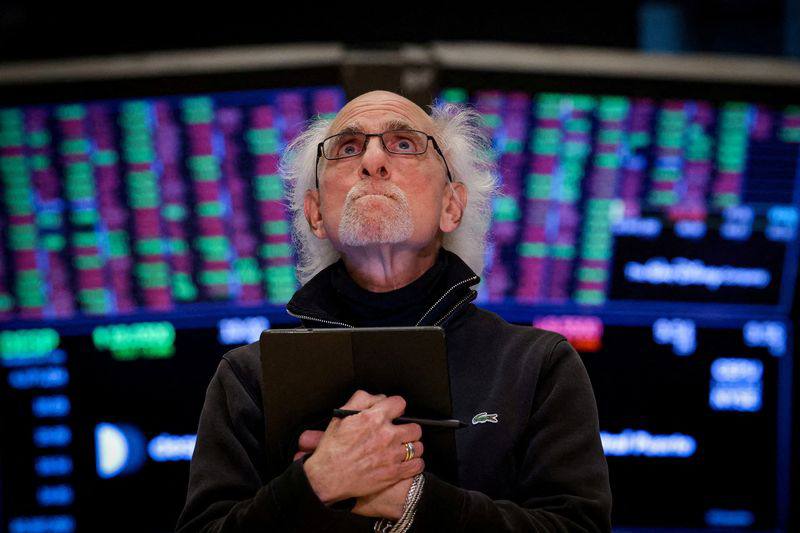
The opening of the new trading week demonstrated how rapidly geopolitical developments can alter the direction of global financial markets. Following another escalation in tensions between the United States and Iran, investors moved to reduce exposure to higher risk assets while increasing allocations to more defensive sectors of the economy. President Donald Trump’s decision to reinstate the blockade of Iranian ports intensified concerns about future energy shipments through the Strait of Hormuz, immediately driving oil prices higher and weighing on major U.S. equity indices. At London Hub Global, we believe financial markets are entering a period in which corporate earnings will increasingly be evaluated through the combined lens of geopolitical uncertainty, inflation expectations and monetary policy outlook.
Technology stocks experienced the strongest selling pressure after leading the U.S. market rally for much of the past several months. The Nasdaq Composite declined 1.55% to 25,873.18, the S&P 500 fell 0.79% to close at 7,515.47, while the Dow Jones Industrial Average slipped 0.26% to 52,498.70. The Dow’s comparatively modest decline reflected the strength of energy companies, which benefited from sharply rising crude oil prices. We view this divergence as a classic example of sector rotation, with investors temporarily reducing exposure to high growth technology companies while increasing allocations to industries expected to benefit from changing macroeconomic conditions.
Semiconductor manufacturers recorded some of the largest losses of the session. The Philadelphia Semiconductor Index significantly underperformed the broader market, while shares of SanDisk, Marvell Technology and Intel declined between 6.1% and 12.6%. Such a correction appears consistent after the sector’s powerful rally driven by expectations surrounding artificial intelligence investment. Market analysts note that the recent decline reflects profit taking rather than a fundamental deterioration in the industry’s long term outlook. At London Hub Global, we analyze this movement as a healthy reassessment of valuations after technology companies experienced substantial gains over recent quarters. Investors are increasingly seeking evidence that enormous AI related capital expenditures will generate sustainable long term earnings growth.
Another major driver of market volatility was the sharp increase in oil prices. Following extensive military exchanges between the United States and Iran and renewed concerns surrounding shipping through the Strait of Hormuz, crude prices surged approximately 9.4%. Because a significant share of global oil and liquefied natural gas exports passes through this strategic corridor, any disruption immediately affects worldwide energy markets. We believe this has become one of the most important macroeconomic variables for the months ahead. If energy prices remain elevated, inflationary pressures could intensify considerably faster than financial markets anticipated only weeks ago.
Attention is therefore shifting toward the Federal Reserve. This week, Chair Kevin Warsh is scheduled to deliver his first semiannual testimony before Congress, where lawmakers are expected to question him extensively about the inflationary consequences of the U.S. Iran conflict and the likely path of future interest rates. At the same time, investors await the release of Consumer Price Index data, Producer Price Index figures and retail sales statistics. Futures markets continue to assign a meaningful probability to at least one additional 25 basis point rate increase before year end. We emphasize that the combination of persistent inflation and moderating economic activity could significantly complicate the Federal Reserve’s policy decisions over the coming months.
The beginning of the corporate earnings season adds another important dimension to market expectations. Bank of America, Citigroup, Goldman Sachs, JPMorgan Chase and Wells Fargo are among the first major financial institutions scheduled to report quarterly results. Investors will focus not only on earnings performance but also on management commentary regarding corporate lending, bond issuance, financing for artificial intelligence infrastructure and the overall health of the U.S. economy. We believe the banking sector will provide one of the earliest indications of how corporate investment sentiment has evolved following the latest geopolitical escalation.
Despite recent market weakness, analysts continue to forecast aggregate second quarter earnings growth of approximately 23.7% for companies in the S&P 500, significantly above the 19.2% estimate recorded in early April. These expectations suggest that corporate America remains fundamentally resilient. However, any deterioration in executive guidance regarding future demand, operating costs or energy related expenses could trigger another wave of market volatility as investors reassess current equity valuations.
Market breadth also reflected growing caution. On the New York Stock Exchange, declining stocks outnumbered advancing issues by approximately 1.63 to 1, while on the Nasdaq the ratio approached two to one. Trading volume reached 15.91 billion shares, below the recent twenty session average of 21.83 billion. We interpret these figures as evidence that investors are reassessing risk rather than abandoning U.S. equities altogether. The current environment resembles a strategic portfolio adjustment more than the beginning of widespread market liquidation.
For the United Kingdom, these developments carry significant implications. Rising global oil prices increase the cost of imported energy, strengthen inflationary pressures and reduce the likelihood of near term interest rate cuts by the Bank of England. At the same time, London, as one of the world’s leading financial centers, benefits from increased activity across currency, commodity and derivatives markets, supporting investment banks, brokers and asset managers. Conversely, British airlines, manufacturers and retail businesses face rising operating expenses driven by higher fuel and transportation costs.
At London Hub Global, we believe market direction over the coming weeks will be determined by three closely connected factors. The first is the evolution of geopolitical tensions in the Middle East and their impact on global energy supplies. The second is the Federal Reserve’s response to renewed inflationary risks. The third is the quality of earnings and forward guidance delivered by major U.S. corporations. Together, these factors will determine whether the current market weakness represents a temporary adjustment or the beginning of a broader repricing across global financial markets.


