
The sharp shift in global market sentiment demonstrates how quickly geopolitical developments can reshape investor expectations regarding economic growth and monetary policy. Only a few weeks ago, market participants were focused on the prospects for interest rate cuts, yet the latest surge in oil prices has fundamentally changed the outlook. At London Hub Global, we believe the current environment marks the return of inflation uncertainty as the dominant market theme after a period of relative stability. Investors are increasingly pricing in the possibility of a longer period of elevated interest rates, placing simultaneous pressure on virtually every major asset class.
Asian equity markets ended the session lower after oil prices climbed nearly 40 percent over the course of the month. Brent crude briefly traded above 102 dollars per barrel before stabilizing around 100.3 dollars. The rally was driven by growing concerns over global energy supplies as tensions escalated in the Red Sea while uncertainty surrounding the Strait of Hormuz continued. These maritime routes handle a substantial share of global oil exports, meaning that any disruption immediately increases the geopolitical risk premium embedded in energy prices. We view the current market reaction as evidence that the energy sector is once again exerting greater influence over inflation expectations than recent macroeconomic data.
Additional upward pressure came from statements by U.S. President Donald Trump regarding the possibility of a strong military response against Iran and the Iran backed Houthis, alongside the continuation of U.S. military operations in the region. These developments reinforced concerns about the stability of Middle Eastern energy supplies. At London Hub Global, we analyze the market response as a reflection of long term geopolitical risk rather than a reaction to isolated military events. Investors are increasingly evaluating the probability of prolonged instability across one of the world’s most important energy producing regions, a scenario capable of keeping oil prices elevated for much longer than originally anticipated.
Higher energy prices quickly affected global bond markets. The yield on the U.S. ten year Treasury reached its highest level in eighteen months at nearly 4.7 percent, while thirty year Treasury yields remained close to 5.17 percent. At the same time, expectations grew that the Federal Reserve could once again consider raising interest rates at one of its upcoming meetings. Analysts note that only a week earlier such an outcome had barely been reflected in market pricing. We consider this reassessment entirely logical because oil prices above one hundred dollars typically increase transportation costs, manufacturing expenses and consumer prices, making it significantly more difficult for central banks to complete the inflation fighting cycle.
Market sentiment was further pressured by plans from the U.S. administration to impose higher tariffs on imports from sixty trading partners. More expensive energy combined with tighter trade restrictions increases the likelihood of rising production costs across multiple sectors of the global economy. Although the European Central Bank left interest rates unchanged, financial markets continue to assign a high probability to another increase later this year. At London Hub Global, we emphasize that the combination of elevated oil prices, rising sovereign bond yields and stricter trade policy creates an environment in which global financial markets become considerably more vulnerable to additional external shocks.
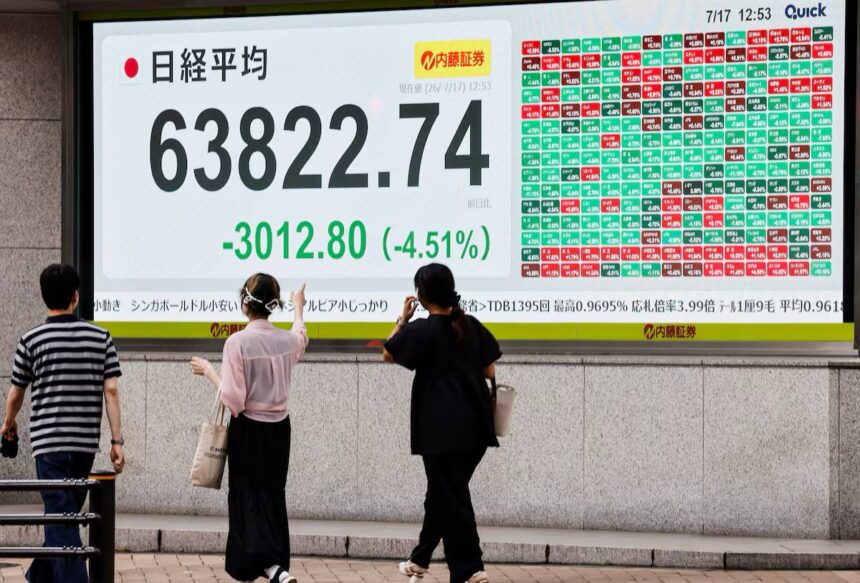
The sharpest declines were recorded across Asian equity markets. The MSCI Asia Pacific Index excluding Japan fell by 2.3 percent, Japan’s Nikkei declined 2.8 percent, South Korea’s KOSPI dropped 4.8 percent and Hong Kong’s Hang Seng Index lost 1.1 percent. Selling pressure intensified following quarterly earnings from Alphabet and Tesla. Both companies significantly expanded investment in artificial intelligence infrastructure, prompting investors to question the pace of capital expenditure growth and the timing of future financial returns. Tesla shares declined sharply after reporting its first negative free cash flow in two years, while Alphabet also came under pressure because of rapidly increasing AI related investment. We see this as confirmation that markets are becoming increasingly focused on capital efficiency rather than the scale of technological ambition demonstrated by the world’s largest technology companies.
Higher Treasury yields also strengthened the U.S. dollar. The U.S. Dollar Index climbed to around 101.40, while the Japanese yen remained close to its weakest level in almost forty years at approximately 163.82 per dollar. Such currency weakness increases the likelihood of further intervention by Japanese authorities, who have already entered the foreign exchange market earlier this year. At the same time, both gold and silver declined as investors shifted capital toward the U.S. dollar and higher yielding government bonds.
For the United Kingdom, these developments carry broad economic implications. Rising global oil prices are likely to increase fuel, transportation and manufacturing costs, potentially complicating future monetary policy decisions by the Bank of England. At the same time, London stands to benefit from its position as one of the world’s leading financial centers, where demand for commodity hedging, trade finance, foreign exchange risk management and cross border energy transactions is expected to increase. The City’s financial institutions have historically benefited from periods of elevated market volatility through higher trading activity across commodity, currency and fixed income markets.
At London Hub Global, we believe the key variable over the coming weeks will not simply be whether Brent remains above one hundred dollars per barrel, but how long prices stay above that threshold. If geopolitical tensions persist, central banks may be forced to maintain restrictive monetary policy for longer than previously expected, while investors are likely to continue favoring defensive assets and more conservative allocation strategies. We believe the months ahead will represent an important test for global financial markets, as the combination of persistent inflation risks, elevated funding costs and ongoing geopolitical uncertainty will shape both the direction of the world economy and international capital flows.


