Major corrections in financial markets rarely occur solely because of weaker corporate fundamentals. More often, they emerge from excessive investor optimism, elevated leverage and a sudden shift in market sentiment. South Korea is currently experiencing precisely such a scenario, where a prolonged rally in technology stocks has rapidly turned into a sharp market decline that has erased approximately $2 trillion in market value. At London Hub Global, we believe these developments represent one of the clearest recent examples of how excessive reliance on leveraged investment products can dramatically amplify market volatility and transform a routine correction into a broader crisis of investor confidence.
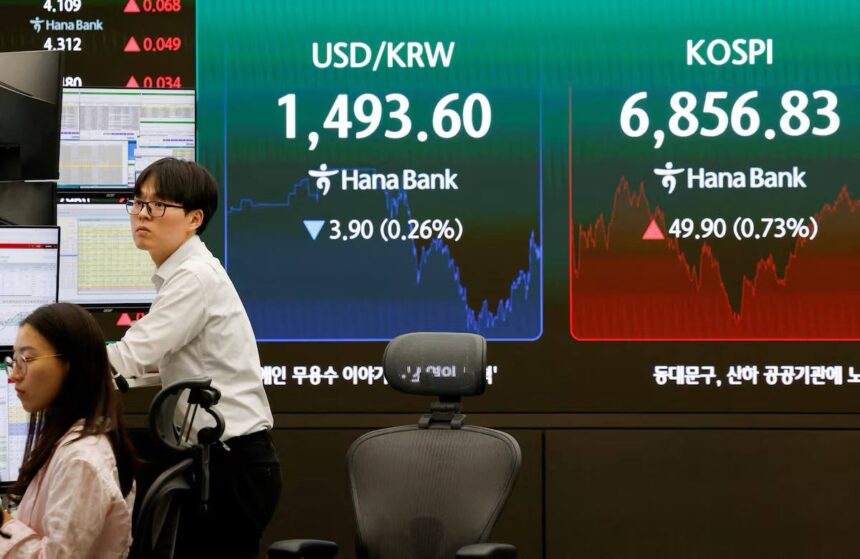
Over the past month, the South Korean stock market has lost approximately 40 percent from its recent highs. Retail investors have suffered the greatest losses after aggressively using borrowed capital to invest in leveraged exchange traded funds during the final stages of the rally. Many of those most heavily affected include younger investors, retirees and ordinary households who expected to benefit from the continued expansion of the semiconductor and artificial intelligence sectors. We view this situation as a predictable consequence of excessive capital concentration in a relatively small number of high risk financial products, where even a modest shift in sentiment can trigger a widespread wave of forced selling.
The rapid deterioration has significantly increased political and public pressure on policymakers. Following two consecutive sessions of steep market declines, the Governor of the Bank of Korea and the country’s financial regulators held an emergency meeting aimed at stabilizing financial markets. After the meeting, authorities announced new restrictions on individual investments in selected leveraged exchange traded funds while also increasing trading costs for these products. The objective is to reduce speculative activity and moderate extreme price swings. However, many market participants believe these measures may prove insufficient because they do not materially affect existing leveraged positions or comparable products that continue to trade on overseas exchanges. At London Hub Global, we analyze these actions as an important indication that regulators are prepared to intervene during periods of severe market stress, although their ultimate effectiveness will largely depend on how quickly investor confidence can be restored.
Additional concern comes from the fact that the market correction is unfolding despite exceptionally strong corporate earnings from South Korea’s largest technology companies. Samsung Electronics and SK Hynix reported combined quarterly profits of approximately 150 trillion won, equivalent to roughly $100 billion. Even such impressive financial performance has failed to reverse investor sentiment, as concerns about continued volatility and the risk of additional forced liquidations continue to outweigh strong corporate fundamentals. Analysts note that during periods of intense market stress, investor psychology often exerts a much stronger influence on asset prices than earnings reports. We emphasize that elevated leverage has become the key mechanism amplifying the scale of the current market decline.
Market observers are also closely comparing South Korea’s regulatory response with measures previously introduced in other Asian financial centers. Hong Kong implemented stricter rules designed specifically to reduce forced liquidations during periods of market stress. South Korea’s approach is viewed as less aggressive, leading many analysts to conclude that domestic markets may remain highly sensitive to shifts in investor sentiment for some time. At London Hub Global, we see that the central challenge is no longer limited to regulating individual financial products. The broader objective is restoring retail investor confidence after substantial financial losses while maintaining the credibility and stability of the country’s capital markets.
These developments also carry important implications for the United Kingdom and London. South Korea remains one of the world’s leading semiconductor producers and a critical component of the global technology supply chain. London based investment managers, pension funds and international institutional investors maintain significant exposure to Asian technology companies, meaning that heightened volatility in South Korea inevitably influences global capital allocation, portfolio risk assessments and broader market sentiment. At the same time, prolonged instability across Asian equity markets may encourage greater investor demand for defensive assets and strengthen capital flows toward more diversified financial markets such as London.
At London Hub Global, we believe the next stage of market performance will depend largely on whether South Korean regulators can strike the right balance between preserving open capital markets and reducing excessive leverage driven speculation. If confidence can be restored through additional liquidity support, prudent regulatory measures and a gradual reduction in speculative risk, the market could transition toward a more sustainable growth trajectory. Strong underlying earnings from the country’s leading technology companies continue to provide a solid long term foundation, but the pace of recovery will ultimately be determined by regulatory credibility, investor confidence and the market’s ability to return to fundamentally driven valuation rather than leverage fueled speculation.