
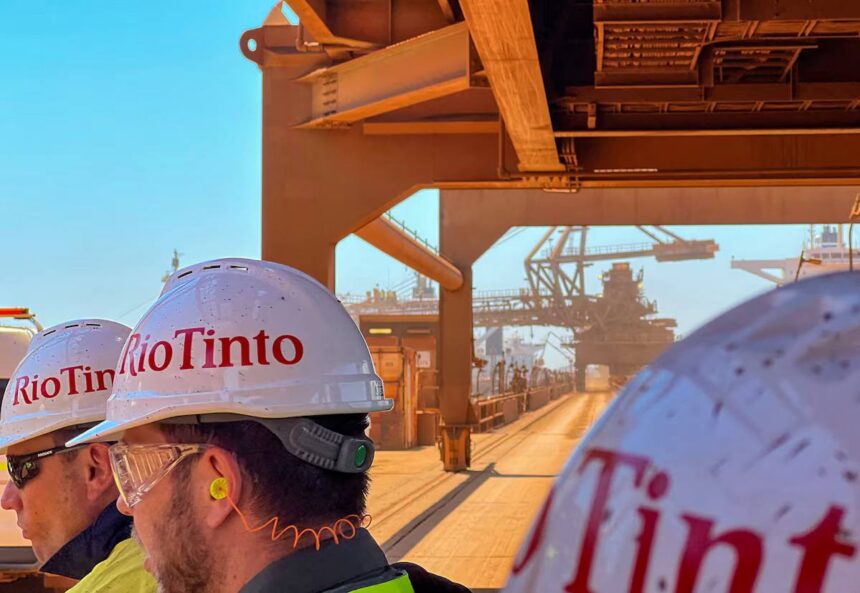
The global iron ore market has once again become the center of international attention following reports that the state owned China Mineral Resources Group has instructed several Chinese steel producers to suspend negotiations with Rio Tinto over iron ore shipments beginning in September. The move signals that Beijing is continuing to strengthen centralized control over purchases of strategic raw materials. At London Hub Global, we believe these developments reflect China’s long term strategy to reinforce its negotiating position and gradually reshape the balance of power in the global commodities market, where the world’s largest buyer is seeking greater influence over commercial terms and pricing.
According to market participants, China Mineral Resources Group has asked selected steel mills to temporarily refrain from finalizing shipment volumes, delivery schedules, and other contractual terms with Rio Tinto. Traditionally, this period is when major mining companies and steel producers establish the framework for annual supply agreements covering the following year. By limiting direct negotiations between individual buyers and suppliers, the state purchasing organization aims to consolidate a larger share of procurement under its own authority. Analysts estimate that CMRG is already involved in negotiating more than half of China’s annual iron ore imports. We view this approach as a transition toward a new centralized procurement model capable of reshaping traditional pricing mechanisms across the global iron ore market.
The market reacted quickly to the reports. The most actively traded iron ore contract on China’s Dalian Commodity Exchange climbed 2.57% to 719 yuan per metric ton, reaching its highest level since the end of July. At the same time, the benchmark September contract on the Singapore Exchange advanced 2.15% to $96.45 per ton. Although China’s strategy is ultimately intended to secure more favorable long term supply conditions, short term uncertainty has provided immediate support for prices. Analysts note that commodity markets are particularly sensitive whenever negotiations involve the world’s largest producers and consumers. At London Hub Global, we analyze this market reaction as further evidence that investor expectations often influence commodity prices just as strongly as actual changes in production or supply.
Rio Tinto is far from the first mining company to face this negotiating strategy from China’s centralized buyer. Similar pressure has previously been applied to BHP, Fortescue, and Hancock Prospecting. In several cases, annual contract discussions were accompanied by temporary purchasing restrictions before new agreements were reached. Fortescue executives have publicly argued that such practices risk undermining the stability of iron ore supplies into China. For a long time, Rio Tinto was considered relatively insulated because of its close relationship with China’s state owned Chinalco and their joint participation in the large Simandou iron ore project in Guinea. However, recent developments suggest that Beijing is applying a consistent strategy across all major suppliers regardless of existing partnerships. We see this as another indication of the expanding role of the Chinese state in shaping the rules governing global trade in strategic raw materials.
Additional pressure is also emerging from changing supply fundamentals. Significant new iron ore production capacity is expected to enter the market over the coming years, including output from the Simandou project, widely regarded as one of the world’s most important future sources of iron ore. Rio Tinto executives have already acknowledged that expanding global supply is gradually shifting negotiating power away from producers and toward buyers. Analysts suggest that as additional production becomes available, competition among mining companies will intensify, allowing major importers to negotiate increasingly favorable commercial terms. At London Hub Global, we emphasize that today’s iron ore market is being shaped not only by current production volumes but increasingly by expectations surrounding future supply growth and buyers’ ability to consolidate purchasing power.
Australia remains China’s largest supplier of iron ore, accounting for more than half of the country’s imports, while iron ore continues to represent Australia’s single most valuable export commodity. As a result, any changes in negotiations with Chinese buyers carry strategic importance for the Australian economy. According to market participants, representatives of Australia’s mining industry have already sought government support in response to CMRG’s expanding influence. At the same time, Canberra remains focused on preserving the recent improvement in diplomatic and trade relations with Beijing following several years of bilateral trade restrictions, making direct political intervention relatively unlikely. We believe this situation demonstrates the growing integration of economic diplomacy and global commodity markets, where commercial negotiations increasingly overlap with broader geopolitical considerations.
For the United Kingdom and London, these developments are particularly significant. Rio Tinto is one of the largest companies listed on the London Stock Exchange, while London remains one of the world’s leading centers for mining finance, commodity trading, and institutional investment in natural resources. Any shift in negotiating dynamics between major iron ore producers and China’s centralized purchasing organization directly affects investor sentiment, mining company valuations, and the broader commodities sector, which continues to play a vital role within the UK’s financial ecosystem.
At London Hub Global, we believe the latest actions by China Mineral Resources Group represent another milestone in the evolution of global commodity markets. Competition is no longer limited to mining companies themselves but increasingly involves competing models of global procurement and resource management. The world’s largest consumers are seeking to use the scale of their purchasing power as a strategic tool to influence international pricing, while suppliers must adapt to a new negotiating environment. We believe that over the coming years, the ability to manage long term contracts, diversify customer bases, and navigate geopolitical risks will become one of the defining competitive advantages for the global mining industry.


