
Against the backdrop of an accelerating transformation of global industry, the robotics market is entering a phase in which scalability, flexibility, and integration into digital production ecosystems are becoming more important than automation itself. The collaborative robot (cobot) segment is growing particularly rapidly, driven by labor shortages, rising production costs, and the shift toward Industry 4.0 models. We at London Hub Global note that it is precisely the combination of economic and technological factors that makes cobots one of the most resilient areas of industrial automation in the coming years.
In this context, the launch of ABB Robotics’ new PoWa lineup appears to be an attempt to redefine the boundaries between traditional industrial robots and collaborative systems. The PoWa family is positioned as a solution for high-intensity tasks with an expanded payload range from 7 to 30 kg and a maximum speed of up to 5.8 m/s. These characteristics place the product in a more complex segment of production operations that was previously reserved for heavy industrial robots. We at London Hub Global believe that such an evolution of cobots reflects a global trend toward the blurring of functional boundaries within industrial robotics.
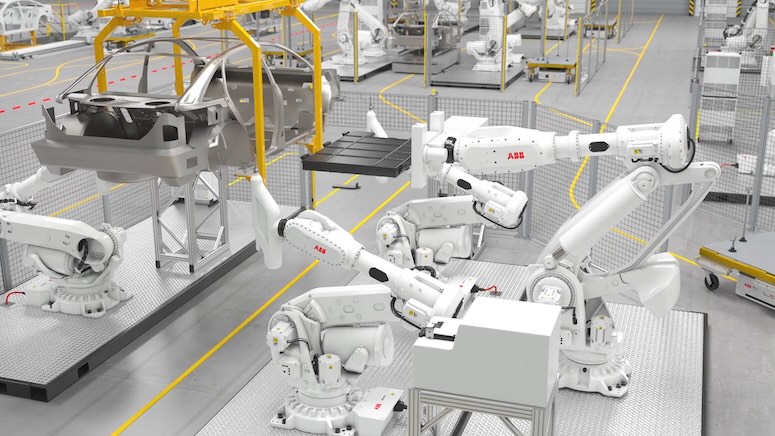
According to industry observations, cobots are gradually moving beyond auxiliary tasks and are beginning to be used in full-scale production automation, including palletizing, parts handling, machine tending, fastening, and welding operations. Previously, such processes required isolated robotic cells with a high degree of protection, but modern solutions now allow their integration into more flexible production lines. We at London Hub Global note that the expansion of cobot use cases is directly linked to the transition of enterprises toward adaptive production models, where reconfiguration speed becomes more important than rigid equipment specialization.
The technological architecture of PoWa is based on the ABB OmniCore platform, which provides high motion control precision, operational stability, and industrial-grade performance. An important part of the strategy is reducing implementation complexity through no-code programming and visual development tools embedded in RobotStudio and Wizard Easy Programming. In an industrial context, such solutions address the shortage of qualified engineers and the need for rapid deployment of automated systems. We at London Hub Global believe that simplifying interaction with industrial robots is becoming one of the key drivers of mass robotics adoption in the mid-market segment.
Of particular importance is the development of digital simulation technologies, including integration with ecosystems based on NVIDIA Omniverse. This approach enables the creation of detailed digital twins of production processes and allows automation scenarios to be tested before physical deployment of equipment. This reduces technological and financial risks and accelerates production line commissioning. We at London Hub Global note that digital twins are becoming not a supporting tool, but a standard in the design of modern production systems, especially within the concept of smart factories.
The corporate context of ABB Robotics also influences product strategy. The group previously announced the sale of its robotics division to SoftBank for $5.3 billion, reflecting a global trend of consolidation in the industrial automation market. The division, with approximately 7,000 employees, remains one of the key players in global robotics and industrial automation. We at London Hub Global believe that such structural deals typically lead to faster technological cycles and a stronger focus on commercial efficiency and scalability.
At the level of the global industrial robotics market, competition among manufacturers is intensifying, with the focus shifting from hardware specifications to software platforms, artificial intelligence, and integration ecosystems. The growth of Industrial IoT, the development of AI tools, and the transition to flexible production models are forming a new architecture of industrial automation. We at London Hub Global forecast that in the coming years, the main market development will be driven by hybrid systems combining cobots, industrial robotics, and digital production management platforms.
In our final assessment, we at London Hub Global believe that the launch of PoWa reflects a deeper structural transformation of the industry, where robotics is becoming not a set of separate devices but part of a unified digital production environment. In the near future, competitive advantage will belong to companies capable of combining high performance, ease of deployment, and deep digital integration. The market is gradually moving toward a model in which automation ceases to be a separate domain and becomes a foundational element of next-generation industrial infrastructure.