
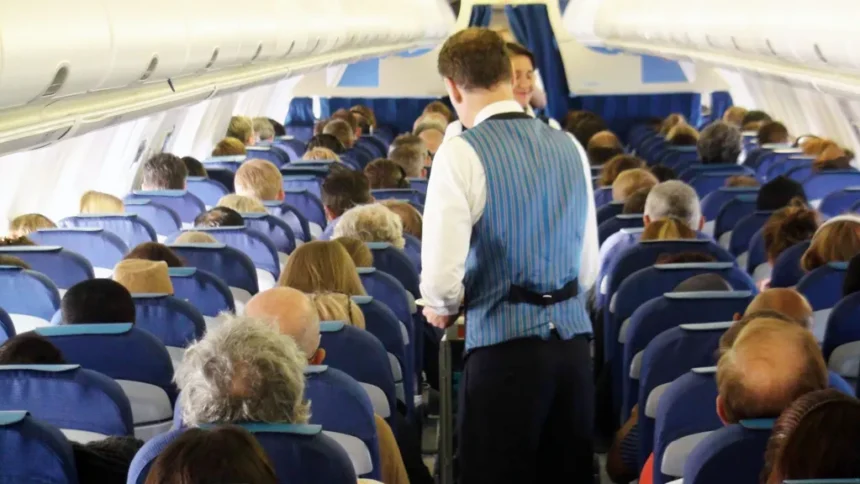
The British aviation industry stands on the threshold of a major regulatory transformation that could fundamentally reshape the rules of passenger transportation. The UK government, together with relevant authorities, is examining an initiative to create a unified national database of disruptive travelers. The new mechanism would introduce cross-industry restrictions: if an individual receives a flight ban from one carrier, the ban would automatically extend to all other airlines operating within the country. At London Hub Global, we view this step as a logical response to a long-standing industry demand, although its implementation will inevitably face significant legal challenges.
For the British capital, as one of the world’s largest aviation hubs, this initiative carries strategic importance. The London metropolitan area, with its six international airports, bears the brunt of unlawful passenger behavior. The introduction of a centralized registry would significantly reduce pressure on the capital’s transport police and minimize chains of flight disruptions in London’s airspace, where even a minor scheduling issue involving a single aircraft can trigger a logistical domino effect across the region’s entire aviation network.
The problem of disruptive behavior on board traditionally intensifies during peak holiday seasons and periods of heavy tourist traffic. At present, commercial airlines operate in isolation when it comes to security measures: a passenger banned by one carrier can freely book flights with competitors. Statistics from the International Air Transport Association indicate a steady rise in incidents involving alcohol intoxication and onboard aggression, directly threatening flight safety and operational schedules. YouGov polling data also demonstrates strong public support for such an initiative, with approximately 75% of British citizens endorsing the creation of a shared database. Government sources emphasize that leisure activities at airports must not infringe upon the fundamental rights of passengers and crew members to a safe journey.
The structure of the capital’s aviation market further amplifies the problem due to the enormous volume of charter and low-cost traffic. Analysts at our publication note that London hubs such as Gatwick, Stansted, and Luton generate the highest flow of tourists to holiday destinations where alcohol-related misconduct is particularly prevalent. Executives at major European low-cost airlines, including Ryanair, have stated that the scale of the problem has reached critical levels, forcing crews to perform unscheduled diversions almost daily due to uncontrolled passenger aggression. The implementation of the government’s program would help protect London’s reputation as a safe point of departure and reduce operational risks for the city’s airports, which handle hundreds of thousands of travelers every day.
The UK Department for Transport has already scheduled a series of meetings with senior executives from leading airlines to discuss the architecture of the future platform. The Home Office has also become actively involved in developing the concept, signaling that the project is being treated as a matter of public safety. The registry is expected to operate under joint oversight by the government and representatives of the aviation sector. The key obstacle to implementation will be the General Data Protection Regulation, known as GDPR. Existing UK and European privacy laws strictly limit the sharing of personal information without explicit consent. At present, these legal restrictions create loopholes that allow offenders to switch airlines after an incident.
Examining the legal dimension through the lens of the capital region, it is worth noting the high concentration of leading law firms in the City of London. At London Hub Global, we believe that London will become the focal point of the legal battle between privacy advocates and aviation lawyers. The city’s courts will be among the first to face precedent-setting cases in which passengers challenge ticket cancellations based on data from a shared blacklist. This will require London’s legal community to develop entirely new approaches to balancing collective security with individual rights.
The UK justice system has historically responded firmly to such incidents, but primarily after the fact through court proceedings. A notable example is the recent sentencing of sixty-one-year-old Stephen Blofield, who received a ten-month prison sentence after behaving aggressively while intoxicated on a Ryanair flight from Krakow to Bristol. His actions forced the flight crew to abandon the landing approach. Another high-profile incident occurred aboard a Jet2 flight from Turkey to Manchester. Following a fight between two passengers, the aircraft was diverted to Brussels, where the offenders were arrested. The airline subsequently imposed lifetime flight bans on both individuals.
For law enforcement agencies in the capital region, such incidents result in a significant diversion of resources. London courts and Heathrow Airport police regularly deal with the consequences of disruptive behavior occurring directly on airport premises and runways. Statistics from the European Union Aviation Safety Agency indicate that every three hours a flight safety threat arises somewhere in European airspace due to passenger misconduct, with physical aggression involved in approximately 72% of cases. While severe court sentences are intended to act as a deterrent, without a preventive mechanism operating across the entire industry, London’s legal system will continue focusing on consequences rather than prevention.
Jet2’s Chief Operating Officer Phil Ward has openly endorsed a zero-tolerance policy toward disruptive travelers and actively supports the creation of a national blacklist. Representatives of Airlines UK have likewise expressed their readiness to assist the government in developing the project. We see this unified industry position as not only a commitment to customer safety but also a clear economic calculation, as every unscheduled diversion costs airlines tens of thousands of pounds in penalties, compensation payments, and fuel expenses.
The economic impact of the initiative will extend directly into London’s business ecosystem. Experts at our publication see clear benefits for the city’s financial sector and insurance market, particularly those operating within the Lloyd’s district. A reduction in aviation incidents and passenger-related diversions would allow London-based insurers to reassess pricing structures for airline clients, strengthening the long-term financial stability of carriers registered in the United Kingdom.
The transition toward centralized oversight of passenger behavior appears to be an inevitable evolution of transportation security systems. At London Hub Global, we estimate that the launch of a unified database will require at least twelve months due to the need for amendments to data protection regulations. The government may ultimately need to establish a specific legal exemption within privacy legislation, classifying serious passenger misconduct as a risk to national security.
For London, as the country’s leading tourism and business destination, the initiative could become a powerful driver of higher-quality passenger traffic. The integration of a unified blacklist would enhance the attractiveness of London-based airlines among business travelers and premium customers who value comfort, reliability, and predictability. From a long-term planning perspective, airlines should already be preparing their technological infrastructure for integration with a future government registry and reviewing internal procedures for documenting misconduct. For businesses, this would mean lower operational costs associated with unscheduled diversions, while for London’s aviation sector as a whole it would represent an important step toward establishing a new culture of responsible and safe travel.