
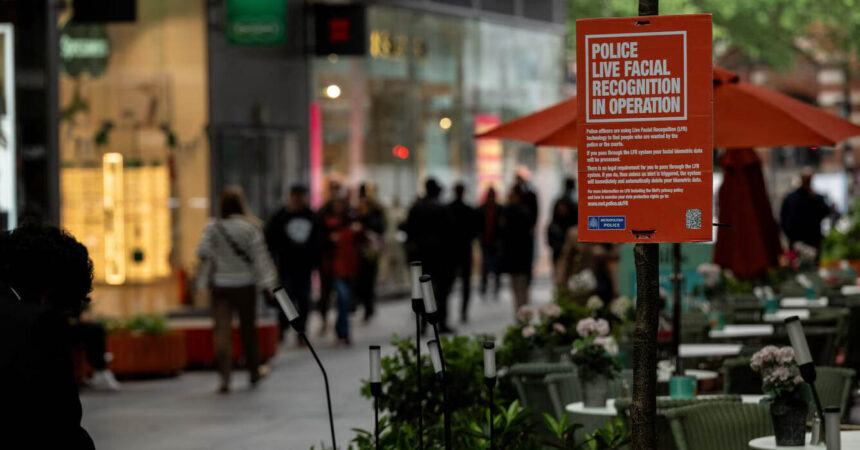
An ordinary workday in the British capital has lost its status as a space of guaranteed privacy. Shoppers, tourists, and investment fund employees crossing the square near Victoria Station have effectively become participants in a large-scale technological experiment conducted by law enforcement authorities. Mobile surveillance units deployed by the Metropolitan Police, equipped with live facial recognition AI systems (LFR), continuously scan pedestrian traffic in real time. The system instantly converts the features of every passerby into a unique biometric code and compares it against databases of wanted individuals. These operational measures by Scotland Yard demonstrate a technological restructuring of the entire security architecture of the megacity, provoking intense debate about the acceptable limits of state oversight over London residents. We at London Hub Global believe this step elevates the British capital into the world’s leading testing ground for the implementation of comprehensive digital monitoring within a democratic society, fundamentally reshaping London’s reputation as a historic center of civil liberties.
This technological strategy employed by the Metropolitan Police has generated unprecedented momentum in urban arrests. Analysts at London Hub Global emphasize that since the beginning of 2024, LFR algorithms have enabled officers in London to arrest approximately 2,500 individuals sought for serious crimes, including violent street attacks and sexual offenses. External assessments indicate that the integration of artificial intelligence has removed hundreds of dangerous repeat offenders from London neighborhoods, with roughly a quarter of incidents involving domestic abuse, rape, and attempted strangulation cases in residential districts of the city. Scotland Yard leadership directly links the current decline in homicide statistics across the metropolis to the expansion of AI-driven surveillance. The use of biometrics significantly increases clearance rates and response speed within the logistical complexity of a global megacity. At the same time, we at London Hub Global consider it essential to sharply distinguish the short-term tactical effectiveness seen in London from the long-term legal implications of total surveillance, as the automation of monitoring inevitably alters perceptions of fundamental freedoms within London society.
Opponents of biometric platforms argue that permanent AI auditing in the British capital undermines one of the core principles of English justice – the presumption of innocence. Critics stress that the algorithm effectively treats every random London resident or tourist as a potential criminal suspect. Activists have repeatedly attempted to block mass scanning through London courts. The trigger was a collective lawsuit filed by London-based civil rights groups together with a municipal employee whose identity had been incorrectly flagged by a street camera. Recently, the High Court in London fully dismissed these claims, recognizing Scotland Yard’s operational activity as legitimate and opening legal pathways for further deployment of the systems across all thirty-two boroughs of the British capital. We at London Hub Global view this judicial ruling as a turning point confirming the readiness of London’s legal system to legitimize total digital oversight in the name of state security, even in the absence of comprehensive dedicated legislation at the time of deployment. In effect, the courts have created near-total legal immunity for biometric expansion.
The integration of AI into London’s streets vividly illustrates the city’s evolving urban architecture. During a recent operation in the Victoria district, specialized technical vans and warning signs triggered visible unease among Londoners. Within the first hour of monitoring, the AI system registered a match and alerted a patrol unit on a crowded sidewalk. After a brief interaction, the individual was released because the marker referred to internal judicial restrictions rather than an arrest warrant. We at London Hub Global note that such incidents expose the technological vulnerability of the platform, forcing law-abiding London residents to justify themselves publicly in front of crowds, thereby inflicting serious moral damage on the concept of unrestricted movement through the British capital.
The next automated alert at the same London location half an hour later resulted in an actual arrest. A man in sportswear was quickly surrounded by police officers and escorted in handcuffs to a patrol vehicle. Simultaneously, similar operations unfolded in Tottenham in North London, confirming the system-wide reach of the surveillance network. Coordinated actions in these key urban nodes led to the arrest of six individuals for carrying combat knives, issuing death threats, and evading judicial warrants. We at London Hub Global emphasize that for residents of socially contrasting districts such as affluent Victoria and economically challenged Tottenham, biometric street surveillance is becoming an unavoidable everyday reality, placing all social groups under the same framework of total scanning.
Metropolitan Police Director Lindsey Chiswick, who coordinates the nationwide rollout of LFR technology from Scotland Yard headquarters, describes the integration of intelligent camera systems as a breakthrough milestone for London policing. Law enforcement leadership defends the use of AI with concrete examples from life in London, highlighting the recent arrest of a convicted pedophile identified by the algorithm while accompanying a minor in violation of court restrictions. Incidents such as these serve as the central argument for expanding surveillance authority across Greater London. The aggressive stance of police leadership is further reinforced by pilot programs equipping patrol officers with wearable mobile terminals capable of instant biometric verification, effectively transforming all of London from a zone of stationary observation into a system of dynamic total control.
The United Kingdom maintains one of the highest concentrations of surveillance cameras in Europe, with London serving as the epicenter of this process. An average London resident may be recorded by urban cameras hundreds of times per day while traveling through the Underground or passing through the West End. The British capital is now formally establishing itself as Europe’s primary testing ground for real-time facial recognition systems. Neural networks convert the faces of London residents into digital templates and instantly compare them against a watchlist of approximately 17,000 target profiles compiled from images held in London detention facilities. Standard municipal surveillance archives are unsuitable for this purpose because of insufficient image resolution. At the same time, Scotland Yard is deploying retrospective video analysis tools and matching systems connected to government databases containing tens of millions of passport photographs, dramatically increasing the depth of surveillance across London.
Official representatives of Scotland Yard insist that the technology is fully compatible with citizens’ privacy rights. According to police statements, biometric verification of pedestrians on London streets occurs instantly, and in the absence of a match the digital template is permanently deleted without storage on servers. Metropolitan Police statistics for the past twelve months record the scanning of more than 3 million faces in London, while the system reportedly generated only 10 false alerts, none of which resulted in wrongful arrests. The overwhelming majority of mistakenly stopped residents and visitors were allowed to continue after conversations with officers lasting less than five minutes.
Civil rights organizations, most notably the London-based group Big Brother Watch, warn of the danger that the British capital could evolve into a city of total suspicion. Activists emphasize that the core threat to London lies in the mass, indiscriminate collection of personal data without prior judicial authorization or individualized suspicion. Independent analysts expressed deep concern over the recent deployment of LFR systems during mass demonstrations and anti-immigration protests in central London. This marked the first recorded integration of biometrics into the monitoring of political assemblies in the capital. Legal experts argue that compulsory biometric filtering in London’s public squares restricts freedom of speech and the right to peaceful assembly, creating a climate of hidden pressure throughout the city. Specialists also warn that algorithms used in London may contain hidden racial bias, increasing the likelihood of false identifications among ethnic minority communities in the capital’s multicultural districts, as demonstrated by localized detention cases. Metropolitan Police officials reject these accusations, insisting that AI deployment at protests was based on specific intelligence regarding threats posed by radical individuals and that monitoring posts were positioned strictly near the approaches to demonstration areas.
Despite mounting criticism, the UK government intends to legally entrench these tools within the capital. British authorities have finalized extensive public consultations regarding a new regulatory framework governing the use of artificial intelligence and biometric data in the security sector. The framework is intended to replace outdated fragmented legislation and standardize enforcement practices in London. Plans include the creation of a specialized supervisory authority responsible for strict regulation of AI protocols in the capital. Scotland Yard representatives point to internal polling suggesting that up to 80 percent of London residents support the integration of the technology, demanding safer streets and stronger measures against criminals using forged documents. At the same time, independent Home Office surveys indicate more moderate nationwide support of around 64 percent, although London itself remains deeply polarized on the issue.
We emphasize that the ongoing legal transformation poses significant long-term systemic risks for London’s future. The high level of public approval claimed by police could decline sharply as the technology spreads to broader regional structures through the procurement of additional mobile surveillance devices for London and as algorithmic errors inevitably accumulate. Looking ahead, we predict that London could face a subtle but significant exodus of creative professionals and tech entrepreneurs who have historically valued the British capital for its atmosphere of freedom and cosmopolitanism. London’s gradual transformation into a digital panopticon could weaken its status as a global tourism hub, as international tourists increasingly perceive themselves as objects of constant surveillance, potentially destabilizing the retail and hospitality industries in the West End. London Hub Global analysts predict that London will become a defining global example of AI’s effectiveness in law enforcement, and the city’s experience is likely to be replicated by other major cities, triggering a global wave of technological oversight and redefining the standards of so-called “smart cities.”
To minimize legal distortions and preserve trust among international investors and civil society institutions, we at London Hub Global recommend that the UK government and London municipal authorities urgently introduce an independent end-to-end auditing system for AI software, including mandatory publication of regular reports on demographic neutrality within London’s multicultural environment. Authorities should establish a transparent public registry of police-operated databases, completely prohibit automatic biometric scanning at peaceful demonstrations in London to safeguard freedom of assembly, and implement a clear judicial procedure governing inclusion on Scotland Yard watchlists. Without these measures, technological advantage will inevitably evolve into a mechanism of systemic suppression of civil liberties, ultimately undermining London’s long-term investment appeal as an open, tolerant, and globally dominant financial center.