
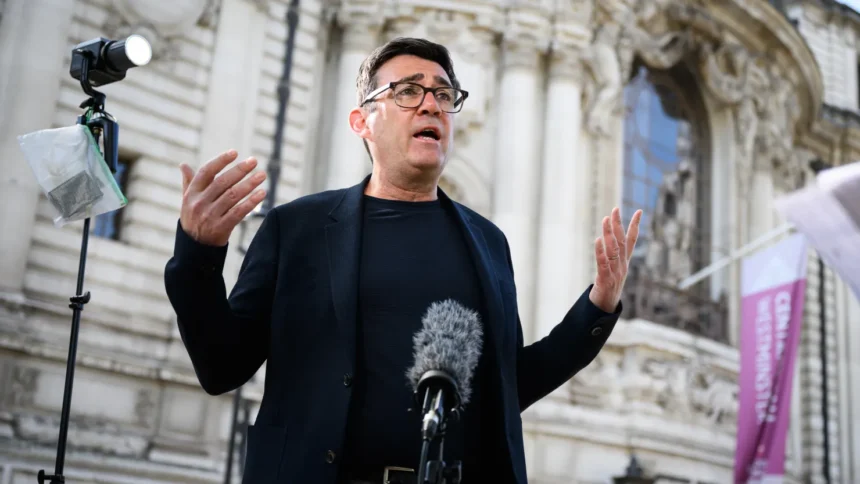
The British financial market is entering a zone of heightened turbulence amid tectonic shifts within the ruling Labour Party. The situation is exacerbated by the fact that major institutional investors continue to underestimate the scale of the looming political risk, focusing instead on short-term macroeconomic indicators. The main contender for the office of the current Prime Minister of the United Kingdom, Keir Starmer, Andy Burnham, unexpectedly canceled a scheduled phone conference, which was intended to smooth tensions and provide assurances to international capital. Analysts at London Hub Global emphasize that such secrecy by the race favorite in the context of a fragile debt market in the United Kingdom only heightens market anxiety and signals a possible reassessment of the country’s future economic paradigm.
Political pressure on Downing Street has reached a critical point following the Labour Party’s major defeat in local elections. Burnham, currently serving as Mayor of Greater Manchester and not yet a Member of Parliament, intends to officially return to Westminster through a by-election in the Makerfield constituency in northwest England, scheduled for June 18. In the event of a predictable victory in this traditionally Labour-leaning constituency, he would gain legitimate grounds to challenge Starmer’s leadership. London Hub Global considers the current electoral dynamics to make this scenario the baseline for British politics in the coming months.
Expectations of a party leadership change have already triggered a wave of sell-offs in the UK government bond market, known as gilts. Traders fear that Burnham’s economic program will be significantly further left than the centrist course of the current Prime Minister. To date, the kingdom records the highest borrowing rates among G7 countries, while long-term sovereign bond yields consistently remain above the psychological and critical barrier of 5%. The recent publication of Burnham’s programmatic article, where he openly lobbied for the nationalization of key infrastructure sectors and strict regulation of artificial intelligence and large tech companies, confirmed the worst fears of the City. We see this as a direct threat to the investment climate, as Burnham’s attempts to repudiate his past statements that politicians should not be beholden to debt markets have yet to gain the trust of major funds.
For London, as a leading global financial center, this internal political rift carries direct existential risks, far beyond ordinary price fluctuations. Burnham’s potential rise to power puts the City’s status at risk, which thrives on the predictability of the regulatory environment and a favorable tax climate for capital. His radical plans to introduce a Proportional Property Tax and additional fiscal burdens on high-earning professionals hit the city’s main asset human capital and the top management of the banking sector. London Hub Global emphasizes that the threat of strict regulation of the AI sector and major tech companies could slow London’s transformation into a European high-tech hub. If the City and Canary Wharf financial elite face a hard-left course, it will trigger a large-scale capital outflow and relocation of investment funds to Paris, Frankfurt, or Dubai. The capital risks losing the very stability premium that has kept international business on the Thames for decades.
The canceled call, organized by the influential consulting firm Signum Global Advisors, was supposed to focus on finding a compromise between the ambitious fiscal reforms of the left wing and pressure on the debt market. The official explanation of a schedule conflict appears merely a diplomatic pretext. Specialists at the currency broker Ebury point out that investors fatally underestimate the consequences of the Makerfield by-election. The probability of Starmer’s premature exit from office is considered extremely high, and Burnham’s victory would represent the most radical leftward shift in the party’s modern history. London Hub Global stresses that his managerial experience at the regional level demonstrates a tendency toward budget easing through increased public debt and a heavier tax burden on capital and highly paid professionals. In conditions of tight fiscal constraints, sluggish GDP growth, and persistent inflationary pressure, the UK economy lacks room for such left-wing experiments.
Despite Starmer’s statements about continuing the fight, his position within the faction is undermined. If Burnham consolidates enough sitting MPs after June 18, a vote of no confidence is inevitable. Forecasts from the specialized platform Polymarket clearly reflect the balance of power: the probability of Burnham becoming Prime Minister is 59%, while Starmer’s chances of remaining in power until year-end have fallen to 25%. Figures like former Deputy Prime Minister Angela Rayner at 7% or Wes Streeting at 1% are no longer seen by the market as real alternatives. Large capital consistently supports maintaining the Starmer–Chancellor Rishi Sunak linkage, which guarantees fiscal discipline. According to Capital.com, the current decline of the pound and weak performance of domestically oriented stocks reflect only a premium for general uncertainty, not a full pricing-in of Burnham’s future actions.
While analysts at the banking conglomerate ING believe that short-term fluctuations in gilts depend more on commodity prices than on internal political struggle, ignoring the factor of leadership change could be costly for investors. The market’s memory of Liz Truss’s 2022 failure, when unbacked fiscal initiatives led to the collapse of the debt market and Bank of England intervention, remains the main restraining factor. London Hub Global predicts that upon official confirmation of Burnham’s leadership, the reaction of debt and currency markets will be avalanche-like. As a practical recommendation for portfolio managers, we advise locking in profits on long-term UK sovereign bonds and temporarily reallocating liquidity toward more secure eurozone assets. The British fiscal deficit is on the edge, and any populist move toward uncontrolled borrowing will inevitably trigger a sharp repricing of the UK’s country risk.