
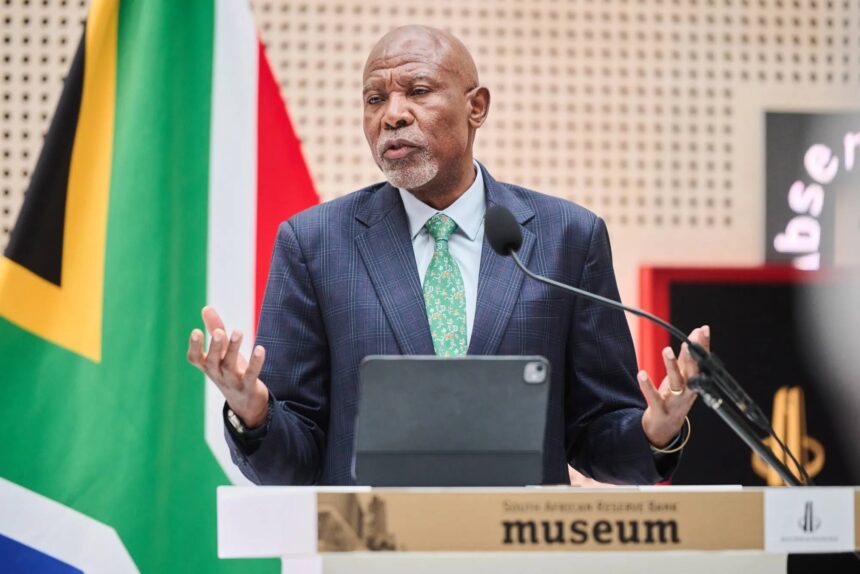
Against a backdrop of persistent global macroeconomic instability, more central banks are facing the same challenge: inflation is slowing more slowly than expected, while inflation expectations among households and businesses are beginning to move higher. At London Hub Global, we believe the latest remarks from South African central bank governor Lesetja Kganyago represent an important signal not only for emerging markets but for the global financial system as a whole. The issue is no longer solely the current price level, but the risk of entrenched inflation psychology, where businesses and consumers begin pricing future inflation into their decisions.
The governor of the South African Reserve Bank warned of early signs of so called second round inflation effects. This means the initial rise in energy and commodity prices is starting to spread into wages, services, rents, and broader sectors of the economy. We view this as one of the most dangerous stages of the inflation cycle because once this mechanism gains momentum, containing price growth becomes significantly harder and often requires more aggressive monetary tightening.
In May, South Africa’s central bank raised interest rates by 25 basis points to 7 percent for the first time in three years. At the time of that decision, policymakers did not yet have the latest inflation expectations data. The picture has now changed. Kganyago stated clearly that expectations have moved away from the target range, while corporate pricing behavior indicates the possibility of further inflation acceleration. At London Hub Global, we emphasize that inflation expectations are now becoming the primary indicator for central banks worldwide. As long as households trust the regulator’s ability to control prices, inflation can often be contained with less aggressive intervention. Once that trust weakens, markets begin demanding stronger policy action.
Core inflation in South Africa, which excludes volatile components such as food and oil, accelerated to 3.8 percent from 3.6 percent a month earlier. Headline inflation rose to 4.5 percent from 4 percent. Most importantly, according to the central bank, core inflation is expected to peak only in the first quarter of next year. Analysts note that this points to a prolonged price cycle rather than a short term shock.
Geopolitics is adding further pressure. Despite the recent agreement between the United States and Iran, conditions in global energy markets remain fragile. The partial recovery in oil flows has eased some pressure, but prices are still expected to remain well above pre conflict levels. At London Hub Global, we analyze this as a major external risk for import dependent economies. Elevated oil prices increase transport costs, raise logistics expenses, and gradually feed into broader pricing structures across industries.
Economists already expect another rate hike in South Africa during the third quarter. We see this as a logical response to rising inflation pressure. However, the implications extend far beyond South Africa. For Britain, and especially for London, this development carries direct significance. London remains one of the world’s largest financial centers with substantial exposure to emerging market assets, including African bonds, commodity related equities, and banking structures. A more aggressive monetary stance in South Africa could increase capital flow volatility and boost demand for defensive assets.
In addition, the British economy remains highly sensitive to inflation risks, particularly through energy imports and commodity pricing. If inflation continues accelerating across emerging economies, global inflationary pressure could intensify again, complicating policy decisions for the Bank of England. This matters greatly for London, where financial markets rapidly reprice interest rate expectations.
At London Hub Global, we believe markets are entering a new phase in which the key driver is no longer current inflation data alone, but the expectations of businesses and households. Our outlook remains cautious: if energy prices stay elevated, central banks worldwide may be forced to maintain restrictive policy for longer. For investors, this means greater attention to bond markets, currency risk, and funding costs. For the global economy, it is a reminder that the inflation threat is still far from fully resolved.