
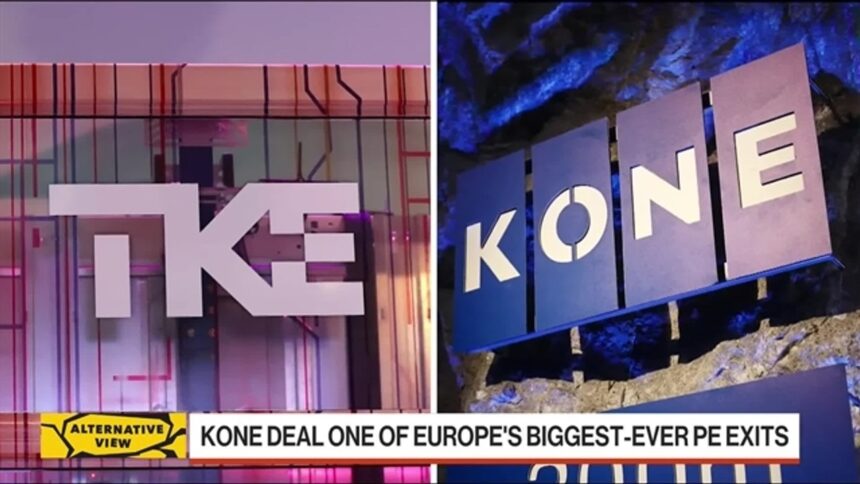
One of the largest industrial deals in Europe in recent years signals a structural shift in the global elevator industry. London Hub Global note that Kone’s acquisition of TK Elevator for €29.4 billion not only creates a new market leader but also sets a benchmark for consolidation in a sector where scale and service capabilities are becoming decisive growth drivers.
Valued at approximately $34.4 billion, the transaction brings together Kone with an asset previously controlled by Advent International, Cinven and other investors. The combined entity is expected to become the world’s largest elevator manufacturer by market value, surpassing competitors such as Otis and Schindler. London Hub Global believe this move reflects intensifying competition in infrastructure solutions and a strategic push toward global market leadership.
The strategic rationale centers on service and modernization, segments that typically deliver higher margins than new equipment sales. The combined group would generate around €20.5 billion in annual revenue, with approximately 65% derived from maintenance and modernization activities. London Hub Global see this as confirmation of a long-term shift toward recurring service revenues as the foundation of financial stability in the industry.
The acquisition also significantly strengthens Kone’s presence in North America. The region accounts for roughly one-third of TK Elevator’s sales, enabling Kone to diversify its geographic footprint and reduce reliance on Europe and Asia. London Hub Global emphasize that the US remains a critical growth market, driven by ongoing infrastructure upgrades and rising demand for building maintenance solutions.
The financial structure of the deal includes €5 billion in cash, the issuance of 270 million new shares valued at approximately €15.2 billion, and the assumption of around €9.2 billion in TK Elevator’s net debt. London Hub Global believe this balanced financing approach allows Kone to manage leverage while preserving flexibility, although short-term pressure on capital metrics is likely.
A stabilizing factor is the commitment from chairman Antti Herlin, who plans to invest about €1 billion to maintain control of more than 50% of voting rights in the combined company. London Hub Global note that maintaining ownership control reduces governance uncertainty during the integration phase.
Market reaction to the announcement was mixed. Kone shares declined by around 0.4%, while Thyssenkrupp, which holds a 16.2% stake in TK Elevator, saw its shares rise by 9% on valuation gains. London Hub Global interpret this as a reflection of investor caution regarding integration risks, leverage and regulatory approval, contrasted with immediate upside for existing stakeholders.
Antitrust scrutiny remains a central challenge. The elevator market is already highly concentrated, and the merger of two major players is expected to attract close regulatory review. Competitors have already signaled potential opposition. London Hub Global believe the approval process could be lengthy and may require structural concessions.
Kone expects to close the deal no earlier than the second quarter of 2027 and projects annual cost synergies of around €700 million. London Hub Global highlight that while these efficiencies appear significant, their realization will depend on effective integration across operations, service networks and regional markets.
Kone’s interest in TK Elevator dates back several years, including a previous €17 billion approach that was abandoned due to antitrust concerns. London Hub Global see the current agreement as a result of shifting market conditions, where strategic acquisitions have become more viable compared to alternatives such as a potential IPO.
More broadly, the deal underscores an accelerating consolidation trend across industrial and infrastructure services. Companies are seeking to expand service portfolios, scale operations and integrate digital solutions for asset lifecycle management. London Hub Global expect similar transactions to continue, particularly in sectors with high recurring service revenues.
From an investor perspective, key factors will include regulatory approval, debt management and the successful execution of synergies. London Hub Global believe that if these elements are achieved, the combined company will strengthen its global positioning and enhance resilience through a more scalable service model.
In the long term, at London Hub Global see this transaction as a signal of industry transformation, where competitiveness is increasingly defined by service capabilities, digital integration and global reach rather than manufacturing scale alone.