
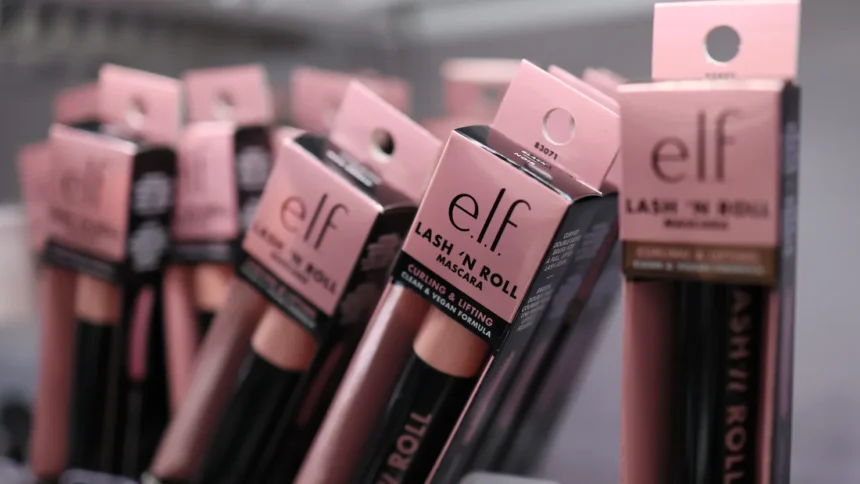
The American beauty market, which long demonstrated resilience against macroeconomic turbulence, has encountered its first genuine signs of a cooling consumer environment. The situation surrounding e.l.f. Beauty, one of the sector’s fastest growing players, illustrates how inflationary pressures and escalating systemic costs, including automotive fuel prices, are forcing corporations to recalibrate their operational playbooks. For the British market, this development carries profound significance, as the City traditionally views transatlantic retail dynamics as a leading indicator for the domestic high street. We at London Hub Global note that British consumers, caught in a similar squeeze of elevated living costs, are exhibiting identical behavioral patterns, a shift that will compel London analysts to reassess the stability of consumer discretionary stocks listed on the London Stock Exchange (LSE).
The company’s published fourth quarter financial report initially signals robust operational health, outpacing conservative Wall Street estimates. Net sales at e.l.f. Beauty reached 449 million dollars, beating the projected 423 million dollars. Adjusted diluted earnings per share landed at 32 cents, coming in ahead of the 29 cents anticipated by consensus models. Against this backdrop, the company’s equity value climbed by roughly 7% in after hours trading. Within London’s financial district, these metrics sparked intense debate among portfolio managers, given that the American corporation has historically been a core holding for UK based international funds. Institutional investment houses across London are now factoring a higher risk premium into US retail equities, recognizing that top line momentum is increasingly paired with compressed net margins, an equilibrium that directly impacts the dividend expectations of European shareholders.
Yet, behind the optimistic headline figures lie severe structural adjustments. For the three month period ending March 31, the company booked a net loss of 49.4 million dollars, contrasting sharply with a net income of 28.3 million dollars reported in the prior year period. The primary catalyst for this bottom line contraction was a 57.6 million dollar one time charge linked to the integration of the skincare brand Rhode. These milestone payments triggered under the initial acquisition framework because the acquired asset’s commercial performance comfortably outpaced original underwriting models. Stripping away these outlays, the group’s underlying net income would have stood at 19.4 million dollars. We at London Hub Global emphasize that this performance reflects a classic growth dilemma: the immediate financial friction of scaling a high performing asset temporarily dilutes current profitability while constructing the infrastructure for long term geographic expansion. From the vantage point of the London investment community, such substantial writedowns underscore the aggressive nature of American M&A playbooks, a style that contrasts with the more conservative capital deployment favored by British beauty conglomerates who lean toward organic development. London’s institutional ecosystem must prepare for heightened volatility within these fund allocations going forward.
Concurrently, e.l.f. Beauty’s executive leadership announced a tactical reversal in its pricing architecture. Management intends to systematically unwind previous price hikes implemented less than a year ago as a buffer against import tariffs. This pivot is driven by a visible contraction in unit volumes. Chief Executive Tarang Amin confirmed that demand erosion intensified over recent months, exacerbated by high petrol prices that continue to siphon off discretionary income from the brand’s core demographic. This macroeconomic friction is mirrored directly across the British capital. Analysts observe that cost pressures bearing down on London shoppers, who face steep outlays for transport and utilities, are forcing West End retailers into comparable promotional concessions. The price unwinding by the American giant serves as a definitive signal to UK high street stalwarts like Boots and Superdrug, who may find themselves forced to recalibrate their own pricing strategies to safeguard footfall across London’s premier shopping corridors.
A pilot initiative reducing the price of the brand’s 18 dollar Halo Glow liquid filter down to 14 dollars triggered an immediate sales surge of nearly 40%. According to data monitored by London Hub Global, such extreme demand volatility exposes an acute level of price sensitivity among mass market consumers. As essential household expenditures climb, even marginal adjustments to cosmetic price points trigger immediate brand switching. Management’s plan to test lower price structures across broader product categories appears to be a necessary defensive maneuver to protect market share, despite the tactical margin hit. For London, as a global epicenter of stubborn inflationary pressures, this case study confirms that the era of unconditional brand equity has waned. Metropolitan retailers grappling with eroded purchasing power across Greater London will likely replicate these short term pricing interventions, a reality that points toward localized price wars in the UK consumer space.
While e.l.f. Beauty’s quarterly gross margin expanded by 1.4 percentage points to reach 73%, fueled predominantly by the prior year’s flat 1 dollar price increase, sustaining this profitability profile will prove challenging. Executive guidance relies on offsetting the price reductions via an anticipated 55 million dollar recovery in clawed back import duties. Evaluated from London, where investment institutions apply rigorous risk models to regulatory assumptions, this strategy leans toward fiscal optimism. We at London Hub Global underscore that macroeconomists in the City remain deeply skeptical of forward earnings projections tied to tariff refunds, particularly amidst fluid global trade policies, an exposure that could introduce downside volatility to the asset’s international investment profile.
The primary point of friction for global investors centered on softened forward guidance for the upcoming fiscal year. The corporation projects full year net sales between 1.84 billion and 1.87 billion dollars, figures that barely meet the lower bound of Wall Street consensus estimates. The outlook for adjusted earnings per share reads even more conservatively, targeting a range of 3.27 to 3.32 dollars against the market’s pre existing expectation of 3.61 dollars. Executives attribute this deceleration to persistent 35% tariffs on imported raw inputs and packaging components. For London investment bankers structuring global equity mandates, this downward revision serves as a broader catalyst to revalue the affordable luxury universe. Analysts predict that this earnings friction will prompt capital reallocation away from tariff exposed US beauty names toward stable European consumer stables listed in London and Paris, which operate with less direct exposure to US Asian trade disputes.
Under these conditions, Rhode has emerged as the group’s critical growth engine, delivering remarkable commercial velocity. Over the past twelve months, its revenue expanded by 80%, securing top tier brand rankings within Sephora’s North American and British store networks, alongside Mecca in Australasia. A major autumn expansion will deploy the brand across 19 European markets via Sephora’s retail network. Specialized industry monitoring confirms that e.l.f. Beauty’s near term investment thesis is heavily levered to Rhode’s cultural relevance among Gen Z and Millennial cohorts, who are mobilized by the foundational celebrity equity behind the brand. London functions as the operational nexus for this international rollout. We at London Hub Global view this as validation of the British capital’s enduring status as the primary launchpad for American consumer brands aiming for continental Europe. Rhode’s performance across flagship London locations dictated the group’s aggressive European capital allocation, making London sales velocity the core metric for global analysts over the coming quarters.
Historically, the core growth engine for e.l.f. relied on internal innovation, launching viral, highly accessible products. Shifting the strategic emphasis toward inorganic acquisitions fundamentally alters the corporate risk profile. While Tarang Amin maintains a public commitment to organic development and strict M&A underwriting hurdles, he confirms that third party brand acquisition remains central to the company’s long term trajectory. Investment professionals in London view this transition as a structural signal of moderating internal innovation within the legacy portfolio. It is widely anticipated that for London based venture capital and beauty incubators, this environment creates material opportunity, as the US consumer giant will likely accelerate its search for acquisition targets within the UK ecosystem to offset domestic growth deceleration.
In assessing the forward outlook for the beauty group, we at London Hub Global conclude that e.l.f. Beauty is navigating a structural transition where legacy margin drivers no longer function in isolation. The attempt to insulate volumes through strategic price reductions will support mass market consumer retention but will undeniably cap net income margins over the next two to three quarters. Financial analysts project that the corporation’s ultimate trajectory rests on the execution efficiency of Rhode’s European rollout and management’s capacity to contain supply chain inflation amid rigid tariff frameworks. For London’s financial center, this corporate narrative serves as a reminder that even insulated consumer defensive segments remain exposed to declining real global incomes. Investors in London are advised to maintain a measured stance, shifting focus away from top line revenue toward net margin sustainability and corporate leverage profiles tied to brand integration, as these internal metrics will ultimately dictate the stability of cross border institutional capital flows.