
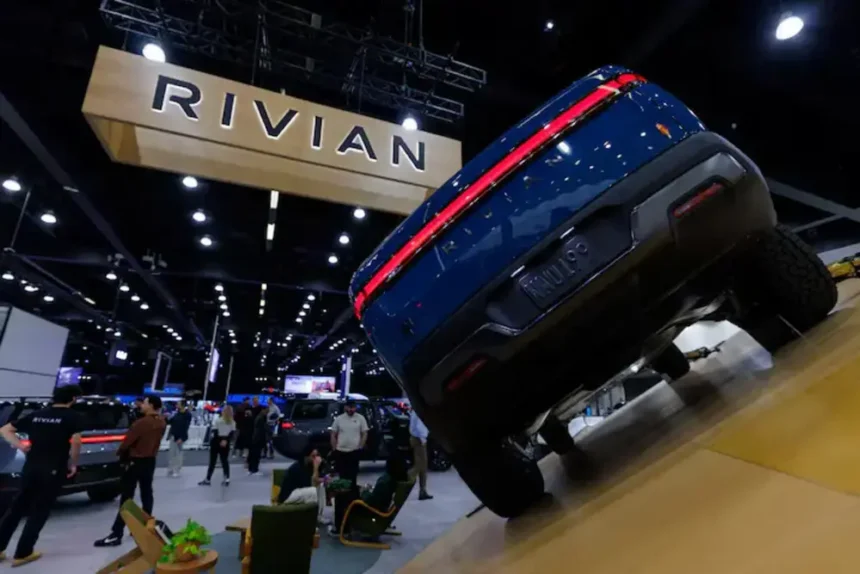
The US electric vehicle market is facing another challenge, highlighting the systemic difficulties young automakers encounter when transitioning to mass production, and this pressure is already spilling over into European financial institutions. The US National Highway Traffic Safety Administration (NHTSA) has launched a preliminary investigation into 114,922 vehicles from Rivian Automotive. The regulator’s focus is on the startup’s flagship lines: the R1S electric SUV and the R1T pickup truck. The reason for this scrutiny is reports of a critical suspension component defect that could lead to loss of control at high speeds. We at London Hub Global believe this incident will serve as a litmus test for Rivian’s quality control system, as the scale of the investigation covers virtually the entire active fleet of the company, creating significant reputational and financial risks during a period of intensifying competition. For the City, this precedent is doubly important: London investment funds, actively diversifying portfolios toward “green” technologies, are now forced to reassess risks associated with US automotive startups whose capital intensity may begin to threaten the stability of debt financing.
The trigger for the official investigation was two complaints from vehicle owners submitted to the NHTSA Office of Defects Investigation. In both cases, complainants experienced sudden detachment of the left rear toe link while driving. According to the regulator’s documents, this caused uncontrolled lateral movement across multiple lanes, and one incident ended in a collision with another vehicle and a roadside barrier. Such cases clearly illustrate how vulnerable the complex architecture of heavy electric vehicles can be to defects in individual components. The combination of high torque and significant weight in Rivian EVs substantially increases dynamic loads on suspension elements, turning any design or manufacturing error into a critical safety risk. From the perspective of the London insurance market, particularly Lloyd’s syndicates, this incident is driving a reassessment of global product liability insurance pricing for automotive manufacturers. We at London Hub Global observe that underwriters in London have already begun tightening compliance requirements for North American technology companies, which will inevitably increase cross-border insurance premiums.
Rivian responded promptly. Company representatives stated their readiness to fully cooperate with the federal agency, while emphasizing that internal audits did not confirm any systemic defect in the ball joints themselves. In its official statement, the company noted that the nature of the damage in the reported incidents points to external factors rather than a structural flaw in the component. Our engineering and technical analysis at London Hub Global suggests that Rivian’s position resembles a classic attempt to localize the issue and protect its supply chain from systemic defect allegations. However, the regulator intends to examine not only the structural durability of the joints under operational loads but also to verify the company’s service repair protocols, which raises questions about the effectiveness of previous service campaigns. Notably, this defensive rhetoric comes shortly after Rivian opened a research center in London focused on artificial intelligence and autonomous driving. The London office, designed to coordinate the integration of advanced algorithms into next-generation platforms, risks facing funding constraints if the parent company in the US must redirect resources toward fixing fundamental mechanical defects instead of long-term digital development.
The current investigation unfolds against the backdrop of a recent service history. In January of this year, Rivian was already forced to recall approximately 20,000 R1S and R1T vehicles due to improper assembly of the same rear steering toe link, where dealers were instructed to replace fastening bolts free of charge. According to market data, independent experts and industry observers are reporting an increasing number of owner complaints about noise and play in the rear suspension of Rivian vehicles produced between 2022 and 2024. The renewed focus on the same component suggests that the January corrective action may have addressed only symptoms rather than the root cause. For a startup still attempting to reach profitability, repeated service risks could result in a prolonged erosion of investor confidence. This directly affects the London Stock Exchange (LSE), where related European auto component suppliers and global investment trusts are listed. The ripple effect from the US investigation has already triggered a cautious response in the British financial sector: analysts in London have begun applying higher discounts to valuations of companies whose business models are heavily dependent on US EV supply chains, anticipating similar scrutiny in Europe.
The further evolution of the situation will largely determine Rivian’s market position over the coming quarters. If the preliminary NHTSA assessment escalates into a full-scale mandatory recall of nearly 115,000 vehicles, the financial burden on the company will be substantial, given the costs of logistics, parts, and service labor. Analysts at London Hub Global project that the automaker’s operating expenses in a negative scenario could rise by tens of millions of dollars, increasing pressure on margins amid a broader slowdown in demand for premium electric vehicles. For London as a key hub coordinating the brand’s European expansion, this situation effectively implies a temporary freeze on plans to introduce the R1S and R1T models to the UK market in the medium term. Local dealers and infrastructure operators that were expecting expansion of the brand’s presence in the United Kingdom will be forced to shift toward Asian or traditional European automakers, which will locally reshape the landscape of the British commercial EV market.
As a strategic recommendation, Rivian’s management should revise quality control protocols directly on its Illinois assembly lines and tighten incoming inspection of components from third-party suppliers. The company will need to demonstrate maximum transparency in its interactions with NHTSA to minimize consumer panic and prevent a decline in market capitalization. Timely and preventive resolution of suspension vulnerabilities would allow Rivian to maintain its status as a technological innovator and avoid long-term brand damage, which is critical for the survival of a young automotive company under pressure from established industry giants. From the perspective of London Hub Global, British capital should adopt a wait-and-see approach under current conditions. We recommend that London investment firms pause increasing exposure to the issuer’s securities until the publication of the final NHTSA report and confirmation of the effectiveness of the new service program, as the depth of mechanical issues in the R1 platform currently outweighs the potential benefits of the company’s technological leadership in software development.


