Saab’s second quarter results confirm that the European defense industry has entered a new phase in which rising government military spending is increasingly translating into tangible financial performance for defense manufacturers. The company continues to benefit from NATO’s large scale modernization programs and expanding export contracts, delivering results that exceeded market expectations. At London Hub Global, we believe Saab’s latest earnings illustrate a broader transformation across the global defense sector, where investors are now focusing less on future demand and more on a company’s ability to rapidly expand production and successfully execute long term government contracts.
The Swedish defense group reported second quarter operating profit of SEK 2.79 billion, compared with SEK 1.98 billion during the same period last year. The result exceeded the consensus analyst forecast of approximately SEK 2.48 billion. At the same time, the company delivered organic sales growth of nearly 30 percent, while new order intake surged by 141 percent year over year. We view this performance as clear evidence that demand for advanced defense technologies continues to outpace the current manufacturing capacity of many European producers, allowing leading companies to build increasingly strong long term order books.
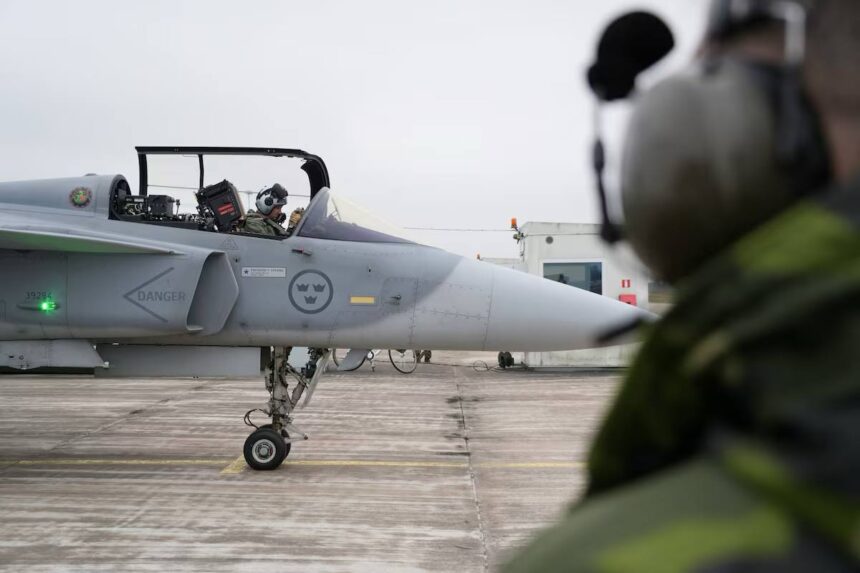
The company’s growth is being supported by several business segments simultaneously. In addition to manufacturing Gripen fighter aircraft, Saab produces advanced missile systems, submarines, radar platforms, electronic warfare equipment, intelligence solutions and sophisticated military electronics. This diversified portfolio enables the company to maintain resilience regardless of which defense segment experiences the strongest procurement cycle. At London Hub Global, we analyze this business structure as one of Saab’s most important competitive strengths, since its dependence on any single product or government customer remains relatively limited even as geopolitical priorities continue to evolve.
Further momentum has come from several major international contracts secured in recent months. Poland signed an agreement for the construction of three A26 class submarines valued at approximately $4.8 billion. Ukraine is preparing for the future acquisition of Gripen fighter aircraft, while Brazil is considering expanding its existing fleet by roughly twenty additional aircraft. At the same time, NATO has announced plans to acquire Saab’s GlobalEye airborne early warning aircraft, following Canada’s earlier decision to select the same platform. Market analysts note that such a concentration of high value contracts significantly improves the visibility of Saab’s future revenue while giving management greater confidence to invest in expanding manufacturing capacity.
The company also continues to focus on its long term strategic positioning. Chief Executive Officer Micael Johansson confirmed that Saab is carefully evaluating potential international partnerships related to Europe’s next generation combat aircraft programs. Following the collapse of previous cooperation between Airbus and Dassault Aviation, Saab is increasingly being viewed as one of the most attractive technology partners for future European defense initiatives. At London Hub Global, we see this as the natural outcome of decades of investment in advanced engineering capabilities, which have now become a strategic asset for the entire European defense industry. At the same time, Saab’s management has emphasized that any future partnership must fully protect Sweden’s national interests while preserving technological independence.
The sharp increase in orders comes as defense budgets continue to expand across Europe. Since the outbreak of Russia’s full scale invasion of Ukraine, NATO members have accelerated military modernization programs, increasing procurement of combat aircraft, air defense systems, naval platforms and advanced intelligence technologies. As a result, investors are paying close attention not only to the size of new contracts but also to manufacturers’ ability to deliver equipment on schedule while maintaining production efficiency and controlling costs.
For the United Kingdom, these developments carry significant strategic implications. On one hand, Saab’s expansion strengthens Europe’s overall defense industrial base and creates additional opportunities for technological cooperation among allied nations. On the other hand, the Swedish manufacturer is becoming an increasingly formidable competitor to BAE Systems in international defense markets and could play a larger role in future European combat aircraft initiatives. For London, this highlights the importance of maintaining the competitiveness of the UK’s defense sector, continuing investment in advanced technologies and expanding industrial partnerships across Europe to ensure British manufacturers retain their leading position in the global defense market.
At London Hub Global, we emphasize that Saab’s latest financial results reflect a structural transformation taking place throughout the international defense industry. Companies capable of combining technological innovation, scalable manufacturing capacity and long term government contracts are positioned to secure sustainable competitive advantages for many years ahead. In our assessment, Saab’s future performance will now depend less on signing additional contracts and more on its ability to efficiently execute its record order backlog. For investors, successful delivery has become the most important indicator of long term corporate value, while for the broader European defense sector these results reinforce expectations that elevated investment activity will remain a defining feature of the market for years to come.