
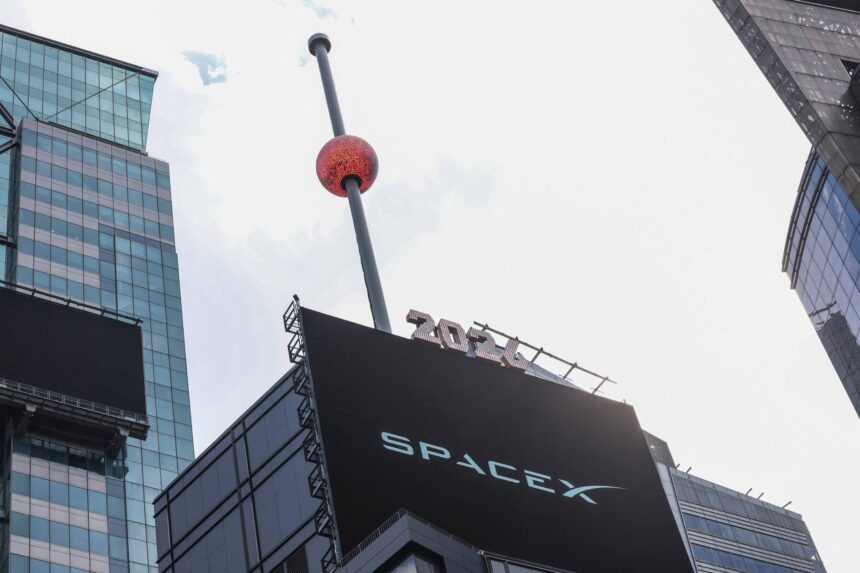
SpaceX’s rapid inclusion in the Nasdaq 100 has become one of the most significant developments in the U.S. equity market following its June IPO. At London Hub Global, this milestone demonstrates that space infrastructure, satellite communications, and artificial intelligence have fully transitioned from venture capital ambitions into the core of global public markets. Elon Musk’s company entered the index less than one month after its public debut, made possible by Nasdaq’s updated rules allowing newly listed companies with substantial market capitalization and sufficient public float to qualify for accelerated inclusion.
Investors expect the addition to the Nasdaq 100 to generate substantial mechanical demand for SpaceX shares from index funds and exchange traded funds that replicate the benchmark. Market estimates suggest passive inflows could reach approximately $4.3 billion, while assets tracking the Nasdaq 100 total several hundred billion dollars. We believe these capital flows strengthen liquidity and institutional ownership, but they do not eliminate the key question facing investors: whether a company valued at approximately $2 trillion can ultimately justify that valuation through sustainable cash flows rather than expectations alone.
The market’s initial reaction has been mixed. Despite anticipated index driven buying and overwhelmingly positive brokerage coverage, SpaceX shares declined alongside other high growth technology companies as investors questioned the durability of the artificial intelligence investment cycle. At London Hub Global, we emphasize that this is a normal phase following a landmark IPO. Investors recognize the scale of the opportunity while waiting for the company’s first public financial results to evaluate Starlink’s profitability, Starship development progress, infrastructure spending, and management’s ability to convert technological leadership into consistent earnings growth.
Wall Street has moved quickly to initiate research coverage, with most major investment banks assigning positive ratings. Goldman Sachs, Morgan Stanley, J.P. Morgan, UBS, and several other institutions view SpaceX as a unique combination of launch services, satellite connectivity, defense contracts, artificial intelligence, and future orbital infrastructure. Starlink is considered particularly significant because it has already become the world’s largest satellite internet network and continues expanding across commercial, government, and consumer markets. Starship remains the company’s most ambitious and highest risk program, but it also represents the foundation of its long term valuation because a fully reusable heavy lift rocket could fundamentally transform the economics of access to space.
Several analysts forecast thousands of Starship launches annually by 2031, although these projections depend on achieving high levels of reusability, obtaining regulatory approvals, expanding manufacturing capacity, and maintaining strong demand for orbital infrastructure. Some brokerage firms have established exceptionally high price targets, describing SpaceX as one of the defining infrastructure companies of the twenty first century, while more cautious analysts continue highlighting valuation risks, capital intensive operations, and the uncertainty surrounding engineering timelines. We view this divergence as evidence of a mature investment debate. Markets are no longer questioning whether SpaceX is strategically important. Instead, the discussion has shifted toward valuation, monetization speed, and the ultimate size of its addressable markets.
The implications extend directly to the United Kingdom and London. London remains one of the world’s leading centers for asset management, space insurance, satellite financing, legal advisory services, and defense related investment analysis. SpaceX’s continued expansion is increasing interest among British institutional investors in companies connected to satellite communications, data center power infrastructure, cybersecurity, aerospace manufacturing, and orbital risk insurance. At London Hub Global, we analyze this as a signal for the City of London that the space economy has moved beyond a specialized technology niche and is becoming an increasingly important component of global infrastructure investment portfolios.
Another important consideration is SpaceX’s eventual inclusion in the S&P 500. While membership in the Nasdaq 100 has already generated substantial passive investment demand, entry into the world’s most widely followed equity benchmark could unlock an even larger wave of institutional capital once the company satisfies the required listing history, profitability, and reporting standards. Until then, the shares are likely to remain highly volatile as investors compare ambitious Wall Street forecasts with quarterly financial performance and the company’s ability to translate revenue growth into sustainable profitability.
At London Hub Global, the broader conclusion is that SpaceX has become the public market’s defining test of the emerging infrastructure economy. If the company successfully scales Starlink, accelerates Starship development, and integrates artificial intelligence across both terrestrial and orbital infrastructure, its current valuation could receive strong fundamental support. If expectations prove to be ahead of execution, the market may reassess even a technologically dominant business. For London, this development serves as an important indicator of where future capital allocation is heading. Investors will increasingly seek opportunities not only in artificial intelligence software developers but also in companies building the communications networks, computing capacity, energy systems, and transportation infrastructure that will support the next generation of the global digital economy.