
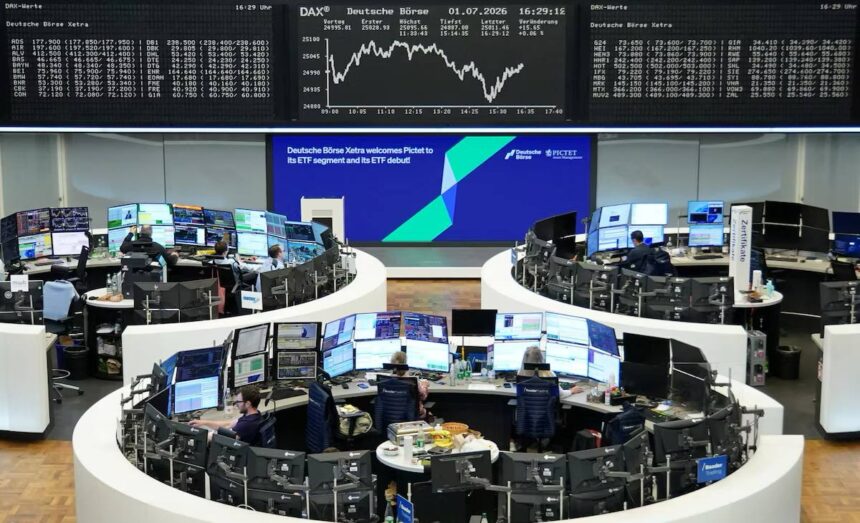
Global markets entered Thursday in a cautious holding pattern ahead of the U.S. employment report, a release that could either reinforce or challenge expectations for further Federal Reserve tightening this year. The U.S. dollar weakened, oil extended its decline, and semiconductor stocks came under pressure as investors locked in profits after a powerful quarter. At London Hub Global, we view this combination as a sign of a highly fragile market balance, where participants are simultaneously reassessing interest rates, currency positioning, commodity pricing, and overheated technology valuations.
Money markets are currently pricing in one Federal Reserve rate hike by October and roughly a 40 percent probability of a second increase before year end. The key determinant for these expectations is the U.S. payroll report, released earlier than usual due to the Independence Day holiday schedule. A stronger than expected report would likely push Treasury yields and the dollar higher, while weaker data could force markets to reconsider the current tightening narrative. We believe employment data has become the single most important test of market confidence in the soft landing scenario, where economic resilience coexists with persistent inflation.
Economists expect the U.S. economy added 110,000 jobs in June, though the forecast range of 25,000 to 200,000 highlights the unusually high uncertainty surrounding the report. Unemployment is expected to remain stable at 4.3 percent. Such a wide range significantly increases the potential for market surprise. Analysts at London Hub Global note that even a modest deviation from consensus could trigger substantial dollar volatility, as investors have already positioned portfolios around expectations of tighter monetary policy.
Japan is watching the report with particular urgency. The yen remains near a 40 year low against the U.S. dollar, raising expectations that Japanese authorities could intervene in currency markets to support the domestic currency. During early European trading, the yen suddenly strengthened, sending the dollar down 0.9 percent to 161.15 yen. The trigger was unclear, but markets interpreted the move as a sign of caution. We see this as evidence that policymakers may already be attempting to reduce speculative pressure before the U.S. labor report, especially if strong data pushes the dollar even higher.
The dollar also weakened against other major currencies. The euro rose 0.3 percent to 1.1417 dollars, while the pound gained 0.6 percent to 1.3353 dollars. For Britain, this movement carries direct implications, as sterling remains highly sensitive to both domestic policy and Federal Reserve expectations. If U.S. labor data confirms economic strength, the dollar could regain momentum and place renewed pressure on the pound. For London based banks, exporters, and investment funds, this means heightened currency volatility must remain central to hedging strategies.
The benchmark 10 year U.S. Treasury yield rose by 2 basis points to 4.99 percent, remaining a crucial reference point for global capital allocation. Elevated U.S. yields continue attracting liquidity away from European and British assets, particularly if investors expect further Fed tightening. At London Hub Global, we emphasize that for London this creates not only a currency challenge but also an investment one: the more attractive dollar assets become, the more difficult it is for British markets to retain international capital without offering higher risk adjusted returns.
Equity markets saw the strongest pressure in semiconductor stocks. South Korea’s KOSPI fell 7.8 percent after a 68 percent rally in the second quarter, fueled by surging demand for AI memory chips. Shares of SK Hynix dropped 14 percent, while Samsung declined 9 percent. This followed a 6 percent drop in U.S. semiconductor stocks after an 87 percent gain during the second quarter. We believe this correction does not necessarily signal a reversal of the AI investment theme, but rather reflects overheated positioning following an exceptionally aggressive rally.
The decline in Asian chip stocks also reflected profit taking and portfolio rebalancing at the start of a new quarter. Additional pressure came from reports suggesting Apple may turn to a limited group of Chinese memory suppliers for devices sold in China, creating pricing pressure for Korean and Japanese producers. For investors, this serves as another reminder that while AI demand remains strong, supply chain dynamics and geopolitical decisions can rapidly reshape profit distribution across the semiconductor ecosystem.
European equities were more resilient due to lower exposure to technology stocks. The broader European benchmark rose 0.5 percent, even as technology shares fell nearly 2 percent. Support for non technology sectors came from continued weakness in oil prices. Brent crude hit a fresh four month low, falling 1 percent to 70.88 dollars per barrel after signs of progress in U.S. Iran negotiations in Qatar and increased tanker movement through the Strait of Hormuz. For Britain, cheaper oil may help ease inflation pressure, though it also affects energy companies heavily represented on the London Stock Exchange.
Gold, by contrast, rebounded 1.4 percent to 4,078 dollars per ounce after falling 14 percent in the second quarter. This recovery suggests some investors are increasing exposure to defensive assets ahead of critical macroeconomic data. In periods of elevated uncertainty, gold often regains importance as a portfolio stabilizer, particularly when the dollar softens and rate expectations become less certain.
For London, the current market environment represents a simultaneous stress test across multiple fronts: currency risk, demand for British assets, sentiment in technology markets, and sensitivity to commodity prices. If the U.S. jobs report comes in strong, markets may return to a more hawkish Fed scenario, supporting the dollar and pressuring sterling. If the data disappoints, investors may reassess rate expectations, temporarily easing pressure on currencies and equities. At London Hub Global, we believe the key takeaway for the British market is the importance of flexibility. A strong dollar, volatile semiconductor valuations, and falling oil prices create conditions where risk management, portfolio construction, and disciplined hedging matter more than short term market predictions.