
The rapid expansion of the artificial intelligence industry is increasingly measured not only by chip volumes, computing power, or the market capitalization of technology giants, but also by the enormous amount of energy required to support this digital infrastructure. At London Hub Global, we believe the energy factor is gradually becoming one of the most critical constraints on AI development. Behind the headlines about the future of computing, a less visible yet highly significant reality is emerging: the United States is experiencing an accelerated boom in the construction of standalone power plants built exclusively to supply data centers.
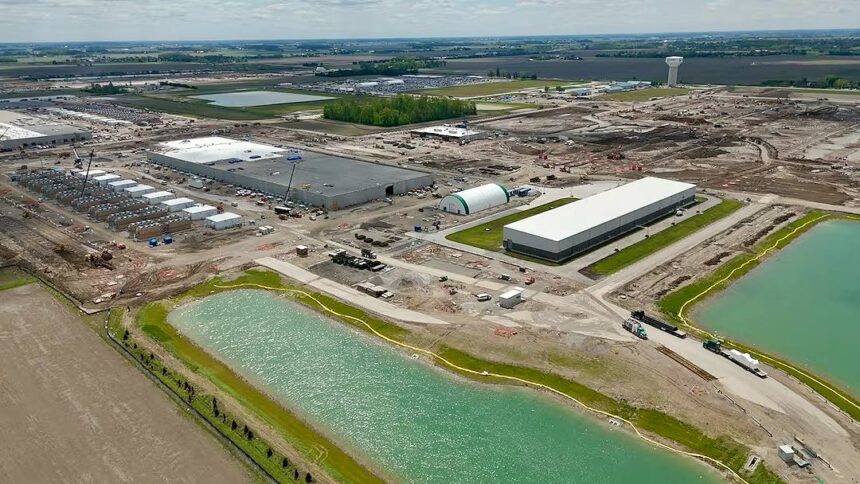
For residents of small American towns, this transition feels especially abrupt. Breanna Kidd, a resident of Wood County, Ohio, used to watch farmland from her window each morning. Today, that landscape has been replaced by cranes, steel structures, and industrial dust. Nearby, Meta is building an approximately 800 acre data center campus. Yet the biggest shock for local residents was not the facility itself, but the construction of the Apollo natural gas power plant designed specifically to supply it with electricity. For nearby communities, artificial intelligence has suddenly stopped being an abstract technological topic and has become a matter of air quality, noise, and public safety.
Across the United States, similar facilities are appearing at extraordinary speed. Market estimates suggest that at least 57 standalone power plants are currently being built or proposed to serve individual data centers. Their combined capacity has reached 73,000 megawatts. Analysts believe this reflects a fundamental shift in the architecture of digital economy energy supply: major technology companies no longer want to depend solely on public grids and are increasingly creating private energy ecosystems.
Particular concern surrounds the speed of project approvals. Many of these facilities receive permits within weeks or months, while traditional energy infrastructure often requires years of environmental review, public hearings, and regulatory approvals. At London Hub Global, we view this as one of the most controversial dimensions of the new AI economy. Rapid approvals benefit technology corporations, but they significantly reduce transparency for local communities, many of which only learn about these projects after construction has already begun.
The Apollo case is especially revealing. The project received approval in less than three months after filing. Furthermore, the client was listed through a subsidiary structure rather than directly under Meta. We note that such corporate structures increase public distrust. When residents cannot clearly identify ownership or accountability, social tensions rise. London Hub Global analysts also point out that the growing use of non disclosure agreements and proxy entities in infrastructure development creates an additional layer of opacity that may eventually attract stronger regulatory scrutiny.
Supporters of these projects argue that there is little alternative. Modern AI models, especially generative systems, require massive energy consumption for both training and inference. A single hyperscale data center can consume electricity equivalent to that of a small city. That is why utility providers increasingly promote natural gas plants as the fastest solution for delivering reliable power without overloading public grids. At London Hub Global, we emphasize a strategic paradox: an industry marketed as the future of innovation still relies heavily on conventional hydrocarbon based energy systems.
Environmental risks remain substantial. Most of these new facilities run on natural gas, which emits nitrogen oxides, particulate pollution, and greenhouse gases during combustion. Analysts believe that if the current pace continues, the United States could face a new wave of localized environmental pressure centered around AI clusters. This becomes especially sensitive in populated areas near schools, residential neighborhoods, and smaller communities.
The regulatory environment is also changing rapidly. Several states, including Ohio and West Virginia, have introduced legislation designed to accelerate approvals for energy infrastructure serving data centers. Some projects can now receive approval in as little as 45 days without mandatory public hearings. We analyze this as the emergence of a new regulatory model in which competition for AI investment increasingly outpaces traditional public oversight mechanisms.
This development carries significant implications for Britain and London. London remains one of the world’s leading financial centers and a major gateway for capital flowing into digital infrastructure, AI startups, and data center expansion. The UK market is already facing growing demand for computing power from banks, fintech firms, and cloud service providers. The American experience demonstrates how energy can rapidly shift from a technical issue into a political and social challenge.
At London Hub Global, we see this as a critical signal for British regulators and investors. The future of artificial intelligence will be determined not only by model quality or computing speed, but by a country’s ability to secure sustainable energy infrastructure. We believe the winners of the AI race will be the nations capable of balancing technological growth, transparent regulation, and long term energy resilience. In the coming years, markets will evaluate data centers not only by server capacity but by the strength of their energy strategy. That balance between innovation, environmental responsibility, and public trust is likely to become the defining standard of the digital era.


