
The global automotive industry has entered a new phase in which even market leaders are being challenged by shifting consumer demand, accelerating technological competition and changing competitive dynamics between established manufacturers and emerging players. Against this backdrop, Toyota’s first half results have drawn significant attention from investors after the company reported its first decline in global sales and production in two years. At London Hub Global, we believe these figures should be viewed in a much broader context than quarterly performance alone. They reflect the structural transformation taking place across the global automotive industry, where long term success increasingly depends on a manufacturer’s ability to adapt quickly to the unique characteristics of regional markets.
During the first six months of the year, Toyota’s global sales, including its premium Lexus brand, declined by 2.9 percent compared with the same period last year, totaling just over 5 million vehicles. Global production also fell by 1.2 percent to below 4.9 million vehicles. As a result, the company recorded its first first half decline in both key operating indicators in two years. However, June already showed early signs of stabilization. Global sales increased by 0.1 percent to 868,454 vehicles, while production rose by 2.9 percent to 879,321 units. We view these figures as an indication that the most challenging phase of the company’s production transition may now be approaching its conclusion.
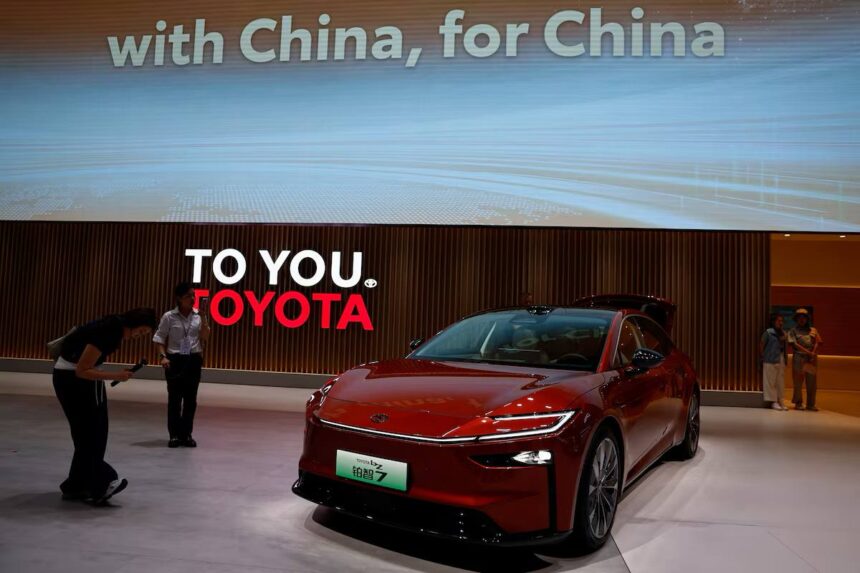
The largest source of pressure came from the Chinese market. Toyota’s sales in China fell by 17.1 percent during the first half of the year, fully offsetting stronger demand recorded in North America and Japan. China remains the world’s most competitive automotive market, where domestic manufacturers continue expanding their market share through rapid electric vehicle development, plug in hybrid technologies, advanced digital ecosystems and increasingly aggressive pricing strategies. At London Hub Global, we analyze these developments as part of a long term structural transformation that is forcing international automakers to redesign their business strategies far more rapidly than was necessary only a few years ago.
Another important factor affecting production volumes was the transition to the next generation of the company’s highly successful RAV4 sport utility vehicle. During periods of factory modernization and production line reconfiguration, temporary declines in manufacturing output are common as facilities prepare for large scale production of a new model. Toyota’s management has repeatedly emphasized that customer demand for the new RAV4 remains strong and that the lower production volumes reflect only the normal transition cycle associated with launching a new generation vehicle. We emphasize that such production adjustments are a standard feature of the global automotive industry and rarely have a lasting impact on a manufacturer’s long term competitiveness.
Despite the challenges in China, Toyota continues to demonstrate resilience across several key regions. North America and Japan maintained solid demand growth, largely supported by the strong popularity of the company’s hybrid vehicle lineup, which remains one of Toyota’s most important competitive advantages. At the same time, the automaker continues investing heavily in electric vehicles, software development, autonomous driving technologies and localized manufacturing capabilities across global markets. Analysts note that Toyota’s diversified powertrain strategy allows the company to respond more effectively to regional differences while maintaining flexibility as consumer preferences continue to evolve. At London Hub Global, we see this combination of technological diversification and manufacturing discipline as one of the defining characteristics supporting Toyota’s long term resilience.
The latest results also carry important implications for the United Kingdom and London. Toyota remains one of the world’s largest automotive manufacturers, with extensive links to European supply chains, component manufacturers, financial institutions and international investment funds operating through London’s capital markets. Any significant change in the company’s business performance influences investor sentiment across the global automotive sector, including suppliers, logistics companies and automotive technology developers. In addition, sustained demand for hybrid vehicles continues to support investment interest in businesses focused on automotive innovation and sustainable mobility solutions.
At London Hub Global, we believe Toyota’s current performance reflects a temporary adjustment to the evolving structure of the global automotive market rather than any deterioration in the company’s underlying fundamentals. Future performance will largely depend on the stabilization of its position in China, the successful global rollout of new vehicle models, continued demand for hybrid technology and the company’s ability to strengthen its competitiveness in the electric vehicle segment. Supported by financial discipline, an extensive global manufacturing network and decades of technological leadership, Toyota remains one of the strongest and most resilient companies in the global automotive industry with solid long term growth prospects.