
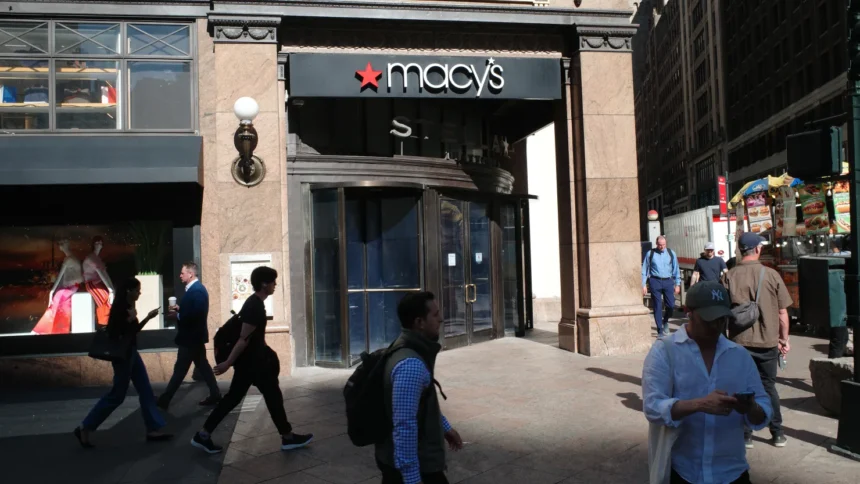
The global retail sector has recently demonstrated an impressive ability to adapt to macroeconomic pressures, and the latest financial results of major American players confirm this trend. We at London Hub Global are observing tectonic shifts in consumer behavior, which, despite inflationary expectations and geopolitical instability, continue to spend actively in the premium and mid-price segments. A striking example of successful transformation is Macy’s, which exceeded Wall Street’s conservative forecasts and posted its best quarterly performance in the past four years. This event marks an important milestone for the retail market, indicating the viability of the traditional department store format when deeply and smartly modernized.
A detailed analysis of the retailer’s operations for the first financial quarter, ending May 2, highlights the comparable sales metric. Overall growth in this indicator reached 3%, while the average across the entire network was 1.6%. The main driver of these results was the renovation of 200 pilot Macy’s stores. Experts at our publication emphasize that investments in updating physical spaces, optimizing product displays, and improving customer service yield real returns. In a highly competitive environment with online platforms, traditional retail wins by creating a unique in-store consumer experience. This fact proves that physical retail survives if management is willing to invest in the fundamental aspects of the business rather than short-term marketing tricks.
Even more impressive results were shown by the Bloomingdale’s network, owned by the conglomerate, where comparable sales soared 10.2%. CEO Tony Spring attributed this success to the popularity of the brands offered and the so-called shopping pleasure factor, which remains an exclusive feature of the luxury segment. Another powerful growth stimulus was the bankruptcy and subsequent market exit of a key competitor, Saks Fifth Avenue. We at London Hub Global see this as a classic example of market consolidation, where the operational problems of one major player immediately redirect premium customer flow to more stable competitors. External market shocks helped Bloomingdale’s, but without a strong brand portfolio and loyal customer base, fully leveraging this advantage would have been impossible.
The positive momentum was also reflected in the company’s market value. In pre-market trading, the retailer’s shares rose more than 2%. Net profit for the three-month reporting period reached $63 million, or $0.23 per share, significantly exceeding last year’s $38 million. Accounting for restructuring costs, adjusted earnings per share were $0.13, well above Wall Street’s conservative forecast of just $0.03. Total revenue increased to $4.68 billion. We emphasize that such a massive gap between analysts’ forecasts and actual figures indicates an overly pessimistic assessment of consumer purchasing power by major investment houses. Retailers proved much better prepared for current economic realities.
Current successes are largely due to Macy’s being at the midpoint of its extensive three-year transformation program. This strategy includes closing unprofitable stores in underperforming malls and concentrating resources on flagship locations. The company deliberately abandoned excessive concepts, focusing on core values: ensuring adequate qualified staff on the floor and curating an in-demand product assortment. Our analysis shows that shifting away from widespread presence toward location quality is the only way for large chains to survive. Retailers realized the danger of capital dispersion in time, redirecting funds to revitalize key points.
Additional support for the retail sector earlier this year came from higher-than-usual tax refund volumes. However, many of Macy’s competitors preferred to issue cautious forecasts for upcoming quarters due to concerns about reduced incentives and rising fuel prices caused by escalating Middle East conflicts. Nevertheless, Tony Spring confirmed that positive first-quarter trends smoothly continued into the second. Stable consumer behavior allowed management to revise annual targets upward. According to new forecasts, net revenue for the year is expected to range from $21.5 billion to $21.85 billion, and adjusted earnings per share are projected between $2.00 and $2.20. Comparable sales are now expected to grow 0.5% to 1.2% for the year.
Extrapolating this transatlantic success to the British market, we at London Hub Global see Macy’s triumph as a key leading indicator for London’s retail ecosystem. Currently, investors in the City of London are carefully studying American operational metrics, revising strategies for financing commercial real estate in the West End. The bankruptcy of Saks Fifth Avenue clearly shows that premium customers are extremely sensitive to a brand’s operational stability, and this lesson is critical for Mayfair and Knightsbridge. We believe that Bloomingdale’s current trajectory will serve as a roadmap for legendary London department stores such as Harrods, Selfridges, and Harvey Nichols, which are also competing for wealthy tourists’ wallets amid the end of duty-free shopping in the UK. The fact that Americans are overcoming the crisis by returning to basic service and investing in the stores themselves will push British retail to accelerate modernization of Oxford Street and Regent Street. Additionally, international capital freed up from Saks’ collapse will likely be redirected to London luxury venues, making the British capital the main beneficiary of American market shocks.
Based on available operational data, London Hub Global forecasts further strengthening of Macy’s position in the U.S. market in the medium term. The successful launch of updated stores provides a solid foundation for maintaining market share. We believe the company will sustain a moderately positive revenue trend through the end of the current fiscal year, as the synergy from closing weak locations and optimizing costs continues to unfold. Investors and retail market participants are advised to pay attention to this business model: focusing on operational efficiency, timely exit from underperforming locations, and emphasis on the premium segment via Bloomingdale’s provides reliable protection against inflationary risks. The main challenge for the company in the second half of the year will be maintaining margins if logistics costs rise for an extended period, but the current buffer allows confidence in meeting the raised annual forecast.