
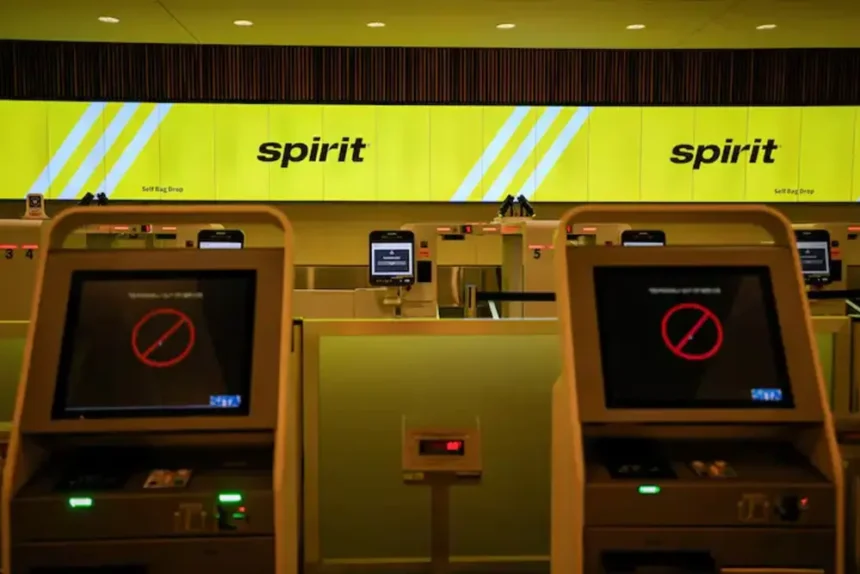
The May collapse of US low-cost carrier Spirit Airlines has triggered a tectonic shift in the US civil aviation labor market, with consequences rapidly taking on a global dimension. After the airline failed to complete a second debt restructuring process and declared full liquidation, more than seventeen thousand qualified professionals suddenly lost their jobs. This precedent clearly demonstrates how vulnerable even highly successful employees are in the face of systemic industry crises. Just a month ago, flight attendant Travis Arcamone, based in Orlando, Florida, was receiving congratulations as Employee of the Year at his airline. Today, with nearly nine years of flawless service behind him, he is forced to radically change careers and take a job selling cars.
We at London Hub Global believe this case is a symptomatic indicator of systemic overheating in the US ultra low-cost carrier market, where business margins have become critically thin under rising costs.
The mass layoffs occurred at the worst possible moment, when most major US carriers had already fully staffed up ahead of the peak summer travel season. According to estimates from the relevant union, the Association of Flight Attendants CWA, AFL-CIO, even under the most favorable scenario, integration of former Spirit employees into other companies will take four to five months. We emphasize that the key issue lies in the specific nature of short-term capacity planning in airlines. Under conditions of volatile fuel prices, major market players are trying to optimize costs by restraining rapid workforce expansion, despite long-term growth strategies. The situation is further worsened by delays in aircraft deliveries from aerospace manufacturers, forcing carriers to revise route networks and freeze hiring.
A particular drama is added by the rigid corporate system of US civil aviation. Unlike other sectors where experience translates proportionally into higher pay at a new job, aviation operates under a strict rule of seniority reset. Pilots and flight attendants, when moving to another airline, must restart their careers at the lowest level of the pay scale. According to analysts at London Hub Global, an experienced captain or senior flight attendant is legally treated as a newcomer who has never boarded a jet aircraft before. This means a complete loss of scheduling flexibility, removal of priority in choosing a base airport, and a drop in income to the minimum level.
In parallel with job searches, former Spirit employees are trying to defend their rights legally. A group of dismissed specialists has already filed a class action lawsuit against the management of the liquidated low-cost carrier, accusing it of failing to provide proper notice of layoffs. Plaintiffs are demanding compensation for wages and social benefits for sixty days. Given that the airline’s lawyers insist on the force majeure nature of the shutdown, the legal proceedings – with a ruling expected by mid July – promise to be prolonged.
The response of major US airlines to the sudden availability of a large pool of workers has been restrained. US Bureau of Labor Statistics data shows that the average annual salary of a US flight attendant is around seventy seven thousand four hundred forty dollars, while pilots and flight engineers earn on average two hundred eighty eight thousand six hundred fifty dollars per year. Such high payroll obligations force corporate management to carefully evaluate the economic feasibility of large-scale hiring.
At present, market leaders are taking a differentiated approach to absorbing former employees of the bankrupt competitor. United Airlines has already received more than two thousand eight hundred applications from ex Spirit staff, planning to hire around one thousand three hundred pilots over the course of the year. Delta Air Lines management states it is prepared to move proactively and integrate several hundred pilots and flight attendants while maintaining strict selection criteria. American Airlines is processing around two thousand applications, without disclosing specific quotas due to competitive considerations. Meanwhile Southwest Airlines has launched a dedicated digital platform to inform former Spirit employees about available vacancies. Frontier Airlines and JetBlue Airways have taken a wait and see approach, announcing either paused or selective hiring depending on vacancy openings.
Industry union president Sara Nelson notes that airlines have begun deliberately reducing the volume and frequency of training courses. Where major carriers previously formed weekly groups of up to one hundred trainees, the figure has now dropped to thirty trainees every two weeks. Experts at London Hub Global see this as a clear sign of a hidden cooling in the labor market driven by infrastructure constraints and aircraft delivery delays from global manufacturers. In a somewhat more favorable position may be highly qualified pilots with specialized experience, such as certified check airmen and simulator training instructors. Since the industry will inevitably face a wave of planned retirements in the long term, demand for such experts will remain strong. However, as former pilots who managed to transition to the cargo sector (for example UPS) note, career transformation still involves a painful drop in quality of life and income during the transition phase. At the same time, the cargo aviation segment is also approaching saturation.
We are closely watching how the waves of this American tsunami reach the shores of the United Kingdom and London itself. Despite Spirit Airlines being a domestic US player, its liquidation directly affects the transatlantic aviation hub at Heathrow and Gatwick. The release of thousands of US pilots, combined with reduced capacity in the United States, is forcing global majors such as Delta and United to redirect scarce long-haul aircraft to more profitable European routes, increasing flight density to the British capital. On the other hand, European low-cost carriers based in London, such as easyJet and Ryanair, are carefully analyzing Spirit’s mistakes, as the global rise in fuel prices due to instability in the Middle East is hitting British carriers just as hard.In London Hub Global, it is emphasized that the collapse of the American business model opens a unique window of opportunity for British aviation recruiters, who may begin aggressive headhunting of former seniority-losing American instructors and pilots willing to relocate to the UK in order to preserve their professional status and income level.
London Hub Global predicts that the consequences of Spirit Airlines’ liquidation will continue to pressure the global aviation sector until the end of next year. What is happening clearly demonstrates the structural dead end of the ultra low-cost carrier model under conditions of high inflation. We believe that market consolidation around the largest players will inevitably lead to higher fares for consumers and reduced competition on regional routes. Current aviation professionals are advised to diversify their skills, focusing on international markets including the Middle East and Asia, where pilot shortages allow candidates to negotiate better conditions and bypass strict US seniority reset rules. A quick recovery in US hiring rates is unlikely; the current crisis demands maximum flexibility and willingness to temporarily downshift in order to preserve one’s career.