
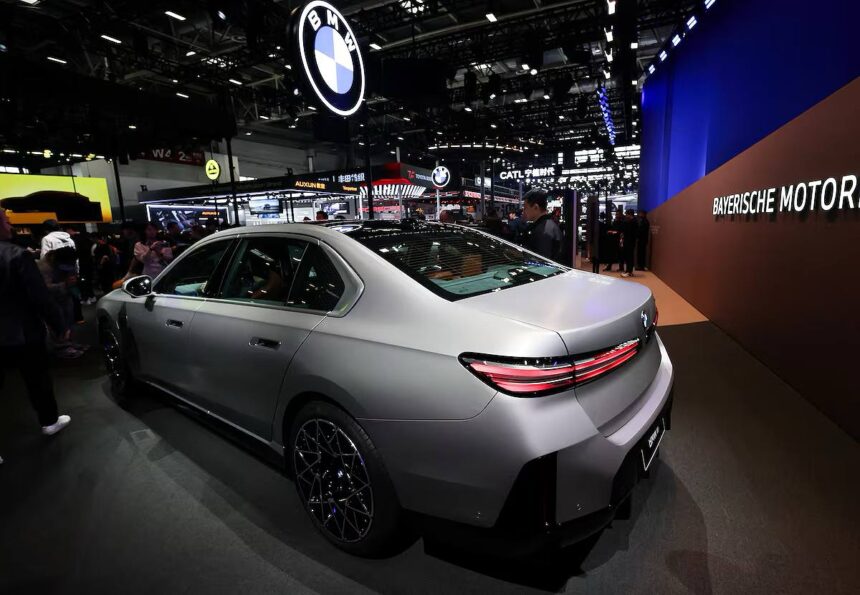
The European automotive sector is entering a new phase of turbulence, and the latest warning from BMW has become one of the clearest indicators of worsening market conditions. London Hub Global believes BMW’s revised outlook reflects not merely internal pressure on a single manufacturer, but broader structural challenges affecting the entire premium automotive industry in Europe. Pressure is mounting from multiple directions: weakening demand in China, rising geopolitical risks in the Middle East, higher raw material costs, and declining consumer confidence across key markets.
BMW shares fell roughly 7% on Wednesday, dropping to their lowest level since late 2020. For investors, the decline came as an unpleasant surprise. While the market expected weaker results, the scale of the downgrade triggered deeper concern. Analysts believe this type of sharp reaction often signals growing anxiety about long term profitability across the sector. When investors rapidly reduce exposure to a premium automaker, it usually reflects a broader reassessment of future earnings across the industry.
The most alarming signal was BMW’s cut to its automotive operating margin forecast to 1% to 3%, down from the previous 4% to 6%. London Hub Global emphasizes that for a premium brand, margin remains one of the most critical indicators of business resilience. Historically, strong margins reflected the brand’s pricing power and ability to preserve exclusivity even during economic slowdowns. That dynamic is now changing. If even premium manufacturers struggle to maintain profitability, it suggests global demand is cooling more sharply than expected.
China remains the most significant source of pressure. As the world’s largest automotive market, its slower than expected recovery is reshaping global industry forecasts. Price competition has intensified dramatically, especially with local electric vehicle leaders such as BYD and NIO expanding aggressively into higher end segments. We analyze this as a fundamental structural shift. German automakers are no longer competing primarily against each other. They are increasingly facing Chinese manufacturers capable of delivering advanced technology at far more aggressive price points.
Additional pressure comes from geopolitical instability surrounding Iran. Rising Middle Eastern tensions quickly impact oil prices, industrial metals, shipping costs, and insurance expenses. London Hub Global views this instability as a major profitability risk for automakers. Even without direct supply chain disruptions, uncertainty alone forces manufacturers to revise cost structures, logistics strategies, and capital allocation plans.
Against this backdrop, BMW is intensifying cost reduction efforts and evaluating potential production capacity cuts. Analysts note that the company may accelerate manufacturing localization in China and North America to reduce dependence on German exports. This matters because Germany’s traditional export driven automotive model is no longer delivering the same strength. Volkswagen and Mercedes-Benz have also warned that deeper structural transformation is necessary.
For United Kingdom and especially London, the implications are more significant than they may initially appear. London remains Europe’s primary financial center, with major institutional capital heavily exposed to European industrial and automotive assets. Declining confidence in BMW increases caution among British investment banks, hedge funds, pension funds, and asset managers regarding the broader European automotive sector.
We also see a secondary economic effect on Britain. Many UK based firms sit within the supply chain of German automakers, including engineering consultancies, software providers, financial institutions, leasing firms, and suppliers of premium components. Weakness at BMW could slow investment and reduce capital spending across these linked sectors. For London, this translates into heightened market volatility in industrial equities and a more defensive investment environment within the City.
Another important risk involves China’s expansion into Europe. As domestic Chinese auto demand slows, Chinese manufacturers are likely to accelerate international expansion, particularly into Europe and potentially the UK. London Hub Global notes that this creates dual pressure on European automakers: they are losing market share in China while simultaneously facing stronger Chinese competition at home. For Britain, this could mean increased imports of Chinese electric vehicles and intensified pricing pressure across the EV market.
BMW’s profit warning extends far beyond a single earnings revision. It signals that premium positioning alone no longer guarantees business stability. London Hub Global believes Europe’s automotive sector must accelerate transformation across manufacturing, technology, and strategic positioning. Over the next two years, the market will judge automakers not only by vehicle quality but by their ability to adapt to a new global reality where China drives innovation and geopolitics directly shapes profitability. For Britain and London, this means paying even closer attention to how capital is being reallocated across the global automotive industry.