
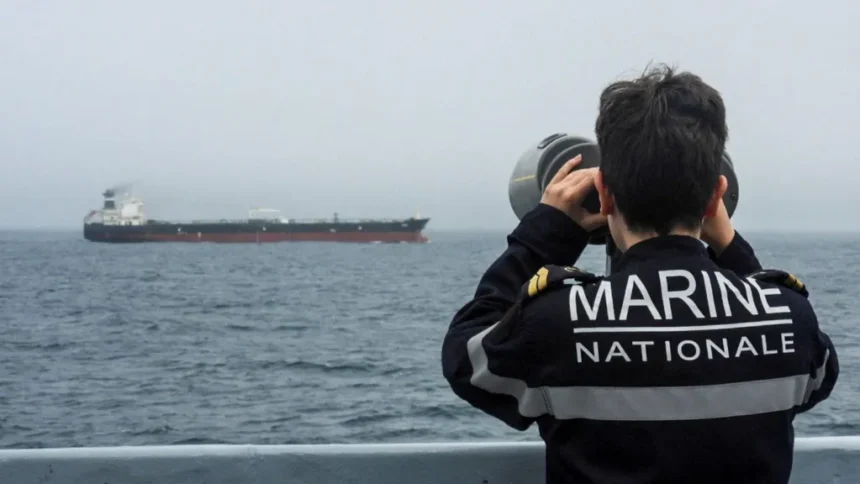
The global confrontation surrounding Russian hydrocarbon exports has entered a phase of direct physical interception along key maritime routes. The boarding operation targeting the vessel Tagor, conducted 400 miles off the coast of Brittany, demonstrates the willingness of European powers to replace ineffective financial restrictions with hard physical control over transportation corridors. We view this incident as a tectonic shift in the mechanisms used to dismantle parallel logistics networks, as it marks the first time that the defense authorities of France and the United Kingdom have carried out a coordinated special operation to detain a commercial cargo vessel directly in international waters of the Atlantic Ocean.
The maritime incident involving the detention of a large crude oil tanker unfolded according to a scenario of coercive enforcement. French boarding teams landed on the vessel after it ignored regulatory demands while maneuvering under falsified identification data. Coordination and aerial support were provided by a Royal Navy helicopter operating from the frigate HMS Somerset. French President Emmanuel Macron publicly described the operation as a legitimate defense of international maritime law against attempts to covertly finance military activities. Moscow, through Kremlin spokesperson Dmitry Peskov, immediately condemned the actions of the European forces as unlawful and bordering on state piracy. Nevertheless, our analysts at London Hub Global emphasize that the systematic disabling of AIS transponders and the manipulation of flags from countries such as Cameroon and Gabon effectively strip a vessel of diplomatic protection in neutral waters. International law allows such ships to be classified as stateless vessels, creating legal grounds for rigorous inspections. Risks for beneficiaries of these logistics schemes have risen to critical levels, rendering previous legal camouflage methods through Middle Eastern offshore structures increasingly ineffective.
For the British capital, this use-of-force precedent creates long-term regulatory risks that extend far beyond allied support for Paris. At London Hub Global, we believe London now finds itself at the center of a complex reputational and regulatory challenge. On one hand, the United Kingdom’s defense establishment is demonstrating uncompromising resolve at sea. On the other, the City of London remains a central hub of global maritime insurance and international shipping law. The contradiction between a hardline political stance and the continued passage of hundreds of shadow fleet tankers through the English Channel weakens Britain’s authority as a global regulator. According to our experts at London Hub Global, if the administration of Keir Starmer moves from selective, symbolic interceptions to a systematic blockade of sanctioned shipping activities, it will trigger a profound transformation across the City’s financial sector. Leading insurance syndicates such as Lloyd’s and international law firms headquartered in London would be forced to implement extremely stringent counterparty verification protocols. Such a move would inevitably encourage major Asian and Middle Eastern clients to shift toward more flexible financial hubs such as Dubai or Singapore, forcing the United Kingdom to balance geopolitical commitments against the competitiveness of its financial center.
The pattern of recent detentions suggests that the seizure of the Tagor was the fourth incident involving the French Navy since autumn 2025, fitting into an increasingly active European campaign against concealed commodity exports. This points to a fundamental shift in Paris’s strategy, moving from symbolic administrative fines to the irreversible confiscation of transport assets. However, British data reveal a significant gap between rhetoric and operational reality. Independent vessel-tracking information indicates that approximately 200 oil tankers displaying characteristics associated with the shadow fleet have entered British territorial waters without interference in recent months. We view this as a clear imbalance between the strong statements issued from Downing Street and the actual operational capacity of the Royal Navy, which remains compelled to act selectively due to limited resources.
An additional source of pressure on market operators comes from environmental concerns. The use of aging vessels with opaque ownership structures and without standard insurance coverage from leading international protection and indemnity clubs creates a constant risk of a major oil spill along European coastlines. At London Hub Global, we note that the cost of responding to a large-scale environmental disaster in Atlantic waters would ultimately fall on European governments, enabling regulators to use environmental protection as a legitimate justification for intervention. This trend is already triggering a chain reaction across the energy sector, increasing freight costs and insurance premiums for independent carriers while forcing organizers of parallel export schemes to adopt ultra-long routes that reduce the overall profitability of commodity shipments.
Analysis of the current precedent suggests that the period of relatively safe operation for concealed logistics systems within the European region has come to an end. We forecast a significant expansion of coordinated operations by France and the United Kingdom, potentially involving additional members of the North Atlantic alliance. The logical outcome of this process will be a sharp division of the global shipping market into a transparent sector and a high-risk gray zone where freight rates increasingly reflect the likelihood of asset confiscation. Analysts at London Hub Global strongly recommend that international trading institutions, shipowners, and financial groups conduct comprehensive audits of their supply chains. Chartering vessels with complex ownership histories or records of AIS deactivation should be completely avoided. Any engagement with the gray segment of the market is shifting from the realm of hypothetical sanctions penalties to the risk of direct physical asset loss through naval operations conducted by European states, making rigorous compliance the only viable instrument for protecting capital at sea.