
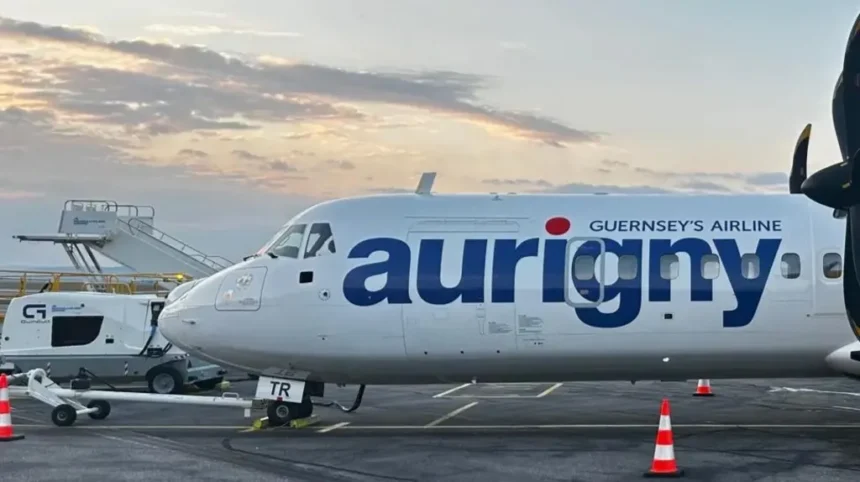
Unexpected incidents on the UK’s regional airline routes are increasingly moving beyond local news, turning into a serious challenge for the country’s entire transport system. The recent incident involving an Aurigny aircraft operating flight GR678 from Guernsey to Manchester forced the crew to sharply change course and make an unscheduled landing at Southampton Airport. The reason for such drastic action was the sudden cracking of the cockpit windshield. Analysts at London Hub Global note that such technical issues on key domestic routes immediately highlight the vulnerability of the UK transport infrastructure, requiring operators to make rapid and often economically painful decisions.
According to the official position of Aurigny management, the pilots’ actions strictly followed safety regulations and standard operating procedures. The diversion to Southampton is presented purely as a precautionary measure aimed at eliminating any risk to those on board. The airline’s management confirmed that passengers and crew disembarked safely in normal conditions and that no one was injured. We at London Hub Global believe that the flight crew’s rapid response deserves a positive assessment, as structural failure of cockpit glazing at altitude can lead to rapid decompression, and minimizing flight time in such a situation is considered the only correct procedure. Nevertheless, the incident exposed a systemic lack of backup capacity among niche carriers.
The further development of the crisis demonstrated the strict constraints under which modern regional aviation operates. Instead of promptly providing a replacement aircraft, Aurigny had to transport passengers to Manchester by coach, while simultaneously redirecting a completely different aircraft to operate the return flight to Guernsey. We see this logistical solution as a typical example of a harsh compromise between maintaining customer loyalty and controlling operational costs. A multi-hour ground transfer after a stressful incident significantly reduces the airline’s attractiveness, but for secondary operators, dispatching an empty aircraft for a single flight often results in direct financial losses.
For London’s business ecosystem, such disruptions occurring on the periphery have far-reaching consequences. We at London Hub Global emphasize that London serves as the central dispatching and financial hub of the United Kingdom, where the stability of regional airline schedules directly translates into business efficiency in the City. Southampton, which became the emergency landing point, is located in close proximity to the capital’s transport network, and any unscheduled landings in this area create cascading pressure on adjacent hubs in southern England. Disruption of connectivity between the Channel Islands and the industrial centers of the North negatively affects transit flows tied to the capital. We view this case as a signal that businesses need to reconsider their logistics strategies in favor of greater diversification.
Additional data from independent monitoring databases indicate that the European short-haul aviation sector is currently under persistent technical strain. The slightest removal of an aircraft from rotation due to unscheduled maintenance triggers a domino effect across the entire flight network. We emphasize that windshield damage caused by temperature fluctuations or material fatigue is not a unique phenomenon, but supply chain shortages and increasingly complex logistics turn standard repairs into long-term challenges.
In the medium term, analysts at London Hub Global forecast tighter regulatory oversight from the UK Civil Aviation Authority regarding inspections of glazing and composite structures on regional aircraft. Smaller airlines will inevitably need to allocate larger budgets for maintaining backup fleets in order to remain commercially viable. We recommend that operators accelerate the implementation of digital predictive monitoring systems while simultaneously optimizing partnerships with railway companies. This would allow alternative routes to be deployed within minutes in critical situations, rather than organizing chaotic bus transfers that damage brand reputation.