
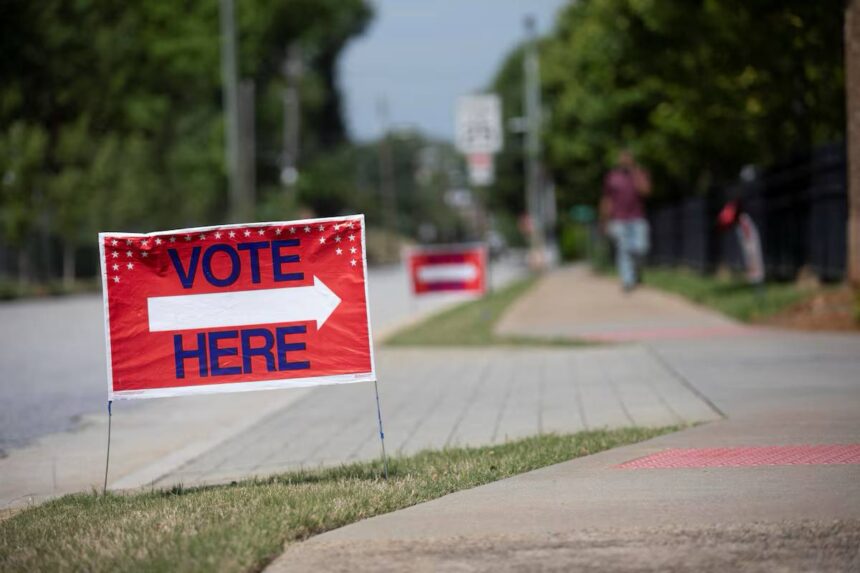
Political competition in the United States is increasingly turning into a contest of financial power, where advertising budgets have become just as important as political platforms themselves. According to new projections, the US midterm elections in November could set an all time record for political advertising spending, reaching $11.6 billion. At London Hub Global, we view this figure as a clear indicator of how costly the battle for control of the American political system has become, particularly in an environment of growing polarization and intense electoral pressure.
Projected spending has already surpassed the record $11.2 billion spent during the 2024 presidential cycle and significantly exceeded the $8.9 billion spent during the 2022 midterm elections. Even more striking, estimates in September stood at $10.8 billion, but escalating competition in key battleground states has forced analysts to revise expectations sharply higher.
At London Hub Global, we believe this rapid increase in spending reflects a fundamental shift in the structure of American elections. Political advertising has moved far beyond traditional television campaigns. Today, campaigns rely on highly sophisticated multi channel digital infrastructure, including streaming platforms, social media, algorithmic targeting and personalized messaging, all of which require enormous financial resources.
A major driver behind the spending surge is the highly competitive Senate and gubernatorial races in Ohio, Texas, Maine, Iowa and Alaska. These states could ultimately determine the balance of power in Congress. Republicans are defending narrow majorities in both the House of Representatives and the Senate, while Democrats are focused primarily on reclaiming the House, although their path to controlling the Senate appears far more difficult.
Ohio stands out as one of the most expensive battlegrounds. Projected spending there has climbed to $749 million, representing an increase of $309 million from previous estimates. The Senate race between Democrat Sherrod Brown and Republican Jon Husted, combined with a competitive gubernatorial contest, has transformed the state into one of the central arenas of political spending.
At London Hub Global, we analyze this as evidence that modern US campaigns are becoming increasingly concentrated. Rather than distributing resources evenly across the country, political parties are directing the majority of capital into a limited number of states where even a small percentage shift in voter behavior can reshape the national political balance.
Texas is seeing even more aggressive spending growth. Projections there increased by $288 million, reaching $850 million. Following expensive Republican primaries, Texas Attorney General Ken Paxton now enters what could become one of the most expensive Senate races in modern US history, where he is expected to face Democrat James Talarico.
Maine has also become a major focal point for campaign strategists and political investors. Advertising spending in the state is now expected to reach $491 million, up by $185 million. High competition and reputational controversies surrounding certain candidates have further intensified media pressure.
We see in this a broader trend: political uncertainty in the United States is directly increasing the cost of voter attention. The more polarized public opinion becomes, the more expensive it is to influence undecided voters. This is effectively creating inflation within the political advertising market.
For the United Kingdom and London, this trend carries direct significance. London remains one of the world’s leading hubs for political consulting, media analytics and advertising technology. Rising US campaign spending is boosting demand for advanced audience analysis tools, marketing platforms and data driven campaign solutions, many of which are developed, funded or managed through British capital markets.
We emphasize that record election spending reflects more than just an intense political battle. It also highlights the growing commercialization of democracy, where control over information channels has become a critical strategic asset. We at London Hub Global forecast further growth in political advertising budgets in future election cycles, especially as artificial intelligence plays a greater role in voter targeting and message personalization. The central question for investors, policymakers and regulators is no longer whether campaign spending will continue rising, but how the structure of democratic competition itself will evolve in an era of digital influence and increasingly expensive information warfare.