
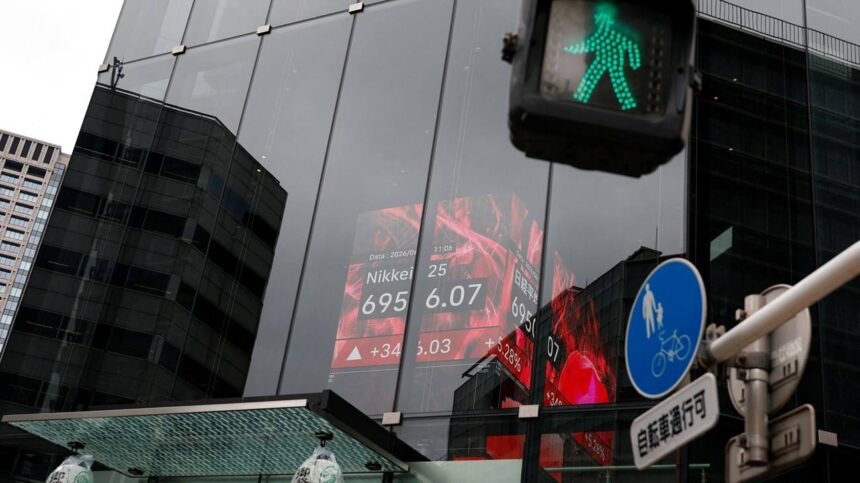
Global financial markets began the week with a strong rally after news of a framework peace agreement between the United States and Iran, a development that could materially reduce the geopolitical premium embedded in oil prices. At London Hub Global, we view this as one of the most significant macroeconomic turning points of recent months, as the implications extend far beyond Middle East de-escalation and directly affect global inflation expectations, interest rate trajectories, and capital flows. Market reaction was immediate: equities and bonds surged, while oil prices fell by roughly 5%, reflecting a sharp repricing of geopolitical risk.
European markets responded particularly strongly. The STOXX 600 and FTSE Eurofirst indices reached record highs, while Asian markets posted powerful gains before Europe even opened. US equity futures pointed to advances of 1.3% to 2%. We believe such synchronized movement highlights how heavily investors had been positioned defensively in recent weeks. Markets had largely been pricing in a scenario of further escalation around the Strait of Hormuz, through which roughly one fifth of global oil supply passes.
The main catalyst behind the move was the prospect of the reopening of the Strait of Hormuz. While full details of the agreement remain limited, the mere sign of diplomatic progress significantly reduced fears of supply disruptions. Brent crude declined to around $83 per barrel after reaching a May peak of $126.41. Even so, oil remains well above the pre-war level of roughly $67, indicating that part of the geopolitical premium is still intact. Analysts at London Hub Global note that markets are currently trading not on actual physical flows, but on the expected speed of normalization in shipping routes and the restoration of confidence among shipping operators and insurers.
The decline in oil prices immediately affected inflation expectations. Lower energy prices reduce pressure on logistics, manufacturing, and consumer prices. This explains the strong rally in global bond markets. US two-year Treasury yields fell by 6 basis points to 4.02%, while equivalent German yields also moved lower. At London Hub Global, we emphasize that markets have begun reassessing the probability of further tightening by the Federal Reserve. Investors rapidly reduced bets on additional rate hikes this year, expecting softer rhetoric from central banks.
Attention is now focused on monetary policy meetings. This week, the Federal Reserve, the Bank of England, the Bank of Japan, the Swiss National Bank, and several other central banks are due to announce policy decisions, making this one of the most important weeks for the global monetary outlook. An additional factor is the leadership transition at the Fed. New Chair Kevin Warsh is perceived as having a stricter communication style, adding another layer of uncertainty. We analyze this as the beginning of a new phase in central bank communication, where forward guidance may become less transparent.
Currency markets also reflected the shift in sentiment. Dollar weakness supported gains in the euro, which rose to 1.1617, while sterling strengthened to 1.3446. For Britain, this is particularly important. Lower energy prices could reduce domestic inflationary pressure, easing the burden on the Bank of England. For London, as Europe’s largest financial center, lower volatility in commodity markets supports stronger appetite for risk assets, increased institutional activity, and more favorable conditions for equity and corporate financing markets. This is especially relevant as the UK prepares for fresh inflation, retail sales, and employment data.
Interestingly, gold also climbed 2.5% to $4,322 per ounce despite the broader risk-on environment. We see this as a signal that investors continue maintaining hedges against structural risks. Bitcoin also gained 2.5%, indicating that liquidity is returning to alternative asset classes.
At London Hub Global, we believe the current rally is fundamentally justified, though markets may be overestimating the speed of full normalization. Even with a political agreement in place, restoring physical oil flows, logistics, and insurance routes could take months. Our base case assumes Brent may decline toward the $78-80 range by year-end, provided the Strait of Hormuz remains open. The key risk remains unchanged: any disruption to the agreement could quickly reintroduce a geopolitical premium into global asset prices. For now, markets are betting on diplomacy, but the durability of this optimism will ultimately be tested by real economic data.


