
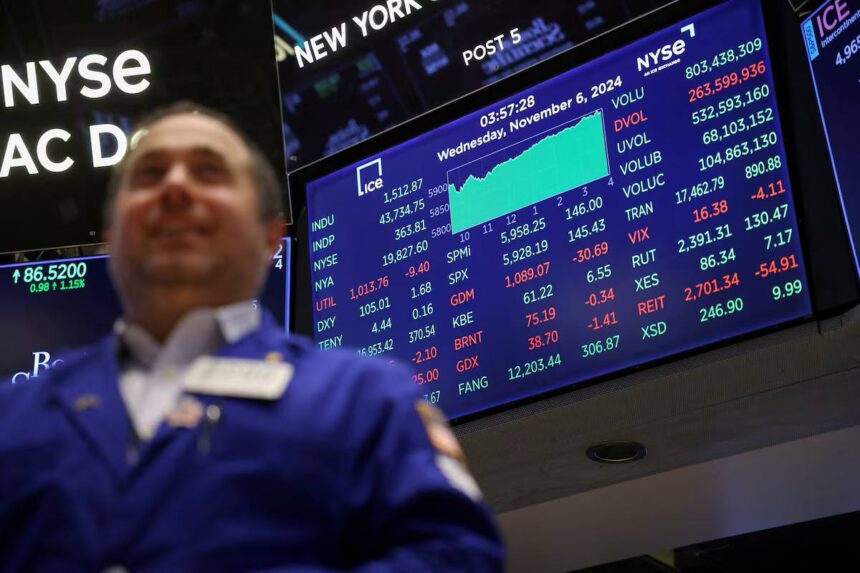
The US stock market enters the second half of 2026 with strong momentum, but also with a significantly higher threshold of expectations. At London Hub Global, we believe that further upside for the S&P 500 and Nasdaq will now depend not only on optimism surrounding artificial intelligence, but also on companies’ ability to demonstrate tangible returns on record-breaking investments. After a three-year bull cycle, the market is no longer willing to price in promises alone. Investors increasingly demand proof in the form of earnings growth, free cash flow and sustainable demand.
The S&P 500 has gained more than 8 percent since the beginning of the year, while the Nasdaq Composite has advanced roughly 11 percent. However, the June pullback revealed early signs of market fatigue. We view this not as a structural break in the rally, but as a natural stress test of elevated expectations. When markets rally for an extended period on a single dominant narrative, even minor doubts about that narrative can quickly translate into volatility. In 2026, that narrative remains AI infrastructure.
The largest technology companies continue allocating enormous capital toward data centers, advanced chips, cloud capacity and power infrastructure. Market estimates suggest combined capital expenditures from major hyperscalers could approach $700 billion this year, with some forecasts pointing even higher in 2027. At London Hub Global, we emphasize that this scale of spending has become both the engine of the rally and one of its greatest risks. Investors want confirmation that these investments are not merely expanding computing capacity, but are translating into revenue growth, stronger margins and durable competitive advantages.
Markets are particularly focused on Microsoft, Alphabet, Amazon, Meta and other companies building the foundation of the AI economy. Their spending supports semiconductor manufacturers, memory suppliers, energy providers, industrial contractors and data center operators. Yet this concentration of capital in a small group of companies makes the broader market more vulnerable. If even a few hyperscalers slow investment or acknowledge weaker-than-expected AI monetization, pressure could quickly spread across semiconductors, infrastructure and technology indices.
The second major test centers on earnings. Corporate profit expectations in the US remain high, with forecasts for the S&P 500 implying strong earnings growth in 2026, and some estimates pointing to double-digit expansion in earnings per share. Analysts note that optimism extends beyond technology into financials, industrials, communication services and selected consumer sectors. At London Hub Global, we analyze this as a critical condition for market resilience: if earnings growth broadens beyond AI, the rally gains a far stronger foundation.
Still, the bar has become demanding. When valuations are elevated, companies must do more than simply meet expectations. They need to demonstrate meaningful improvement through stronger revenue, cost discipline, capital efficiency and clear AI monetization strategies. Any disappointment could trigger sharp repricing, particularly in sectors where investors have already priced in years of future growth. This applies not only to chipmakers, but also to energy, utilities, industrial suppliers and data center developers.
The third major risk factor is the Federal Reserve. The new Fed chair and evolving interest rate expectations will play a central role in shaping the second half of the year. If inflation remains above target, markets may face a more hawkish rate environment than previously expected. Higher capital costs are particularly important for the AI cycle because infrastructure expansion requires massive financing. We see this relationship as impossible for investors to ignore: the higher rates remain, the stronger the demand for measurable returns on AI spending.
The political calendar may add another layer of volatility. Midterm elections typically increase uncertainty, and historically these years have often produced deeper intrayear corrections. Against a backdrop of elevated valuations and strong dependence on the AI narrative, even moderate political tension could accelerate rotation from overheated technology names into defensive and cyclical sectors.
For Britain, and especially London, this story carries direct significance. London-based funds, banks and asset managers remain deeply exposed to US equities, dollar-denominated bonds, derivatives and global technology portfolios. If AI spending continues supporting corporate profitability, British investors will gain stronger confidence in the durability of US growth. If markets begin questioning the return on these investments, sentiment across London could deteriorate quickly, increasing hedging demand and prompting portfolio reallocations away from US technology exposure.
At London Hub Global, we believe the second half of 2026 will become a period of quality verification rather than simple continuation of the rally. Our outlook remains cautiously constructive: US equities can maintain upside if corporate earnings justify expectations, the Federal Reserve avoids materially tightening financial conditions and AI investments begin producing measurable commercial returns. For investors, the conclusion is increasingly clear: the next phase of the market will reward those who can distinguish genuine profitability from overextended expectations of future growth.