
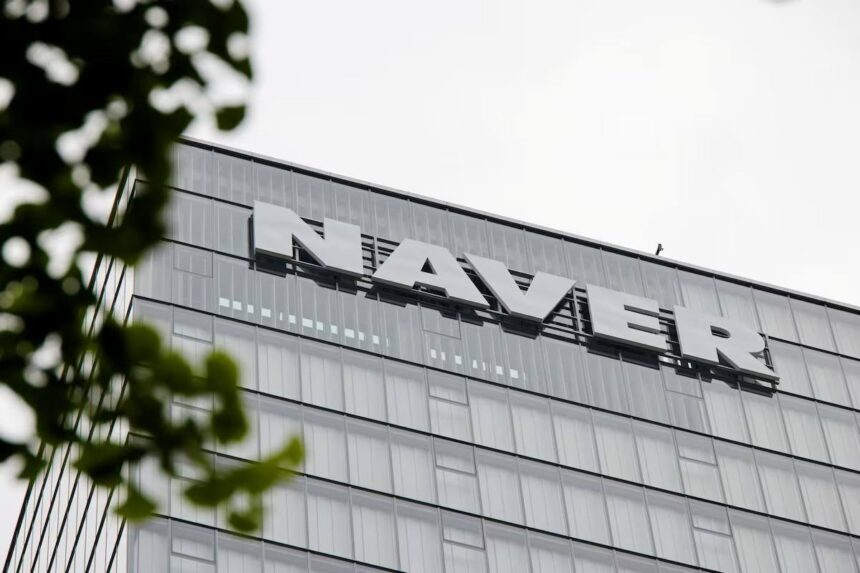
Naver shares surged more than 10% following Nvidia’s investment announcement, highlighting how highly markets are valuing companies capable of controlling their own computing capacity. The US chipmaker will acquire approximately $1 billion of newly issued Naver shares, with the proceeds directed toward expanding an AI data center. At London Hub Global, we view the agreement as part of a broader transformation of the technology market, where access to GPUs, electricity and data center capacity is becoming a critical competitive resource. For Nvidia, the transaction expands its customer ecosystem, while Naver gains an opportunity to develop a substantially larger infrastructure business.
Under the agreement, Naver will issue 7.2 million new shares to Nvidia at 204,500 won each, representing a discount of approximately 1% to the previous closing price. Following the transaction, Nvidia will hold around 4.5% of Naver and become one of its largest shareholders. South Korea’s National Pension Service controlled 9.25% at the end of 2025, while BlackRock Fund Advisors held 6.12%. We consider Nvidia’s emergence among Naver’s leading shareholders particularly significant because the relationship is evolving from a conventional supplier and customer arrangement into a long term financial and technological partnership.
The scale of the project extends considerably beyond Nvidia’s direct investment. Brookfield intends to provide up to $9 billion as an equity partner, bringing potential financing for the expansion to $10 billion. The initial infrastructure will be developed at Naver’s GAK facility in Sejong, where capacity is expected to reach 200 MW by 2028 using Nvidia Blackwell and Vera Rubin platforms. At London Hub Global, we regard Brookfield’s participation as an important component of the project’s structure. Modern AI data centers require enormous investment in servers, electricity supply, cooling systems and network infrastructure, making access to long term capital almost as important as access to advanced processors.
The strategic ambition extends far beyond the Sejong facility. In June, the companies announced plans to jointly develop infrastructure with capacity of up to one gigawatt in South Korea and international markets. Infrastructure of that scale could accommodate hundreds of thousands of advanced Nvidia GPUs. Jensen Huang previously suggested that Naver could become approximately ten times larger once the vision is implemented. We interpret that statement primarily as an indication of potential scale, since the eventual economic outcome will depend on utilization rates and the company’s ability to convert capital expenditure into sustainable revenue.
The strategy is supported by growing demand for sovereign artificial intelligence. Governments and major national technology companies increasingly want computing infrastructure located within their own jurisdictions to retain greater control over data, models and critical digital resources. For Nvidia, this approach expands its addressable market beyond the largest US hyperscalers. Naver, which already operates its own cloud technologies and HyperCLOVA X models, gains an opportunity to serve government institutions and corporate customers requiring locally controlled AI computing capacity.
For the United Kingdom, projects of this scale intensify the debate around domestic computing capacity. Britain has a strong AI research base, but international competition is increasingly determined by access to large data centers and sufficient energy resources. If South Korea accelerates the development of gigawatt scale infrastructure, pressure on the UK to attract capital for major AI facilities will increase. At London Hub Global, we emphasize that investment in electricity networks, data centers and computing capacity is becoming essential to maintaining Britain’s competitiveness in artificial intelligence.
For London, the agreement also has a distinct financial dimension. The city remains one of the world’s largest centers for global capital management, while infrastructure funds are gaining greater exposure to AI related assets. Brookfield’s involvement in a project worth up to $10 billion demonstrates how rapidly data centers are evolving into strategic investment assets. For London based institutional investors, such projects create new opportunities while increasing the importance of analyzing electricity costs, infrastructure utilization and long term demand for computing power.
Nvidia’s investment strategy also warrants close attention. The company is allocating capital across model developers, cloud platforms and infrastructure projects, creating an ecosystem that can potentially increase future demand for its own accelerators. This structure can support further expansion, although it also increases the industry’s dependence on the continuation of the current investment cycle. If the commercial returns generated by AI begin to lag behind capital expenditure, markets are likely to apply greater scrutiny to multibillion dollar infrastructure programs.
At London Hub Global, we believe the effectiveness of the partnership should ultimately be measured through the pace of capacity deployment, utilization at GAK Sejong, the number of external customers and Naver’s ability to monetize its computing infrastructure. For Britain, the central implication is the intensification of international competition for capital, energy and GPUs. London retains considerable strength as a financial center, but the next phase of the AI cycle will require a closer connection between investment capital and physical digital infrastructure. If Naver successfully reaches its stated capacity targets by 2028, the agreement could provide a reference model for similar projects in Europe and influence the future allocation of investment across the global artificial intelligence market.


