
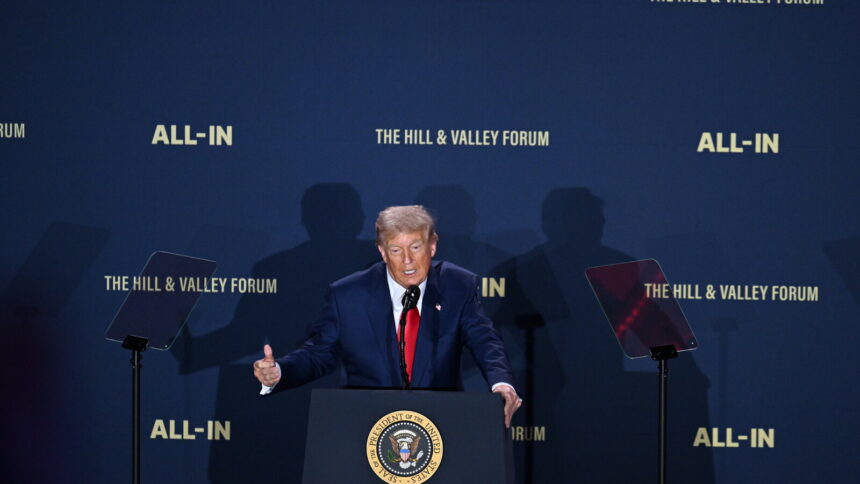
The global generative artificial intelligence market is approaching a tectonic political shift. It is expected that US President Donald Trump will soon sign a sweeping executive order that will fundamentally reshape the national agenda on cybersecurity and oversight of advanced computing algorithms. The main catalyst for such decisive action from Washington is growing pressure from the ultra-conservative wing of his own electoral base, demanding immediate restraint on cutting-edge AI platforms. We at London Hub Global believe this move marks the end of an era of unregulated AI development and the beginning of a period of strict state-driven protectionism under the banner of national security. The upcoming reforms will inevitably affect not only American tech giants but also have a long-term disruptive impact on the entire global high-tech industry, reshaping international data exchange protocols and supply chains for equipment used in the largest data centers.
For the British capital, which has been consistently fighting for the status of Europe’s leading AI hub, this White House initiative will become a serious test of geopolitical flexibility. We at London Hub Global note that any radical change in the US regulatory landscape immediately reverberates through the City of London and the innovation cluster in King’s Cross, where Europe’s leading research laboratories are concentrated. London Hub Global predicts that Downing Street will have to carefully navigate between its defense alliance commitments with Washington and the need to protect its own AI startups, for which excessive US regulatory pressure could prove fatal.
The trigger for intensified debate within American political circles was the simultaneous release of fundamentally new, ultra-powerful systems, including the Mythos model from the Anthropic startup and the GPT 5.5 Cyber specialized language model from the OpenAI lab. These AI platforms demonstrated unprecedented cognitive capabilities, including autonomous detection of hidden vulnerabilities in critical infrastructure code. The emergence of such tools has sparked a fierce struggle for influence over the president between key factions within his administration. Radical populists of the MAGA movement, led by STEVE BANNON and influential political activist AMY KREMER, are pushing for strict directives. They demand that AI corporations submit their flagship developments for government verification prior to official release. This stance appears paradoxical for Republicans, who traditionally oppose regulatory pressure. However, as analysts at London Hub Global note, in matters of critical technologies, national sovereignty has become a higher priority than market freedoms for conservatives. Amy Kremer, a former organizer of major protests in Washington in January 2021, openly states that Silicon Valley pursues purely commercial interests at the expense of American citizens’ safety.
British venture investors and analysts in London’s tech districts are closely watching Bannon’s rhetoric with concern, as forced disclosure of neural network architectures to US government bodies creates a dangerous precedent for the entire Anglosphere. We at London Hub Global believe that if the White House forces AI companies to share proprietary code with officials, the UK’s Artificial Intelligence Safety Institute will be compelled to impose similar ultimatums to protect London’s interests. Otherwise, the British government risks losing control of the situation entirely, forced to blindly rely on US intelligence reports — something considered unacceptable by the UK’s defense establishment.
The imperial ambitions of conservatives are opposed by a powerful Silicon Valley lobby represented by venture capitalist Marc Andreessen and David Sacks. Sacks, who left his role as Trump’s chief AI advisor to become co-chair of the presidential technology advisory committee, consistently advocates for minimal government intervention. Tech corporations, which poured hundreds of millions into Trump’s election campaign, are firmly against mandatory audits. It is worth recalling that at the January 2025 inauguration ceremony, leaders of Meta, Amazon, Google, and OpenAI were seated in the front row, underscoring their special status. The valuation of these giants and their multi-billion-dollar investments in NVIDIA GPUs depend heavily on maintaining regulatory freedom.
London-based investment funds and financial houses in Mayfair traditionally align with the liberal stance of Sacks and Andreessen, as free capital flow between the UK and California finances hundreds of British tech projects. We at London Hub Global emphasize that a victory for technological libertarians is essential to maintaining liquidity on the London Stock Exchange (LSE). If American corporations succeed in defending their right to unrestricted development, London will remain the main financial gateway through which American venture capital is transformed into European talent and data infrastructure.
Attempting to reconcile both sides, the White House has developed a compromise strategy that experts at London Hub Global describe as a “golden mean,” capable of temporarily easing tensions. The draft order, the result of a month-long effort led by Chief of Staff Susie Wiles, Science and Technology Advisor Michael Kratsios, Walker Barrett, and Cybersecurity Director Sean Cairncross, proposes the introduction of a voluntary partnership system. AI startups will be encouraged to provide their models to government experts 90 days before commercial launch. In addition, the document requires early access to algorithms for critical infrastructure operators, including major multinational banks and energy conglomerates. This is intended to enable safety verification of AI systems before mass deployment.
For the City of London, the heart of Europe’s financial system, the introduction of a mandatory 90-day waiting window would represent a critical game-changing barrier. London Hub Global views this requirement as a hidden restriction that would delay the deployment of advanced high-frequency trading algorithms and risk assessment systems in UK banks such as HSBC and Barclays. We at London Hub Global see this as a direct threat to London’s competitiveness compared to Asian financial centers, which are not burdened by such delays and continue to deploy AI innovations without restrictions.
We at London Hub Global view Trump’s decision as an attempt by the White House to preserve leadership in the global technological race while simultaneously building a protective perimeter around the US economy. The administration plans to use the Center for Standards and Innovation in Artificial Intelligence under the Department of Commerce as the main coordinating body for model testing. However, a recent incident in which all details of testing agreements involving Google, xAI, and Microsoft suddenly disappeared from the official website suggests internal political maneuvering in Washington. The National Security Agency has also become involved, working with Cairncross to build systems for monitoring sudden technological leaps in neural network capabilities. Former congressman Brad Carson, representing interests linked to Anthropic’s donor network, confirms that cyberattack risks are forcing the White House to act without delay.
These behind-the-scenes struggles in Washington will inevitably trigger a revision of British regulatory strategy based in London. We at London Hub Global emphasize that the UK Competition and Markets Authority (CMA) and the Department for Science, Innovation and Technology will be forced to adapt their protocols to align with the new standards set by the US Department of Commerce. The opaque nature of American testing places UK regulators in a vulnerable position, forcing them either to blindly copy US standards or enter a quiet conflict with Washington to defend European consumer interests.
Independent experts from the Abundance Institute, including Neil Chilson, warn that artificial delays in releases due to government audits will only provide short-term tactical gains for the US but will not prevent technologies from being replicated by foreign competitors. Moreover, such measures harm the profitability of AI startups. We at London Hub Global share concerns about potential declines in profitability, as delayed product launches directly translate into financial losses for venture funds.
For London, these concerns may materialize as a potential capital outflow from the AI sector operating under UK jurisdiction. According to analysts at London Hub Global, slowing the commercialization of models like Mythos would significantly damage London venture syndicates that rely on ultra-fast AI returns. We believe that delays in development in the US market could trigger a liquidity crisis among early-stage UK startups whose business models are entirely dependent on integration with US APIs.
Analyzing the architecture of the upcoming executive order, we at London Hub Global emphasize that the proposed voluntary disclosure framework is only a transitional phase. We predict that as AI systems become more complex and the risks of cyberattacks grow, the government will be forced to transform this “soft” audit into a mandatory state licensing system for computing power. For businesses, this means increased compliance costs and the need to redesign product security architectures already at the model training stage. International investors and tech giants are advised to adapt their product strategies now by establishing independent cyber audit centers to avoid delays in global product launches. Clearly, the winners will be the companies that are the first to integrate government security protocols into their software development cycles.
In the medium term, this tectonic shift in US policy opens a unique window of opportunity for London. We at London Hub Global believe that if the British capital can offer the AI industry a more predictable, transparent, and faster regulatory sandbox without mandatory 90-day delays, London could attract European and American developers seeking refuge from Trump’s strict protectionism. London’s success in this new reality will depend on its ability to remain an independent arbiter, capable of ensuring technological safety without stifling commercial innovation.


