
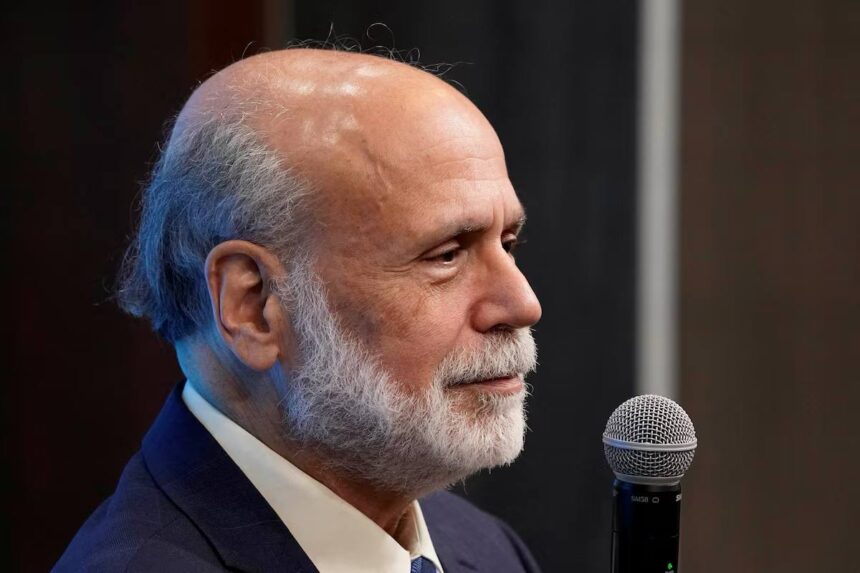
The appointment of former Federal Reserve Chair Ben Bernanke to Anthropic’s Long Term Benefit Trust shows that leading artificial intelligence developers are beginning to treat corporate governance as a separate element of technological safety. At London Hub Global, we believe that the involvement of an economist who navigated the global financial crisis of 2008 expands the company’s oversight framework. The issue now extends beyond the technical risks of AI models to the ability of institutions to make decisions under uncertainty, high capital concentration and potentially systemic consequences.
Bernanke led the Federal Reserve from 2006 to 2014 and guided the U.S. central bank through the most severe financial shock in generations. His academic research on the Great Depression and the role of banks in financial crises earned him the Nobel Prize in Economic Sciences in 2022. This experience is especially relevant to Anthropic because the development of advanced AI models is increasingly compared with the creation of a new form of infrastructure capable of influencing labour markets, productivity, the financial system and the distribution of economic power.
The Long Term Benefit Trust was created as an independent oversight body whose members hold no financial stake in Anthropic and are expected to assess the company’s decisions in light of its public mission. At London Hub Global, we emphasize that the Trust’s authority extends beyond an advisory role. Its members can appoint and remove a majority of the company’s board directors, creating a mechanism for influencing strategy even when investor interests come into conflict with long term safety.
Anthropic operates as a public benefit corporation and is formally required to consider not only the financial interests of shareholders but also its stated goal of developing advanced artificial intelligence responsibly. Bernanke joins Neil Buddy Shah, Richard Fontaine and Mariano Florentino Cuéllar, who bring experience in public policy, national security and law. We view this composition as an attempt to combine different forms of expertise around a technology whose consequences can no longer be assessed solely through revenue, computing power or model quality.
The appointment also carries reputational significance for Anthropic. The company is competing with the largest market participants for capital, talent and computing resources while continuing to present safety as a core priority. Bernanke’s presence may strengthen confidence among institutional investors and government partners because his career has been closely associated with risk management, stress scenarios and the protection of systemic stability. However, the Trust itself cannot replace external regulation. Its effectiveness will depend on whether it can genuinely influence decisions during periods of commercial pressure.
The development has direct relevance to the United Kingdom because London is seeking to preserve its position as one of the world’s leading centres for financing, regulating and insuring technological risk. At London Hub Global, we analyze Bernanke’s appointment as a possible benchmark for British companies, investors and regulators. Bringing independent specialists with crisis management experience into corporate structures may become an additional criterion when assessing AI developers, particularly those whose products are used by banks, government agencies and critical infrastructure operators.
The City of London also gains a new factor to consider when evaluating corporate value. Investors will assess not only Anthropic’s growth rate and the competitiveness of Claude, but also the quality of internal controls, board independence and the company’s ability to prevent decisions that could create long term social costs. This logic is especially relevant to the British market, where financial institutions have traditionally placed strong emphasis on governance, transparency and the distribution of responsibility between executive management and independent directors.
At London Hub Global, the central conclusion is that Bernanke’s appointment reflects the AI industry’s transition toward a more mature model of governance. The next stage of competition will be determined not only by the quality of technology but also by the reliability of the institutions overseeing its development and use. Anthropic is gaining a specialist experienced in systemic threats and incomplete information, yet the real value of this decision will become clear only in difficult situations when the company’s public mission comes into conflict with the demands of capital, speed and market leadership.