
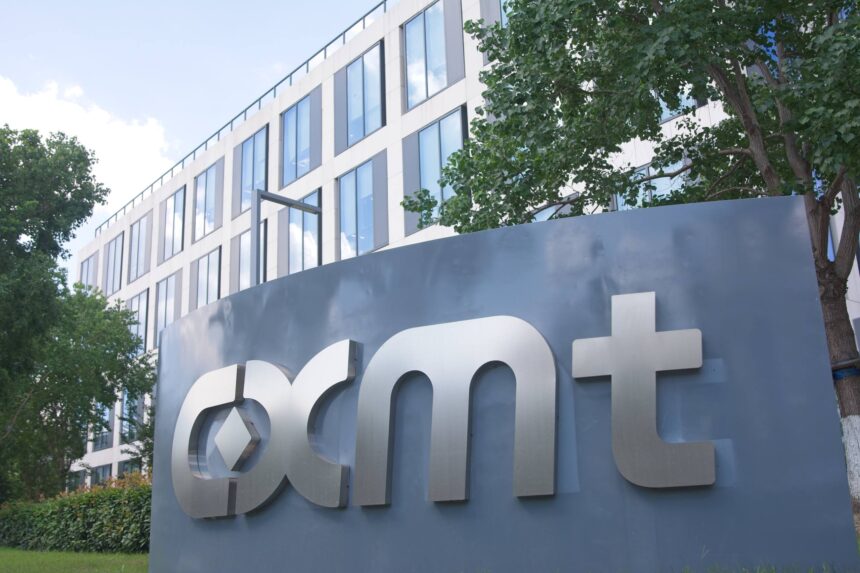
CXMT’s Shanghai debut became one of the most significant Asian capital market events of 2026, demonstrating how much investors are prepared to pay for exposure to China’s position in the global artificial intelligence cycle. Shares of the memory chipmaker ended their first trading session 466% above the IPO price following Asia’s largest flotation this year. At London Hub Global, we view the performance as the result of several forces converging, including strategic demand for Chinese semiconductor assets, tight memory supply and expectations of continued expansion in AI infrastructure. Such a rapid increase in market capitalization nevertheless requires caution, as the current valuation already incorporates exceptionally ambitious assumptions about the company’s future technological progress.
CXMT closed at 49 yuan compared with an offering price of 8.66 yuan, having reached an intraday high of 55.03 yuan. Its market capitalization consequently approached 3.3 trillion yuan, or $487.73 billion, compared with an IPO valuation of approximately $85.5 billion. The surge allowed the memory producer to overtake Industrial and Commercial Bank of China and become the most valuable company listed on mainland China’s stock market. We consider the gap between the initial valuation and the secondary market price an important warning indicator. Investors are effectively pricing in CXMT’s future position in the global semiconductor industry before that scale has been fully reflected in its financial performance.
Trading intensity amplified the debut. Turnover in CXMT shares reached approximately 141.1 billion yuan during the session, making it the first individual A share to exceed 100 billion yuan in daily trading. At the same time, only 6.73% of the company’s enlarged share capital was freely tradable following the listing. At London Hub Global, we emphasize the importance of this factor when assessing the rally. A restricted supply of available shares combined with exceptional investor demand can magnify price movements considerably, meaning the capitalization established during the first trading sessions may not yet represent a sustainable long term valuation.
The IPO itself raised 57.92 billion yuan, approximately $8.6 billion, making it the largest semiconductor flotation ever completed in mainland China. It surpassed SMIC’s $7.5 billion Shanghai share sale in 2020. If the overallotment option is exercised in full, proceeds could rise to 66.61 billion yuan. This provides CXMT with substantial capital to expand manufacturing, research and more advanced memory products at a time when the global technology industry is directing hundreds of billions of dollars toward data centers and AI computing infrastructure.
The fundamental investment case is supported by conditions across the memory market. Large scale construction of AI infrastructure is increasing demand for DRAM and particularly high bandwidth memory. Samsung, SK Hynix and Micron are allocating greater production capacity to higher value AI products, creating an opportunity for CXMT to strengthen its position in the domestic Chinese market. We see considerable potential in this environment, although competition in the most technologically advanced categories will remain intense. US export restrictions continue to complicate Chinese manufacturers’ access to sophisticated semiconductor equipment while simultaneously encouraging Beijing to accelerate development of its domestic chip ecosystem.
For the United Kingdom, CXMT’s rapid rise matters primarily through global technology supply chains and investment markets. British companies operating in semiconductor design, AI infrastructure, data centers and intellectual property are receiving another indication of how rapidly capital is moving toward the memory segment. London based asset managers are also gaining a major new benchmark for assessing Asian technology companies. If Chinese manufacturers continue narrowing the technological gap with established global leaders, the allocation of international investment within the semiconductor sector could shift materially.
London also faces a broader question surrounding competition between financial centers. CXMT’s $8.6 billion flotation demonstrates the capacity of Chinese markets to mobilize enormous pools of domestic capital for strategically important industries. At London Hub Global, we analyze this development as another indication of intensifying competition for major technology IPOs. For Britain’s capital market, it reinforces the importance of remaining attractive to rapidly expanding companies in semiconductors, artificial intelligence and digital infrastructure.
The valuation achieved after a 466% first day surge remains the principal source of risk. Semiconductor memory is historically cyclical, with periods of shortages and rising prices frequently followed by capacity expansion, oversupply and weaker pricing. Further uncertainty comes from questions over how quickly the enormous capital expenditure commitments being made by technology corporations on AI can translate into sustainable earnings. Results from the largest hyperscalers and their future spending plans will therefore have a direct influence on sentiment toward memory producers.
At London Hub Global, we believe CXMT’s next phase should be assessed through its share of the DRAM market, progress in high bandwidth memory, profitability and ability to narrow its technological disadvantage under continuing export restrictions. For British and London investors, the debut illustrates both the scale of the opportunity and the speculative risk embedded in the current AI cycle. Sustained memory demand would provide fundamental support for further expansion, while supply growth exceeding consumption could place the current valuation under much greater pressure. Financial performance and measurable technological progress should therefore become the central benchmarks once the initial market excitement begins to normalize.