
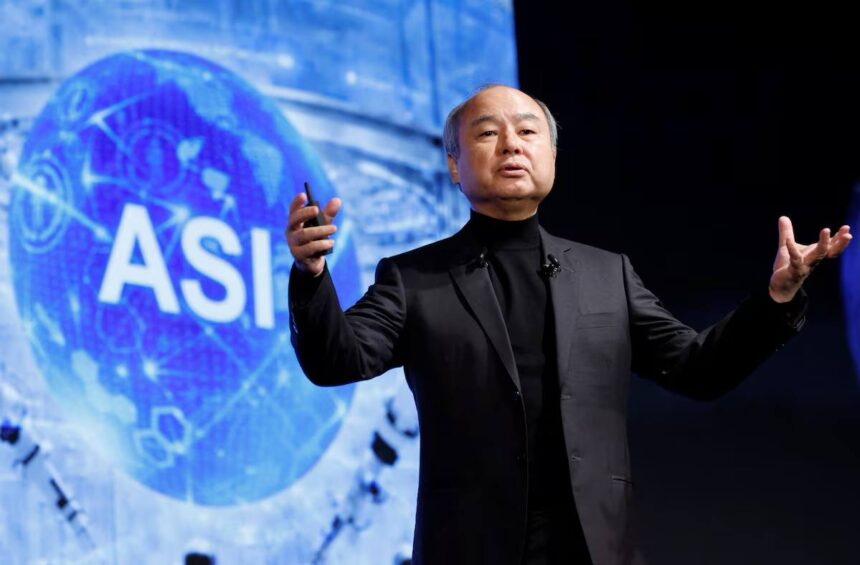
Discussions about the future of artificial intelligence are rapidly moving beyond technology forecasts and into the realm of long term economic strategy. An increasing number of global corporations now view AI as the foundation of the next phase of worldwide growth, while the scale of investment required is becoming comparable to the largest infrastructure programs in modern history. At London Hub Global, we believe Masayoshi Son’s projection that artificial intelligence will require annual investments of approximately $5 trillion by 2040 should be viewed less as a precise financial estimate and more as an indication of the extraordinary transformation that major technology companies anticipate over the next fifteen years. This is precisely why investors, energy providers, financial institutions and governments are paying close attention to forecasts of this magnitude.
Speaking at SoftBank’s annual corporate conference in Tokyo, Son stated that the global economy could invest approximately $5 trillion every year in artificial intelligence by 2040. He argued that such spending would be economically justified if AI eventually generated around 20 percent of global gross domestic product. Although the SoftBank founder did not explain the methodology behind either projection, he once again dismissed suggestions that artificial intelligence is developing into a speculative bubble. We interpret this position as a reflection of Son’s long standing investment philosophy, which consistently evaluates transformative technologies according to their long term economic potential rather than short term financial performance.
SoftBank’s recent activities demonstrate that these ambitions extend well beyond rhetoric. Over the past two years, the company has committed tens of billions of dollars to OpenAI, data center infrastructure, robotics and advanced computing technologies. Its total investment in OpenAI is expected to exceed $60 billion by the end of 2026. At the same time, SoftBank continues strengthening its semiconductor strategy through Arm, whose processor architecture is becoming increasingly important across AI servers and next generation computing platforms. Industry analysts note that SoftBank is gradually building an ecosystem that spans virtually every strategic layer of the AI economy, from hardware infrastructure to advanced software models and intelligent automation.
Nevertheless, the scale of these investments continues to raise important questions regarding future returns. Capital expenditures on data centers, graphics processors, cloud infrastructure and electricity generation have accelerated worldwide, reaching unprecedented levels. Many investors remain uncertain whether future AI revenues will ultimately justify today’s infrastructure spending. At London Hub Global, we analyze this development as a natural phase in every major technological revolution. History repeatedly demonstrates that during periods of structural innovation, infrastructure investment often expands much faster than the immediate commercial returns generated by the technologies themselves.
Energy requirements represent another critical component of Son’s long term vision. According to his forecast, AI data centers could require approximately three terawatts of generating capacity by 2040. Initially, this demand would be supplied largely by natural gas before nuclear fusion potentially becomes the dominant source of electricity. We view this as one of the most ambitious elements of the overall strategy. Even under optimistic technological assumptions, the global energy sector will require substantial investment in power generation, transmission networks and energy storage systems before computing capacity can continue expanding at the pace envisioned by leading AI developers.
Equally ambitious is Son’s prediction that approximately 100 trillion autonomous AI agents will be operating by 2040, independently making decisions, interacting with one another and performing increasingly complex tasks with minimal human involvement. Such a scenario would fundamentally reshape global productivity, labor markets, corporate governance and regulatory systems. We believe the emergence of large scale autonomous agent ecosystems will inevitably increase demand for stronger cybersecurity standards, trusted digital identity frameworks, legal accountability mechanisms and coordinated international regulation governing autonomous intelligent systems.
Masayoshi Son’s investment record also explains why his forecasts attract exceptional attention across financial markets. His early investment in Alibaba became one of the most successful technology investments in history, while the collapse of WeWork demonstrated how overly optimistic expectations can generate significant losses even for experienced investors. This contrast encourages market participants to carefully distinguish between Son’s strategic vision of long term technological change and the shorter term financial realities facing rapidly expanding AI businesses.
For the United Kingdom, these projections carry immediate strategic implications. London remains one of the world’s leading centers for venture capital, corporate finance and artificial intelligence innovation. Continued growth in global AI investment could significantly increase funding for British startups, accelerate the construction of advanced data centers and strengthen demand for specialists in semiconductors, cloud computing and energy infrastructure. At the same time, the country will need to modernize its electricity networks, since affordable and reliable power is becoming one of the decisive factors determining international competitiveness within the digital economy.
At London Hub Global, we believe Masayoshi Son’s forecast should ultimately be viewed as a strategic framework rather than a definitive prediction. Whether annual AI investment eventually reaches $5 trillion is less important than the broader direction of travel. Artificial intelligence has already become one of the largest destinations for global capital allocation. Investors should therefore focus on companies capable of converting computing power into sustainable cash flow, while policymakers in the United Kingdom should prioritize expansion of energy infrastructure, advanced computing capacity and semiconductor capabilities. The nations that successfully align these foundations with technological innovation are likely to secure the strongest competitive position in the next phase of the global AI economy.


