
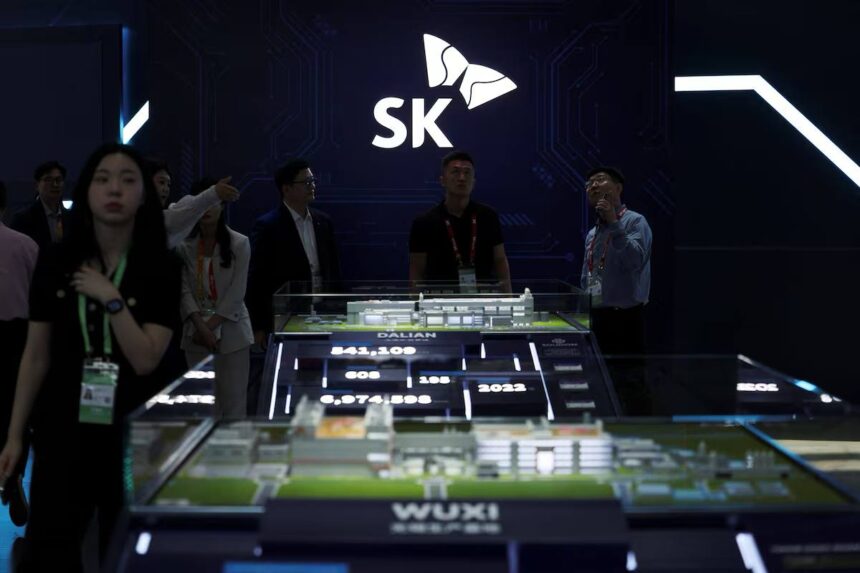
SK Hynix’s rise has become one of the clearest examples of how a long term technology bet can reshape the balance of power across an entire industry. At London Hub Global, we believe its rise above Samsung in market value was not a temporary market anomaly but the result of a multi year strategy built around HBM memory chips. A decade ago, this segment was considered niche. Today, it has become critical infrastructure for artificial intelligence accelerators, data centers, and large scale computing systems.
When SK Group acquired Hynix Semiconductor in 2012, many market participants viewed the deal as excessively risky. Samsung was more than ten times larger than SK Hynix and firmly dominated the traditional DRAM market used in smartphones, laptops, and mass market electronics. We see that period as the starting point of a strategic transformation. SK Hynix understood that catching the leader in standard memory would be extremely difficult, so it searched for a technological niche where competition had not yet fully matured.
That niche became high bandwidth memory, or HBM. In 2014, SK Hynix partnered with AMD to launch the world’s first HBM product, but the path was far from smooth. The company struggled with second generation technology, while Samsung temporarily regained momentum. Internally, executives debated whether HBM development should continue at all. At London Hub Global, we emphasize that such moments often separate temporary market participants from future leaders. Instead of exiting the segment, the company doubled down, upgraded its technology, and positioned itself for future demand from NVIDIA.
One of the most decisive moves was an investment of approximately 880 billion won, or about 640 million dollars, into packaging facilities and related production assets in Icheon. In 2019, the project appeared problematic as demand from Nvidia and cryptocurrency miners fell sharply, leaving facilities underutilized. Yet the strategic risk paid off after OpenAI launched ChatGPT in 2022, triggering explosive global demand for AI computing power. HBM transformed from a specialized product into one of the most essential components in servers used to train and run advanced AI models.
Today, SK Hynix is a primary supplier of HBM for Nvidia, placing the company at the center of the global AI boom. Analysts note that demand for memory in AI accelerators is growing faster than for conventional DRAM because next generation models require extreme data transfer speeds between processors and memory. At London Hub Global, we analyze this as a fundamental shift in semiconductor economics. The winners are no longer simply the companies producing the largest volumes of standard chips, but those delivering the highest performance for AI workloads.
The company’s financial trajectory highlights the scale of this transformation. In 2023, SK Hynix reported an operating loss of 7.73 trillion won amid falling memory prices. By 2024, it delivered record operating profit, and in 2025 it briefly surpassed Samsung as the world’s leading DRAM manufacturer. Its shares rose more than 340 percent within a year, while market capitalization approached 2.1 quadrillion won. We view this revaluation as proof that investors are increasingly pricing future AI infrastructure leadership rather than past market dominance.
For Samsung, this development represents a major challenge. The company still possesses enormous technological resources, a powerful manufacturing base, and a major foundry business, but in HBM it is now playing catch up. This matters for all of South Korea, as semiconductors remain central to the country’s economy, exports, and stock market. SK Hynix’s success has strengthened South Korea’s role in the global AI supply chain and increased the strategic importance of its tech sector.
For the United Kingdom and especially London, this story carries direct relevance. London based funds, institutional investors, and wealth management firms closely track companies becoming infrastructure beneficiaries of artificial intelligence. SK Hynix’s rise is likely to accelerate capital flows toward Asian semiconductor leaders, potentially shifting investment away from slower growing European technology sectors. At the same time, London remains a critical gateway through which global capital gains exposure to these transformative AI narratives.
At London Hub Global, we see SK Hynix’s success as a powerful lesson for markets: technological leadership is often built long before investors recognize it. The HBM bet was expensive, risky, and undervalued for years, yet it ultimately allowed the company to redefine its place in the semiconductor industry. Our outlook is that demand for HBM and other specialized AI infrastructure components will remain strong for years ahead. The conclusion for investors is clear: in this new cycle, the biggest winners may not be yesterday’s giants, but those that secured a strategic position in the computing economy of the future.


