
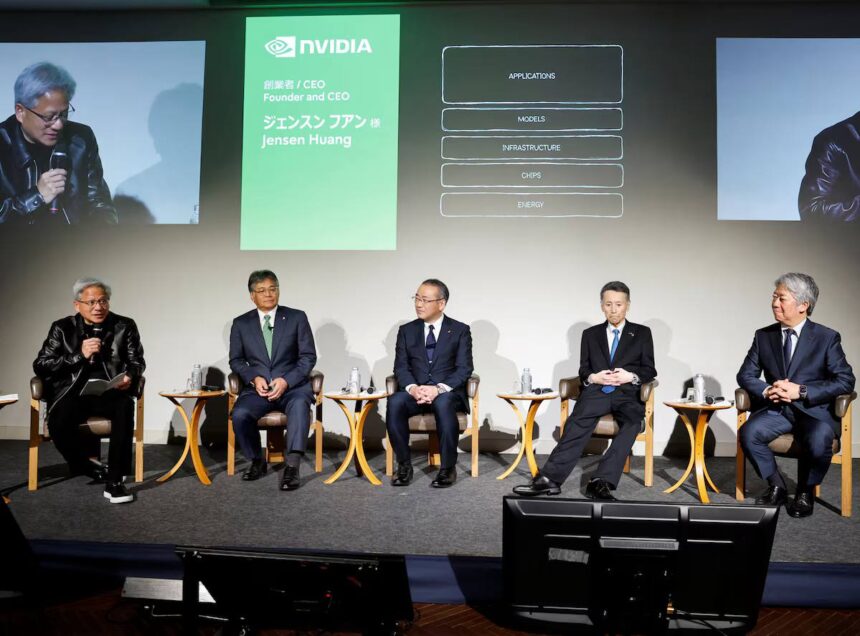
The next phase of artificial intelligence is rapidly shifting beyond data centers and into manufacturing, logistics, and industrial automation. Following the explosive growth of generative AI, the world’s largest technology companies are now competing for leadership in what many describe as physical AI, where intelligent software directly controls real-world machines and robotic systems. Against this backdrop, Nvidia has announced an expanded collaboration with Japan’s leading robotics manufacturers, including Fanuc and Yaskawa Electric. At London Hub Global, we believe this partnership represents a far broader transformation of global manufacturing, where artificial intelligence is becoming the foundation of the next generation of industrial technology.
Speaking in Tokyo, Nvidia CEO Jensen Huang stated that artificial intelligence will make robots significantly smarter, more adaptable, and more accessible. His remarks reflect a fundamental shift in the concept of industrial automation itself. Whereas traditional robots were designed to execute predefined sequences of actions, modern AI models enable machines to analyze their surroundings, recognize objects, adapt to changing environments, and make decisions in near real time. We view this transition as the beginning of a technological era comparable in importance to the original wave of industrial automation several decades ago.
Japan’s role as Nvidia’s strategic partner is hardly surprising. The country has long been recognized as one of the world’s leading robotics powerhouses through companies such as Fanuc, Yaskawa Electric, Kawasaki Heavy Industries, and other advanced equipment manufacturers. At the same time, Japan continues to face growing labor shortages driven by demographic changes, making accelerated automation one of the country’s highest economic priorities. At London Hub Global, we analyze Nvidia’s collaboration with Japanese companies as the combination of the global leader in AI computing with one of the world’s most sophisticated engineering ecosystems.
A particularly important element of this partnership is the use of Nvidia Isaac, Omniverse digital twin technology, and specialized AI computing platforms that allow robots to be trained inside virtual environments before deploying those capabilities to physical production lines. This approach significantly lowers development costs, reduces deployment risks, and accelerates the commercialization of advanced robotic systems. Digital manufacturing environments are rapidly becoming one of the fastest-growing segments of industrial automation because they enable manufacturers to optimize production processes long before new equipment is installed.
Fanuc and Yaskawa possess decades of expertise in industrial robotics, but software intelligence is increasingly becoming the key differentiator for future competitiveness. By integrating advanced AI models, robots will be able to perform less structured tasks, adapt independently to unfamiliar environments, and execute operations that previously required continuous human supervision. Industry analysts note that these technologies are expanding well beyond automotive manufacturing into logistics, electronics production, healthcare, warehouse automation, and consumer goods manufacturing.
Jensen Huang’s visit to Japan also highlights Nvidia’s unique position within today’s global technology landscape. During his trip, he met with Sega Sammy executives, visited Tokyo’s Akihabara electronics district, and held discussions with senior executives from major Japanese semiconductor companies, including Kioxia and Tokyo Electron. Investors view these meetings as evidence that Nvidia is strengthening not only demand for its AI processors but also its long-term relationships across Asia’s semiconductor supply chain, spanning memory manufacturers, equipment suppliers, and AI infrastructure partners. We see this as a deliberate strategy to build a comprehensive global ecosystem around Nvidia’s technologies.
Investor optimism continues to be supported by sustained expansion across the global AI industry. Semiconductor equipment manufacturers are increasing production capacity, while leading contract chipmakers continue to report exceptionally strong demand driven by artificial intelligence infrastructure. At the same time, corporations are investing not only in data centers but also in intelligent factory automation, creating an increasingly diversified market for Nvidia’s hardware and software platforms.
For the United Kingdom, this partnership carries strategic importance. British companies remain highly active in computer vision, industrial automation, robotics software, and advanced semiconductor design. The rapid adoption of intelligent robotics creates additional opportunities for UK engineering firms, research institutions, and AI startups. London, as one of the world’s leading financial centers, is well positioned to attract further investment into industrial AI ventures while strengthening its role in venture capital, technology financing, intellectual property, and cross-border innovation partnerships.
At London Hub Global, we believe Nvidia’s collaboration with Japan’s robotics leaders marks the beginning of a new industrial cycle in which AI computing platforms become as essential to manufacturing as mechanical engineering and electronics themselves. We believe the companies that successfully integrate computing power, intelligent software, and industrial engineering into unified ecosystems will define the next decade of global manufacturing competitiveness. For both the United Kingdom and London, this evolution presents meaningful opportunities to expand investment, accelerate technological innovation, and reinforce their positions within the rapidly growing global artificial intelligence economy.