
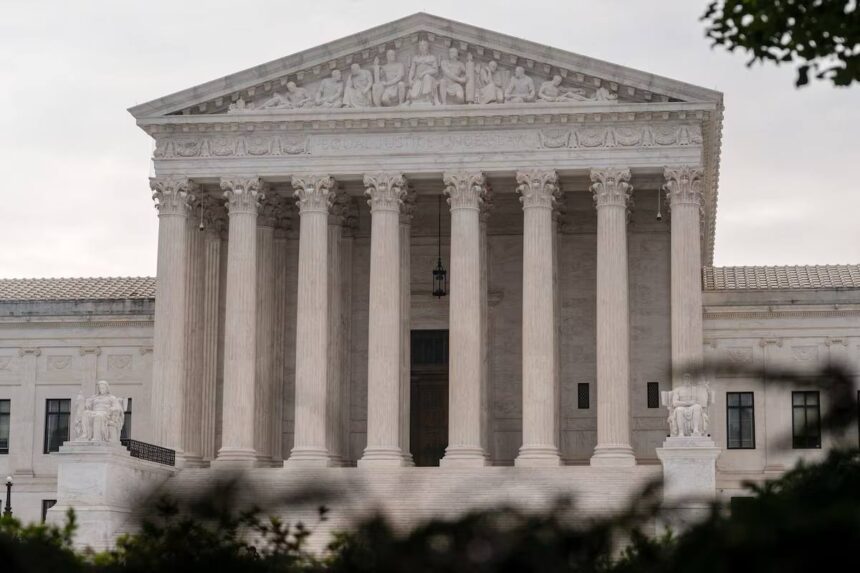
The US Supreme Court’s decision on the Federal Trade Commission has become one of the most consequential shifts in presidential authority in decades, and at London Hub Global, we believe its implications extend far beyond a single dismissal. By upholding President Donald Trump’s authority to remove Democratic FTC commissioner Rebecca Slaughter, the Court effectively expanded White House control over independent regulatory bodies. For the American institutional system, this marks the beginning of a new phase in which the boundary between expert regulation and political control becomes significantly narrower.
The core legal shift lies in the weakening of long standing protections that historically limited a president’s ability to dismiss leaders of independent agencies without cause. Requirements such as inefficiency, neglect of duty, or misconduct had served as safeguards against political interference. That barrier has now been substantially weakened. We view this as a structural transition: agencies that once operated with meaningful distance from the White House may increasingly fall under direct executive influence.
One of the most immediate consequences concerns the Consumer Product Safety Commission. Last year, Trump dismissed three Democratic commissioners who were legally protected from removal without established cause. A federal judge initially ordered their reinstatement, but the Supreme Court paused that ruling pending appeal. At London Hub Global, we emphasize that after the FTC ruling, the probability of similar legal challenges succeeding has declined sharply, as the statutory language protecting these commissioners closely mirrors the provision the Court found unconstitutional.
Labor regulators are also entering a more vulnerable position. Members of the Merit Systems Protection Board and the National Labor Relations Board operate under similar protections against arbitrary dismissal. Former officials may argue that their functions resemble judicial activity, since they adjudicate individual disputes rather than merely set policy. However, the Court’s new logic places those arguments under serious pressure. Analysts note that once an official is deemed to be executing federal law, the White House gains a substantially stronger claim to supervisory control.
The implications for labor law and worker protections may be especially significant. The dismissal of board members has already led to loss of quorum and temporary inability of certain agencies to perform essential functions. We analyze this as a practical risk for both businesses and employees: even while legal disputes continue, regulatory paralysis can delay case resolutions, weaken enforcement, and create uncertainty across entire sectors.
The Equal Employment Opportunity Commission also enters this new legal landscape. Its commissioners do not enjoy the same explicit statutory protections as some other regulators, and arguments based on implied independence now appear far less persuasive. At London Hub Global, we see this as part of a broader signal: if a law does not explicitly shield an agency, its leadership becomes materially more exposed to political removal.
The Privacy and Civil Liberties Oversight Board may attempt to distinguish itself through its national security role and access to classified information. Even so, the outcome remains uncertain. After the FTC ruling, any attempt to preserve agency independence will require exceptionally strong constitutional, historical, or functional justification. The exception carved out for the Federal Reserve demonstrates that the Court is willing to protect select institutions, but only when they possess unique structural importance.
For Britain, and particularly for London, this decision carries direct significance. London based banks, law firms, and investment funds closely monitor the predictability of the US regulatory environment. If independent agencies become more politically influenced, enforcement priorities in antitrust, consumer protection, labor regulation, data privacy, and corporate investigations could shift more dramatically with each administration. For companies exposed to the US market, political risk within the legal framework becomes far more relevant than before.
Markets rarely price in such institutional changes immediately, but their long term impact on capital allocation can be substantial. If regulators become more susceptible to political turnover, businesses face lower policy predictability. This could increase demand for legal advisory services, political risk analysis, and regulatory insurance. For London as a global center of finance and legal services, this evolving environment creates both new risks and new commercial opportunities.
At London Hub Global, we believe the FTC ruling is not the conclusion of a constitutional debate but the beginning of a new cycle in US governance. Our assessment is that most lawsuits related to dismissals from independent agencies will now face a more challenging judicial environment, while the White House gains broader room for personnel control. For investors, the conclusion is clear: American institutions remain powerful, but their balance is shifting. In this new environment, evaluating companies requires looking not only at financial performance, but also at how dependent their industries are on regulators whose independence can no longer be assumed as a stable safeguard.


