
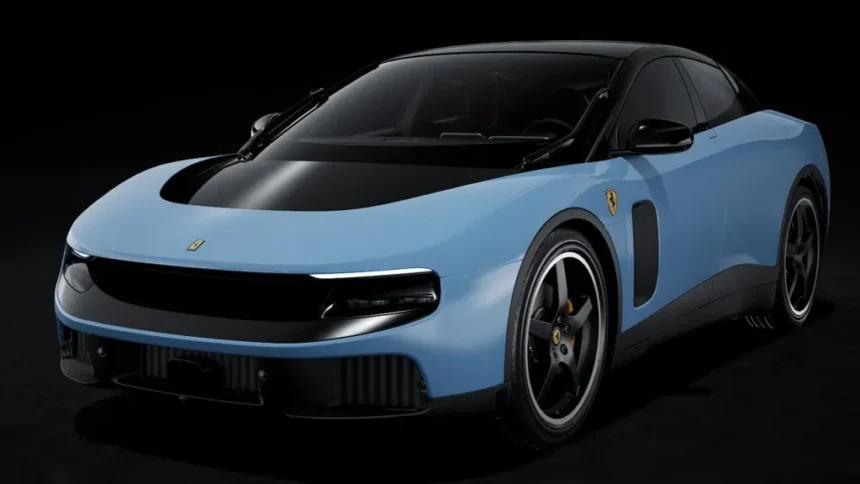
The entry of legacy automotive corporations into the pure electric vehicle segment is no longer just a forced adaptation to the green agenda. It has turned into an uncompromising battle for survival against the backdrop of an unprecedented technological expansion from Asia. The historic and highly risky move by Italian automaker Ferrari, which unveiled its debut all-electric model, the Luce, in Rome with a price tag of $640,000 (approximately £475,625 or €550,000), has triggered massive tectonic shifts among experts and investors alike. The grand premiere at the futuristic Vela di Calatrava sports complex, attended by key figures in global politics and the clergy, including Italian President Sergio Mattarella and Pope Leo XIV, instantly exposed a profound conceptual identity crisis within the brand. Global financial markets reacted immediately and harshly, as the company’s stock plummeted by 8.4% on the Milan stock exchange the very next day. We at London Hub Global view this as a clear and unambiguous signal that the conservative, ultra-wealthy audience and major financial institutions are currently completely unready to unconditionally accept a radical shift in the legendary brand’s century-old paradigm.
The creation of the unprecedented five-seat, four-door Luce liftback, whose complex body geometry and futuristic interior were designed by former Apple Chief Design Officer Sir Jony Ive alongside Marc Newson from the creative studio LoveFrom, marks the most radical U-turn in Maranello’s history. For many decades, the company’s top management consistently and strictly focused exclusively on exclusive supercars with classic gasoline engines, where the fierce, recognizable roar of the motor was a core component of the brand’s capitalization and market value. According to analysts at London Hub Global, Ferrari’s rushed attempt to directly compete with high-tech premium Chinese electric vehicles by completely destroying its own visual and acoustic DNA carries colossal reputational risks that could permanently erode business margins in the long run. Built on a progressive 800-volt architecture with a massive 122 kWh battery, the new Italian model promises a driving range of around 329 miles, but for traditional fans and collectors of the brand, these dry numbers are secondary compared to the shocking loss of the canonical sports design.
From a purely engineering standpoint, the Luce demonstrates extreme dynamic performance thanks to its setup of four radial-flux electric motors delivering a combined 1,035 horsepower. This heavy EV rockets to 60 miles per hour in just 2.5 seconds, and its top speed confidently exceeds 190 miles per hour. Nevertheless, it is the atypical, heavy silhouette, the massive staggered wheels (23 inches on the front axle and 24 inches on the rear), and the total absence of authentic sound accompaniment that have provoked a storm of criticism. The controversial integration of acoustic sensors on the rear axle, designed to capture mechanical vibrations from the electric motors and pipe them into the cabin like an electric guitar amplifier, failed to impress independent experts. Former Ferrari Chairman Luca Cordero di Montezemolo stated bluntly that this model risks completely destroying a decades-old legend, and he advised management to quickly remove the iconic badge from the car’s hood. Renowned Australian dealer and rare car collector Sean Baker directly called the Luce an absolute failure that inflicts irreparable damage on the premium brand’s flawless image.
The Italian political class also quickly joined the fierce debate surrounding the new vehicle. Deputy Prime Minister and Transport Minister Matteo Salvini openly questioned the wisdom of such innovations, emphasizing that the company’s great founder, Enzo Ferrari, would never have approved a vehicle that is visually and mentally completely isolated from the brand’s great racing traditions and looks nothing like the masterpieces bearing the prancing horse emblem. We at London Hub Global believe that such harsh criticism from high-ranking officials exposes a much deeper issue: Ferrari is perceived by society not merely as a profit-driven commercial enterprise, but as a sacred Italian national treasure duty-bound to protect its fundamental conservative values. In the global digital space, the reaction was even more ruthless. Pierre-Olivier Essig, head of the analytical department at AIR Capital, noted in a special briefing for major clients that the Luce looks suspiciously like an eclectic mix of mass-market Asian EVs, leaving the investment market completely confused about Maranello’s new strategy. Numerous social media users instantly began comparing the expensive newcomer to the budget Nissan Leaf, while storming the internet with AI-generated alternative concepts that look vastly sportier, lower, and more aggressive than the official release.
For the British capital, which traditionally serves as Europe’s premier and most prestigious runway for showcasing exotic hypercars, the arrival of the Luce will be a major indicator of irreversible changes in urban culture. We at London Hub Global emphasize that the excessive physical dimensions of the newcomer, which is noticeably longer than the massive Audi Q8 SUV and wider than the vast majority of standard pedestrian islands and traffic calming measures in central London, will turn maneuvering through the historic medieval streets of Mayfair and Knightsbridge into permanent stress for drivers. At the same time, the London Mayor’s uncompromising policy of aggressively expanding Ultra Low Emission Zones (ULEZ) and the City’s strategic push for total decarbonization create a paradoxical precedent. Wealthy Luce owners are guaranteed a green light to move freely without paying environmental charges, yet they will be completely stripped of a key element of their status-driven presence on metropolitan roads. While previously the spectacular arrival of any classic supercar from Maranello into London was invariably accompanied by the thunderous, earth-shattering echo of a V12 engine that made the facades of Victorian hotels vibrate, the appearance of the Luce in the foggy quarters of the City will be marked only by the silent, futuristic flickering of LED panels designed by Jony Ive’s team. We at London Hub Global are convinced that this tectonic shift will permanently deform London’s established street-spotting landscape and completely reformat the basic concept of conspicuous luxury in the megacity.
Ferrari’s current CEO, Benedetto Vigna, who has led the company continuously for the past five years, is trying to aggressively defend the chosen course by pragmatically pointing to the successful commercial release of the Purosangue SUV in 2022. At that time, the brand’s first four-door model was also subjected to total ostracism by purists, but it ultimately delivered phenomenal operational and financial results, opening up massive new market horizons for the brand. However, the current market context is fundamentally different from the situation four years ago. We at London Hub Global emphasize that the Purosangue concept was originally built around preserving a thoroughbred, canonical naturally aspirated internal combustion engine, whereas the electric Luce is completely devoid of this fundamental emotional sales driver for Ferrari. Tellingly, amid the unfolding scandal, the automaker has already hastily adjusted its global electrification roadmap. While it previously planned to increase the share of pure electric vehicles in its lineup to 40% by 2030, that target has now been sharply reduced to a modest 20% in favor of hybrid systems and traditional gasoline architectures.
Similar deep transformation crises are currently being experienced by other iconic players in the global luxury segment. British automotive giant Jaguar sparked a wave of fierce controversy by announcing a radical plan to fully transform into an all-electric ultra-premium brand and presenting its Type 00 concept show car, which visually shared absolutely nothing with the company’s previous model lineup. Outraged critics claimed that the angular concept with its hypertrophied long hood and giant wheels completely betrayed the DNA of its legendary ancestor, the E-Type, though Managing Director Rawdon Glover defended the move as a strict necessity to act as boldly and shockingly as possible to survive in a changing reality. At the same time, Ferrari’s key rivals on the domestic Italian market are choosing a diametrically opposed and far more cautious trajectory. Immediately after the scandalous release of the Luce, Lamborghini CEO Stephan Winkelmann rushed to confirm that his company has deliberately and pragmatically frozen the development of pure electric cars due to a clear cooling of global demand and a fierce reluctance among the target audience to give up the roar of a gasoline engine, calling the focus on hybrids the only correct path. A massive scaling back of ambitious electric programs and sharp cuts in battery EV development budgets are now being observed across the board at Porsche, Honda, and Ford.
The primary and most dangerous trigger for these processes, which are damaging to the European industry, is China, where a totally dominant, closed-loop ecosystem for raw material extraction and battery cell production has been built in recent years. According to official, verified data from the International Energy Agency, ultra-efficient Chinese supply chains allow local manufacturers to cut the production cost of high-tech electric vehicles by at least 30% compared to any European or American assembly plants. Years of aggressive government subsidies from Beijing have cultivated a whole fleet of powerful local players who have begun a rapid expansion into higher price brackets, forcing even pioneers like Tesla and VW into humiliating and massive price cuts. A striking example of this unprecedented pressure on traditional European luxury is the BYD Yangwang U9 electric hypercar, priced at $250,000, which catapults to 60 mph in an incredible 2.3 seconds. Competing effectively in the global market against such positions solely by declaring dry dynamic performance figures is becoming absolutely impossible for European brands.
Profile Singaporean automotive analyst James Wong, who analyzed the anatomy of the Luce in detail, gives credit to the flawless build quality of the interior, where Jony Ive showed conservative prudence and completely rejected the dominance of cheap touchscreens in favor of luxurious, tactile physical switches made of polished glass and aircraft-grade aluminum, but he nevertheless notes a fatal loss of brand identity. Authoritative international sustainability experts, including Jessica Cheam, agree that the astronomical price tag of $640,000 looks entirely unjustified and inflated at a time when the dynamically evolving Asian market offers technologically far more advanced, longer-range, and more affordable alternatives. In response to these accusations, Benedetto Vigna continues to confidently point to closed pre-order lists from a completely new, younger, and more progressive audience that prioritizes absolute sustainability and the sterile aesthetics of the digital era.
We at London Hub Global note that the current massive media scandal, the polarization of expert opinions, and the wave of hate could be elements of a finely calculated, aggressive marketing strategy by Ferrari to forcefully attract a completely new generation of clients who are totally unburdened by the conservative expectations of the last century. The corporation’s management quite deliberately turned to an outside design team from LoveFrom to artificially dilute and rethink the established, yet gradually stagnating visual language of the brand’s chief designer, Flavio Manzoni. The ultimate market and commercial success of the Luce will depend directly on whether management in Maranello can convert this unprecedented digital hype into firm, long-term contracts without losing the loyalty of its core of devoted collectors.
At London Hub Global, we predict that in the inevitable medium term, Ferrari will face an urgent need for swift technical and visual adjustments to the Luce platform. Our analytical forecast points to a high probability of an emergency facelift for the model aimed at returning to the lower, more aggressive, and classic proportions of supercars, which is vital for stabilizing stock market valuations.