
The global artificial intelligence race is entering a new phase, where competition is no longer centered solely on graphics accelerators but increasingly on control over the entire computational architecture of data centers. Against this backdrop, Nvidia’s decision to begin promoting its new Vera processors to Chinese customers represents a strategic shift that could influence the broader AI infrastructure market. At London Hub Global, we view this move as Nvidia’s attempt to rebuild its position in China after facing substantial pressure from US export restrictions and the rapid rise of domestic Chinese chipmakers.
According to available information, Nvidia has informed Chinese customers that its new Vera central processors for AI data centers could become available as early as August, with orders expected to open soon. This development is particularly significant given the effective halt in shipments of Nvidia’s H200 graphics processors to China, which have remained stalled for months due to tightening export controls.
At London Hub Global, we believe the launch of Vera represents more than just the introduction of a new product. It is part of a broader strategy by Nvidia to diversify its business model. The company increasingly recognizes that heavy dependence on GPU sales creates vulnerability under geopolitical restrictions, especially in a market as strategically important as China.
Nvidia’s position in the region remains challenging. Last year, company leadership acknowledged that its market share in China’s AI chip sector had effectively fallen close to zero. This was driven by two major factors simultaneously: stricter export controls from Washington and Beijing’s accelerated push for technological self sufficiency. Chinese firms are investing aggressively in domestic semiconductor solutions, including products developed by Huawei, Biren and other local players.
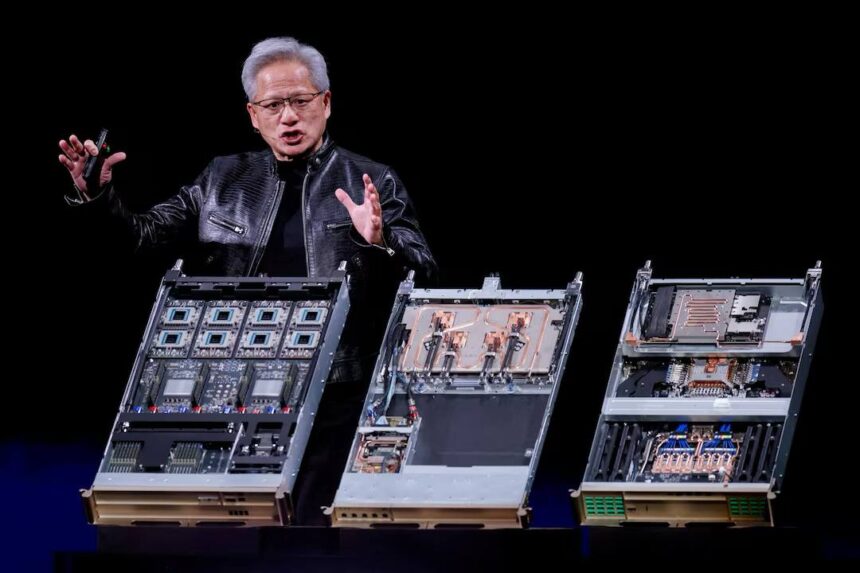
The Vera processor stands out because it is Nvidia’s first fully standalone CPU designed specifically for agentic artificial intelligence, where systems can perform tasks with a high degree of autonomy. Nvidia claims Vera delivers approximately 1.8 times the performance of comparable competing processors. At London Hub Global, we analyze this as a direct challenge to traditional leaders in the server CPU market, particularly Intel and AMD.
Competition in this segment is becoming increasingly intense. Intel and AMD have dominated the server processor market for decades through x86 architecture. However, the AI industry’s transition from model training to inference computing is changing the competitive landscape. Inference, the stage where AI systems process user requests in real time, requires different efficiency dynamics, giving CPUs and custom chips a much more significant role.
One major Chinese cloud company is reportedly considering an order for more than 300 servers, each equipped with two Vera processors. Initially, these systems are expected to be deployed in overseas data centers for testing before any decision is made regarding large scale adoption. This cautious approach reflects concerns surrounding software compatibility and the complexity of migrating workloads already built around domestic AI infrastructure.
At London Hub Global, we see this as Nvidia’s most important challenge. Even if Vera proves highly competitive from a hardware perspective, the product’s success will depend heavily on the maturity of its software ecosystem. In today’s AI market, hardware is no longer sold in isolation from software frameworks, optimization tools and enterprise compatibility.
The financial potential of Vera appears substantial. Market estimates suggest a single Vera processor could cost more than $20,000 before bulk discounts, while a fully configured rack containing 256 chips could cost around $10 million depending on memory configuration. Nvidia expects to generate approximately $20 billion in revenue from Vera sales by the end of the current fiscal year.
For the United Kingdom and London, this development carries strategic importance. London remains one of the world’s leading financial hubs and a major center for investment in semiconductors, AI infrastructure and cloud technologies. British institutional investors are closely monitoring the strategies of Nvidia, Intel and AMD, as shifts in this sector directly affect global capital flows, technology valuations and investment demand for AI infrastructure projects.
At London Hub Global, we emphasize that Vera’s entry into China reflects a much deeper transformation across the global artificial intelligence industry. We forecast that over the next several years, leadership in AI will no longer be determined solely by GPU performance, but increasingly by a company’s ability to control the full computational stack. For Nvidia, Vera could become one of the most important strategic products in reinforcing its dominance within the next generation of AI architecture. However, future growth will depend on whether the company can successfully navigate geopolitical restrictions, strengthen its software ecosystem and maintain technological leadership amid intensifying global competition.


